
杂交种和多倍体中进化新奇性的基因组学
Genomics of Evolutionary Novelty in Hybrids and Polyploids.
作者信息
Nieto Feliner Gonzalo, Casacuberta Josep, Wendel Jonathan F
机构信息
Department of Biodiversity and Conservation, Real Jardín Botánico, CSIC, Madrid, Spain.
Center for Research in Agricultural Genomics, CRAG (CSIC-IRTA-UAB-UB), Barcelona, Spain.
出版信息
Front Genet. 2020 Jul 28;11:792. doi: 10.3389/fgene.2020.00792. eCollection 2020.
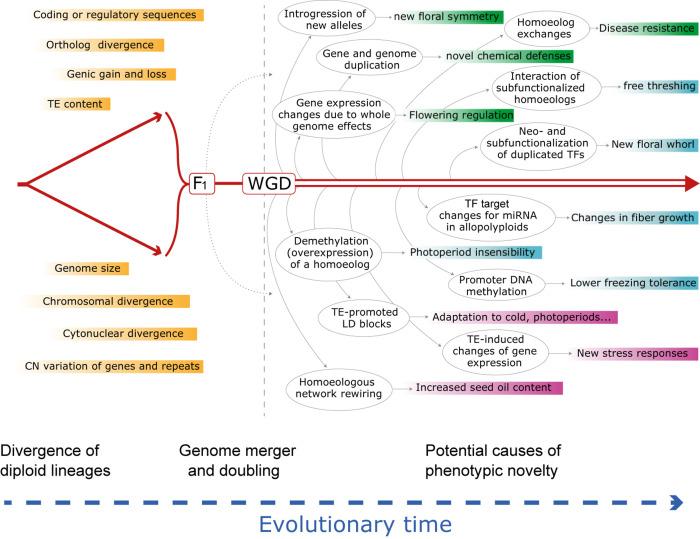
It has long been recognized that hybridization and polyploidy are prominent processes in plant evolution. Although classically recognized as significant in speciation and adaptation, recognition of the importance of interspecific gene flow has dramatically increased during the genomics era, concomitant with an unending flood of empirical examples, with or without genome doubling. Interspecific gene flow is thus increasingly thought to lead to evolutionary innovation and diversification, via adaptive introgression, homoploid hybrid speciation and allopolyploid speciation. Less well understood, however, are the suite of genetic and genomic mechanisms set in motion by the merger of differentiated genomes, and the temporal scale over which recombinational complexity mediated by gene flow might be expressed and exposed to natural selection. We focus on these issues here, considering the types of molecular genetic and genomic processes that might be set in motion by the saltational event of genome merger between two diverged species, either with or without genome doubling, and how these various processes can contribute to novel phenotypes. Genetic mechanisms include the infusion of new alleles and the genesis of novel structural variation including translocations and inversions, homoeologous exchanges, transposable element mobilization and novel insertional effects, presence-absence variation and copy number variation. Polyploidy generates massive transcriptomic and regulatory alteration, presumably set in motion by disrupted stoichiometries of regulatory factors, small RNAs and other genome interactions that cascade from single-gene expression change up through entire networks of transformed regulatory modules. We highlight both these novel combinatorial possibilities and the range of temporal scales over which such complexity might be generated, and thus exposed to natural selection and drift.
长期以来,人们一直认识到杂交和多倍体是植物进化中的突出过程。尽管传统上认为它们在物种形成和适应中具有重要意义,但在基因组学时代,随着大量实证例子的不断涌现,无论是否伴随基因组加倍,对种间基因流重要性的认识显著增加。因此,种间基因流越来越被认为会通过适应性渐渗、同倍体杂交物种形成和异源多倍体物种形成导致进化创新和多样化。然而,人们对由分化基因组合并引发的一系列遗传和基因组机制,以及基因流介导的重组复杂性可能表现出来并受到自然选择的时间尺度了解较少。我们在此关注这些问题,考虑由两个分化物种之间基因组合并的跳跃性事件(无论是否伴随基因组加倍)可能引发的分子遗传和基因组过程类型,以及这些不同过程如何导致新的表型。遗传机制包括新等位基因的注入和新结构变异的产生,包括易位和倒位、同源交换、转座元件移动和新的插入效应、存在-缺失变异和拷贝数变异。多倍体产生大量的转录组和调控改变,推测是由调控因子、小RNA和其他基因组相互作用的化学计量破坏引发的,这些相互作用从单基因表达变化级联到整个转化调控模块网络。我们强调这些新的组合可能性以及可能产生这种复杂性的时间尺度范围,从而使其受到自然选择和遗传漂变的影响。
 Zotero 插件