
28.4对……的后生元活性 。 你提供的原文似乎不完整,请补充完整以便我能准确翻译。
The Postbiotic Activity of 28.4 Against .
作者信息
Rossoni Rodnei Dennis, de Barros Patrícia Pimentel, Mendonça Iatã do Carmo, Medina Rebeca Previate, Silva Dulce Helena Siqueira, Fuchs Beth Burgwyn, Junqueira Juliana Campos, Mylonakis Eleftherios
机构信息
Department of Biosciences and Oral Diagnosis, Institute of Science and Technology, São Paulo State University/UNESP, São José dos Campos, Brazil.
Division of Infectious Diseases, Rhode Island Hospital, Warren Alpert Medical School at Brown University, Providence, RI, United States.
出版信息
Front Cell Infect Microbiol. 2020 Aug 4;10:397. doi: 10.3389/fcimb.2020.00397. eCollection 2020.
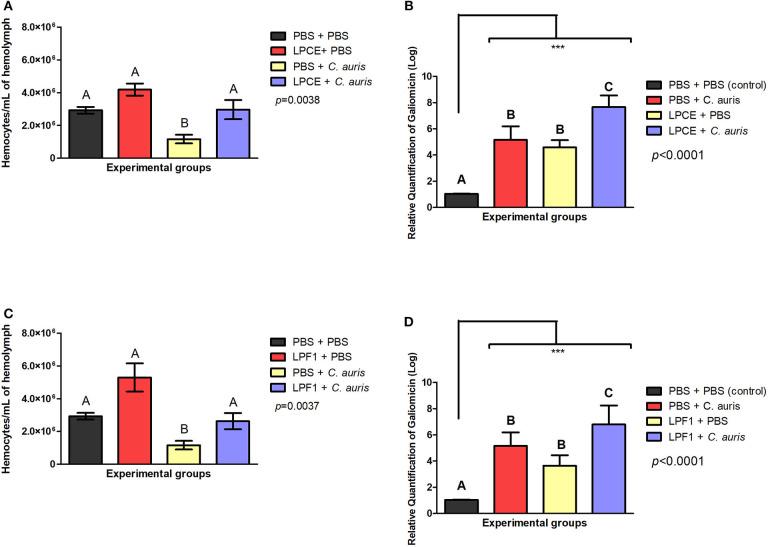
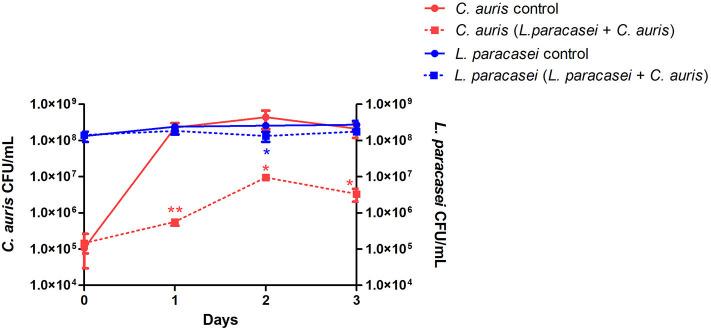
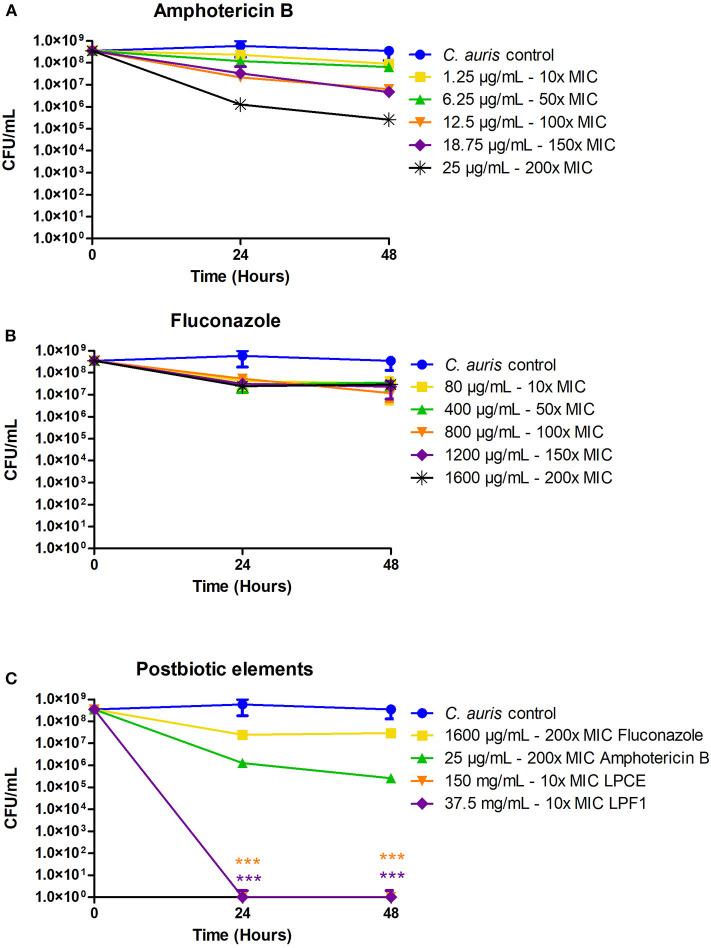
has emerged as a medically important pathogen with considerable resistance to antifungal agents. The ability to produce biofilms is an important pathogenicity feature of this species that aids escape of host immune responses and antimicrobial agents. The objective of this study was to verify antifungal action using and models of the 28.4 probiotic cells and postbiotic activity of crude extract (LPCE) and fraction 1 (LPF1), derived from 28.4 supernatant. Both live cells and cells free supernatant of 28.4 inhibited suggesting probiotic and postbiotic effects. The minimum inhibitory concentration (MIC) for LPCE was 15 mg/mL and ranges from 3.75 to 7.5 mg/mL for LPF1. Killing kinetics determined that after 24 h treatment with LPCE or LPF1 there was a complete reduction of viable cells compared to fluconazole, which decreased the initial inoculum by 1-logCFU during the same time period. LPCE and LPF1 significantly reduced the biomass ( = 0.0001) and the metabolic activity ( = 0.0001) of biofilm. There was also a total reduction (~10 CFU/mL) in viability of persister cells after treatment with postbiotic elements ( < 0.0001). In an study, injection of LPCE and LPF1 into larvae infected with prolonged survival of these insects compared to a control group ( < 0.05) and elicited immune responses by increasing the number of circulating hemocytes and gene expression of antimicrobial peptide galiomicin. We concluded that the 28.4 cells and postbiotic elements (LPCE and LPF1) have antifungal activity against planktonic cells, biofilms, and persister cells of . Postbiotic supplementation derived from 28.4 protected infected with and enhanced its immune status indicating a dual function in modulating a host immune response.
已成为一种具有重要医学意义的病原体,对抗真菌药物具有相当的耐药性。形成生物膜的能力是该物种的一个重要致病特征,有助于逃避宿主免疫反应和抗菌药物。本研究的目的是使用28.4益生菌细胞以及源自28.4上清液的粗提物(LPCE)和组分1(LPF1)的后生元活性,通过和模型验证抗真菌作用。28.4的活细胞和无细胞上清液均抑制,表明具有益生菌和后生元作用。LPCE的最低抑菌浓度(MIC)为15mg/mL,LPF1的最低抑菌浓度范围为3.75至7.5mg/mL。杀菌动力学测定表明,与氟康唑相比,用LPCE或LPF1处理24小时后,活细胞完全减少,氟康唑在同一时间段内使初始接种量减少1-logCFU。LPCE和LPF1显著降低了生物膜的生物量(=0.0001)和代谢活性(=0.0001)。用后生元成分处理后,持续存在细胞的活力也完全降低(~10CFU/mL)(<0.0001)。在一项研究中,与对照组相比(<0.05),将LPCE和LPF1注射到感染了的幼虫中可延长这些昆虫的存活时间,并通过增加循环血细胞数量和抗菌肽加里米星基因表达引发免疫反应。我们得出结论,28.4细胞和后生元成分(LPCE和LPF1)对浮游细胞、生物膜和持续存在细胞具有抗真菌活性。源自28.4的后生元补充剂可保护感染的并增强其免疫状态,表明在调节宿主免疫反应中具有双重功能。



 Zotero 插件