
新冠疫情期间中国长三角特大城市的空气污染物时空变化及减排。
Spatiotemporal variations and reduction of air pollutants during the COVID-19 pandemic in a megacity of Yangtze River Delta in China.
机构信息
Key Laboratory of Geoscience Big Data and Deep Resource of Zhejiang Province, Department of Atmospheric Sciences, School of Earth Sciences, Zhejiang University, Hangzhou 310027, China.
Hangzhou Meteorological Bureau, Hangzhou 310051, China.
出版信息
Sci Total Environ. 2021 Jan 10;751:141820. doi: 10.1016/j.scitotenv.2020.141820. Epub 2020 Aug 20.
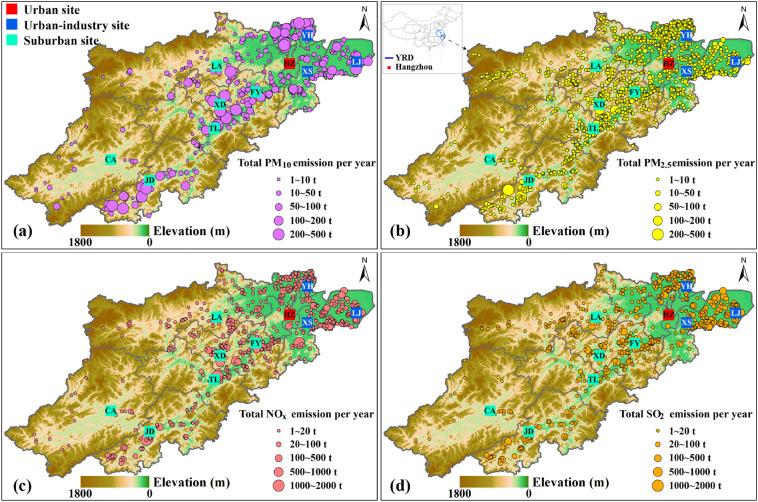
In recent decades, air pollution has become an important environmental problem in the megacities of eastern China. How to control air pollution in megacities is still a challenging issue because of the complex pollutant sources, atmospheric chemistry, and meteorology. There is substantial uncertainty in accurately identifying the contributions of transport and local emissions to the air quality in megacities. The COVID-19 outbreak has prompted a nationwide public lockdown period and provides a valuable opportunity for understanding the sources and factors of air pollutants. The three-month period of continuous field observations for aerosol particles and gaseous pollutants, which extended from January 2020 to March 2020, covered urban, urban-industry, and suburban areas in the typical megacity of Hangzhou in the Yangtze River Delta in eastern China. In general, the concentrations of PM, PM, NO, SO, and CO reduced 58%, 47%, 83%, 11% and 30%, respectively, in the megacity during the COVID-Lock period. The reduction proportions of PM and CO were generally higher in urban and urban-industry areas than those in suburban areas. NO exhibited the greatest reduction (>80%) among all the air pollutants, and the reduction was similar in the urban, urban-industry, and suburban areas. O increased 102%-125% during the COVID-Lock period. The daytime elevation of the planetary boundary layer height can reduce 30% of the PM, PM, NO and CO concentrations on the ground in Hangzhou. During the long-range transport events, air pollutants on the regional scale likely contribute 40%-90% of the fine particles in the Hangzhou urban area. The findings highlight the future control and model forecasting of air pollutants in Hangzhou and similar megacities in eastern China.
近几十年来,空气污染已成为中国东部特大城市的一个重要环境问题。由于复杂的污染源、大气化学和气象条件,如何控制特大城市的空气污染仍然是一个具有挑战性的问题。准确识别传输和本地排放对特大城市空气质量的贡献存在很大的不确定性。COVID-19 疫情的爆发促使全国范围内实行了公共封锁期,为了解空气污染物的来源和因素提供了宝贵的机会。从 2020 年 1 月到 2020 年 3 月,为期三个月的气溶胶粒子和气态污染物连续实地观测覆盖了中国东部长江三角洲典型特大城市杭州的城市、城市工业和郊区地区。总的来说,在 COVID-封锁期间,特大城市的 PM、PM、NO、SO 和 CO 浓度分别降低了 58%、47%、83%、11%和 30%。在城市和城市工业地区,PM 和 CO 的减排比例一般高于郊区。所有空气污染物中,NO 的减排比例最大(>80%),且在城市、城市工业和郊区地区的减排比例相似。在 COVID-封锁期间,O 增加了 102%-125%。白天平流层边界层高度的升高可以使杭州地面的 PM、PM、NO 和 CO 浓度降低 30%。在长程传输事件期间,区域尺度的空气污染物可能对杭州城区的细颗粒物贡献了 40%-90%。这些发现突出了未来对杭州和中国东部类似特大城市的空气污染物的控制和模型预测。




 Zotero 插件