
一种逆转蜜蜂(西方蜜蜂)数量下降的一体化健康模式。
A One-Health Model for Reversing Honeybee ( L.) Decline.
作者信息
Donkersley Philip, Elsner-Adams Emily, Maderson Siobhan
机构信息
Lancaster Environment Centre, Lancaster University, Lancaster LA14YQ, UK.
Elsner Research and Consulting, 8118 Zürich, Switzerland.
出版信息
Vet Sci. 2020 Aug 27;7(3):119. doi: 10.3390/vetsci7030119.
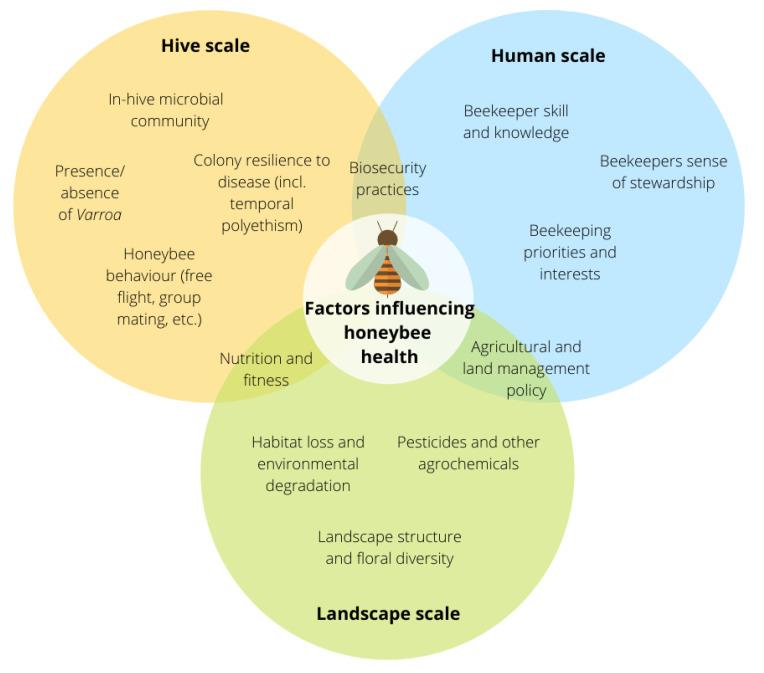
Global insect decline impacts ecosystem resilience; pollinators such as honeybees ( L.) have suffered extensive losses over the last decade, threatening food security. Research has focused discretely on in-hive threats (e.g., and ) and broader external causes of decline (e.g., agrochemicals, habitat loss). This has notably failed to translate into successful reversal of bee declines. Working at the interdisciplinary nexus of entomological, social and ecological research, we posit that veterinary research needs to adopt a "One-Health" approach to address the scope of crises facing pollinators. We demonstrate that reversing declines will require integration of hive-specific solutions, a reappraisal of engagement with the many stakeholders whose actions affect bee health, and recontextualising both of these within landscape scale efforts. Other publications within this special issue explore novel technologies, emergent diseases and management approaches; our aim is to place these within the "One-Health" context as a pathway to securing honeybee health. Governmental policy reform offers a particularly timely pathway to achieving this goal. Acknowledging that healthy honeybees need an interdisciplinary approach to their management will enhance the contributions of veterinary research in delivering systemic improvements in bee health.
全球昆虫数量减少影响生态系统恢复力;过去十年间,诸如蜜蜂(Apis mellifera L.)等传粉者数量大幅减少,威胁到粮食安全。研究分别聚焦于蜂巢内部的威胁(如……)以及更广泛的导致数量减少的外部因素(如农用化学品、栖息地丧失)。但这显然未能成功扭转蜜蜂数量减少的趋势。我们处于昆虫学、社会和生态研究的跨学科交叉点进行研究,认为兽医研究需要采用“同一健康”方法来应对传粉者面临的一系列危机。我们证明,扭转数量减少趋势需要整合针对蜂巢的解决方案,重新评估与众多其行为会影响蜜蜂健康的利益相关者的互动,并将这两者在景观尺度的努力中重新定位。本期特刊中的其他文章探讨了新技术、新出现的疾病和管理方法;我们的目标是将这些置于“同一健康”背景下,作为确保蜜蜂健康的途径。政府政策改革为实现这一目标提供了特别及时的途径。认识到健康的蜜蜂需要跨学科方法来进行管理,将提高兽医研究在实现蜜蜂健康系统性改善方面的贡献。
 Zotero 插件