
四配位键和其他非共价相互作用辅助新型异烟酰肼铅(II)配合物的超分子聚集
Tetrel Bonding and Other Non-Covalent Interactions Assisted Supramolecular Aggregation in a New Pb(II) Complex of an Isonicotinohydrazide.
机构信息
Department of Chemistry, Faculty of Science, University of Maragheh, Maragheh P.O. Box 55181-83111, Iran.
Department of Chemistry, Faculty of Science, University of Mohaghegh Ardabili, Ardabil P.O. Box 56199-11367, Iran.
出版信息
Molecules. 2020 Sep 4;25(18):4056. doi: 10.3390/molecules25184056.
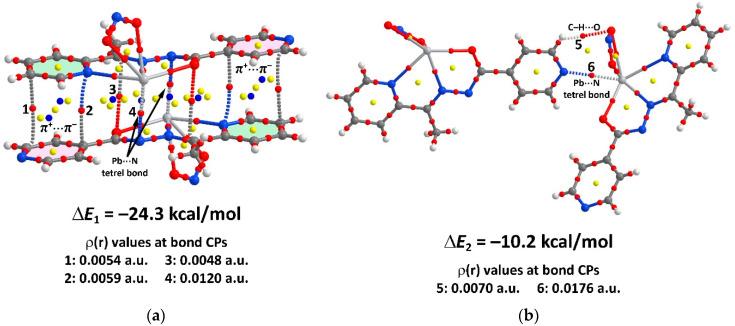
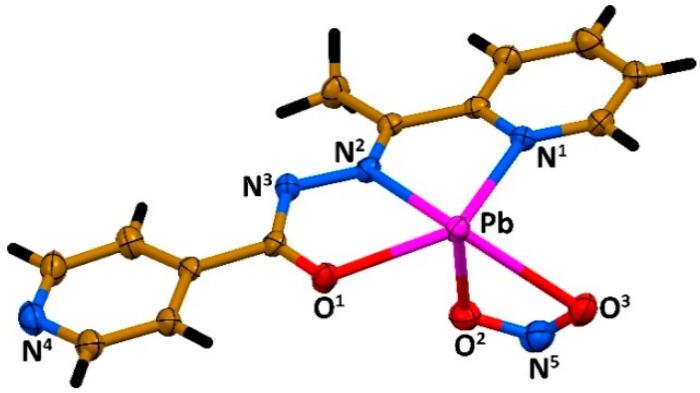
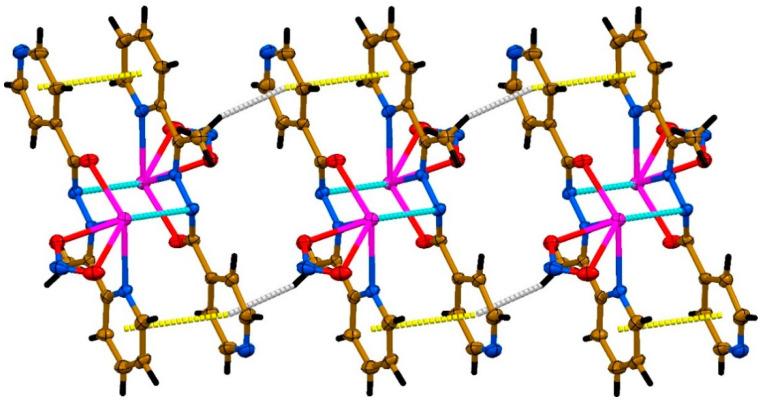
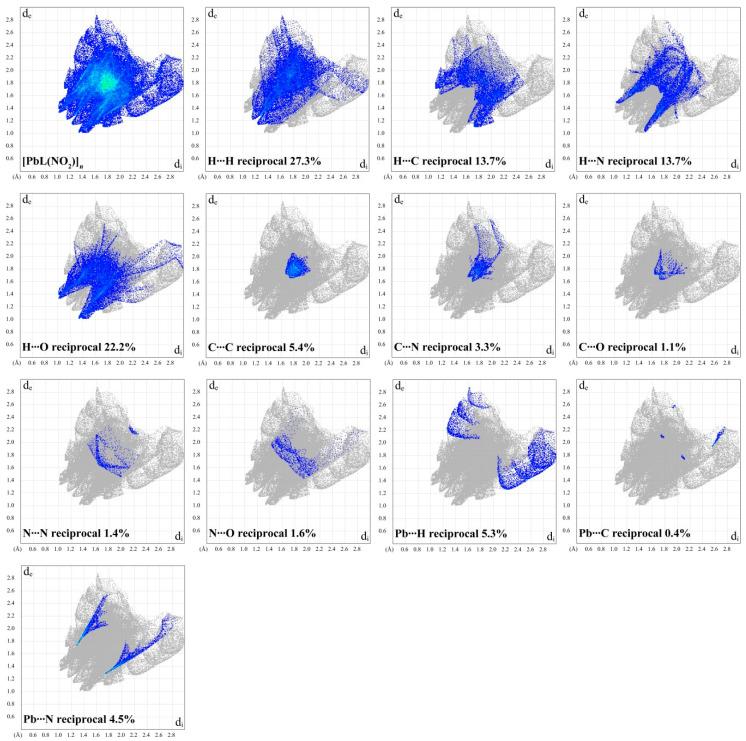
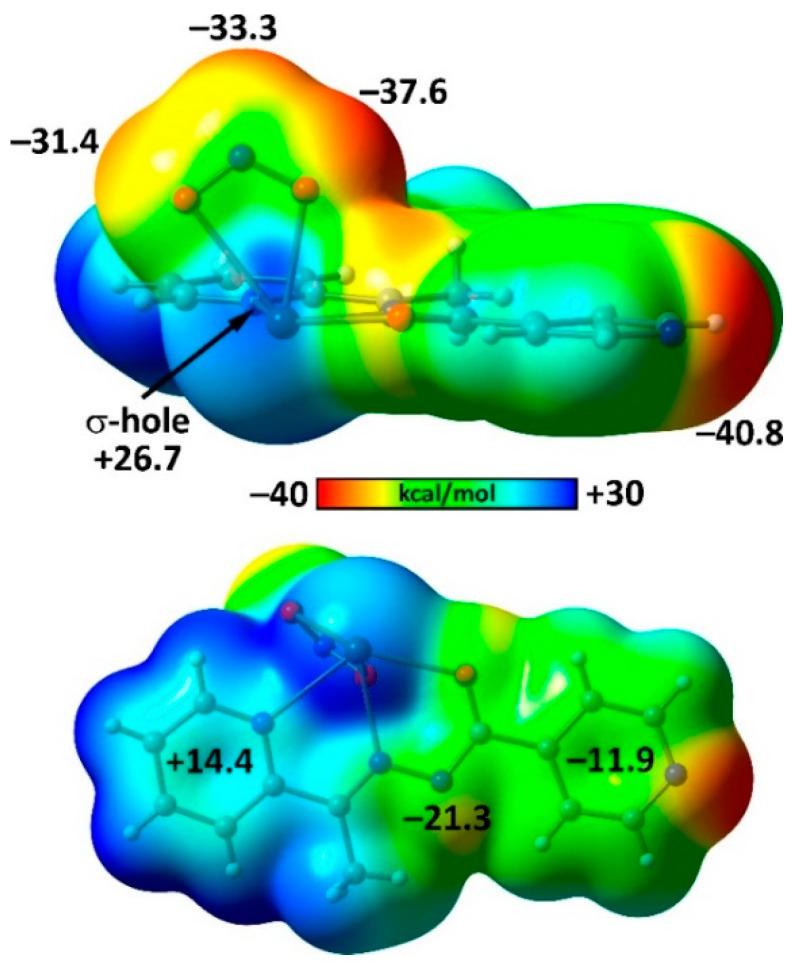
A new supramolecular Pb(II) complex was synthesized from Pb(NO), -(1-(pyridin-2-yl)ethylidene)isonicotinohydrazide () and NaNO. is constructed from discrete [PbL(NO)] units with an almost ideal NO square pyramidal coordination environment around Pb(II). The ligand is coordinated through the 2-pyridyl N-atom, one aza N-atom, and the carbonyl O-atom. The nitrite ligand binds in a -O,O coordination mode through both O-atoms. The Pb(II) center exhibits a hemidirected coordination geometry with a pronounced coordination gap, which allows a close approach of two additional N-atoms arising from the N=C(O) N-atom of an adjacent molecule and from the 4-pyridyl N-atom from the another adjacent molecule, yielding a NO coordination, constructed from two Pb-N and three Pb-O covalent bonds, and two Pb⋯N tetrel bonds. Dimeric units in the structure of are formed by the Pb⋯N=C(O) tetrel bonds and intermolecular electrostatically enforced π⋯π stacking interactions between the 2- and 4-pyridyl rings and further stabilized by C-H⋯π intermolecular interactions, formed by one of the methyl H-atoms and the 4-pyridyl ring. These dimers are embedded in a 2D network representing a simplified uninodal 3-connected (Shubnikov plane net) topology defined by the point symbol (4∙8). The Hirshfeld surface analysis of [PbL(NO)] revealed that the intermolecular H⋯X (X = H, C, N, O) contacts occupy an overwhelming majority of the molecular surface of the [PbL(NO)] coordination unit. Furthermore, the structure is characterized by intermolecular C⋯C and C⋯N interactions, corresponding to the intermolecular π⋯π stacking interactions. Notably, intermolecular Pb⋯N and, most interestingly, Pb⋯H interactions are remarkable contributors to the molecular surface of [PbL(NO)]. While the former contacts are due to the Pb⋯N tetrel bonds, the latter contacts are mainly due to the interaction with the methyl H-atoms in the π⋯π stacked [PbL(NO)] molecules. Molecular electrostatic potential (MEP) surface calculations showed marked electrostatic contributions to both the Pb⋯N tetrel bonds and the dimer forming π⋯π stacking interactions. Quantum theory of atoms in molecules (QTAIM) analyses underlined the tetrel bonding character of the Pb⋯N interactions. The manifold non-covalent interactions found in this supramolecular assembly are the result of the proper combination of the polyfunctional multidentate pyridine-hydrazide ligand and the small nitrito auxiliary ligand.
一种新的超分子 Pb(II) 配合物是由 Pb(NO)3、(1-(吡啶-2-基)亚乙基)异烟酰肼()和 NaNO3 合成的。[PbL(NO)] 单元以近乎理想的 NO 四方锥配位环境构建,其中 Pb(II) 配位。配体通过 2-吡啶 N-原子、一个脒 N-原子和羰基 O-原子进行配位。亚硝酸根配体通过两个 O-原子以-O,O 配位模式结合。Pb(II) 中心表现出半指向性配位几何形状,具有明显的配位间隙,允许来自相邻分子的 N=C(O)N-原子和来自另一个相邻分子的 4-吡啶 N-原子的两个额外 N-原子接近,生成由两个 Pb-N 和三个 Pb-O 共价键以及两个 Pb⋯N 四重键组成的 NO 配位。结构中的二聚体单元通过 Pb⋯N=C(O)四重键和 2-和 4-吡啶环之间的分子间静电强制 π⋯π堆积相互作用形成,进一步通过一个甲基 H-原子和 4-吡啶环之间的 C-H⋯π 分子间相互作用稳定。这些二聚体嵌入在一个二维网络中,代表了简化的非节点 3-连接 (Shubnikov 平面网) 拓扑,由点符号 (4∙8) 定义。[PbL(NO)] 的 Hirshfeld 表面分析表明,分子间的 H⋯X (X = H、C、N、O) 接触占据了 [PbL(NO)] 配位单元分子表面的绝大多数。此外,结构的特点是存在分子间 C⋯C 和 C⋯N 相互作用,对应于分子间的 π⋯π 堆积相互作用。值得注意的是,分子间的 Pb⋯N 和,最有趣的是,Pb⋯H 相互作用是 [PbL(NO)] 分子表面的显著贡献者。前者接触归因于 Pb⋯N 四重键,而后者接触主要归因于与 π⋯π 堆积的 [PbL(NO)] 分子中的甲基 H-原子的相互作用。分子静电势 (MEP) 表面计算表明,对 Pb⋯N 四重键和形成二聚体的 π⋯π 堆积相互作用都有显著的静电贡献。原子在分子中的量子理论 (QTAIM) 分析强调了 Pb⋯N 相互作用的四重键性质。在这个超分子组装中发现的多种非共价相互作用是多功能多齿吡啶-酰肼配体和小的亚硝酰辅助配体的适当组合的结果。



 Zotero 插件