
氢、卤素和碳族元素键供体与富电子和缺电子π体系相互作用的比较研究。
Comparative investigation of interactions of hydrogen, halogen and tetrel bond donors with electron-rich and electron-deficient π-systems.
作者信息
Ibrahim Mahmoud A A, Ahmed Ossama A M, Moussa Nayra A M, El-Taher Sabry, Moustafa Hussien
机构信息
Chemistry Department, Faculty of Science, Minia University Minia 61519 Egypt
Department of Chemistry, Faculty of Science, Cairo University Giza Egypt.
出版信息
RSC Adv. 2019 Oct 15;9(56):32811-32820. doi: 10.1039/c9ra08007d. eCollection 2019 Oct 10.
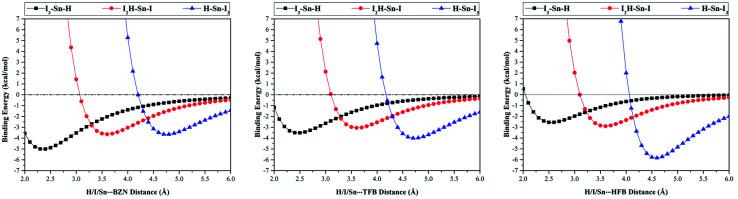
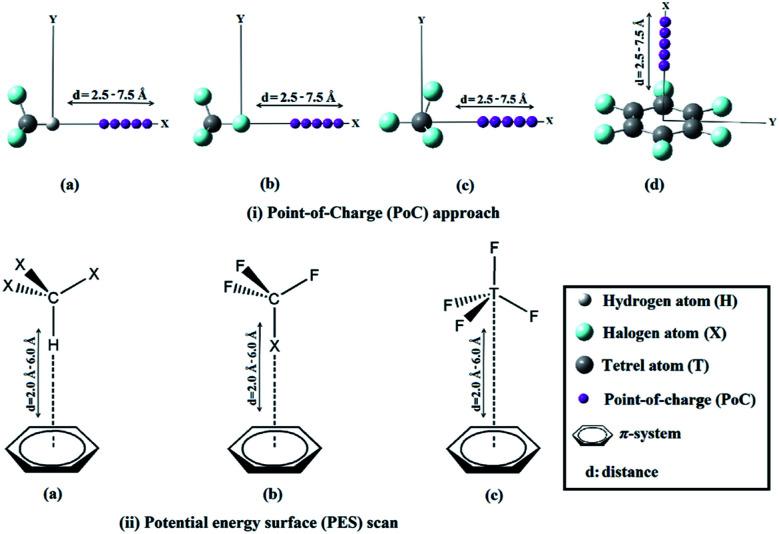
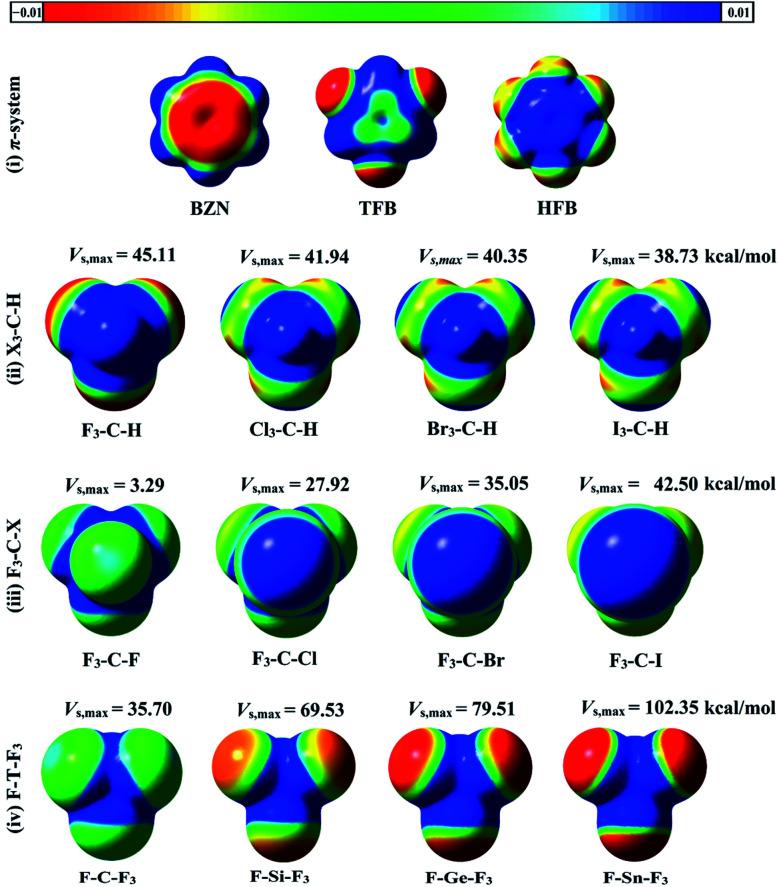
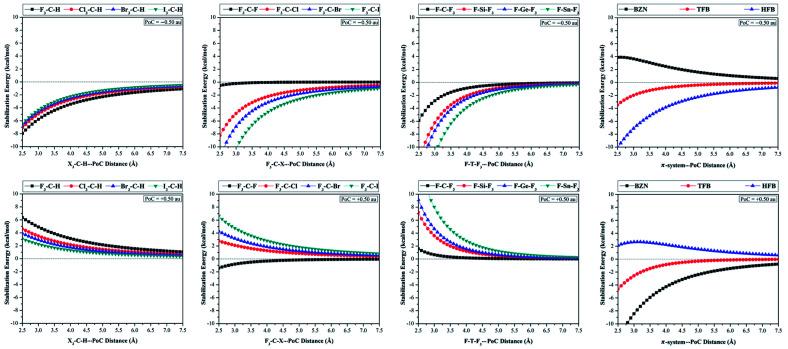
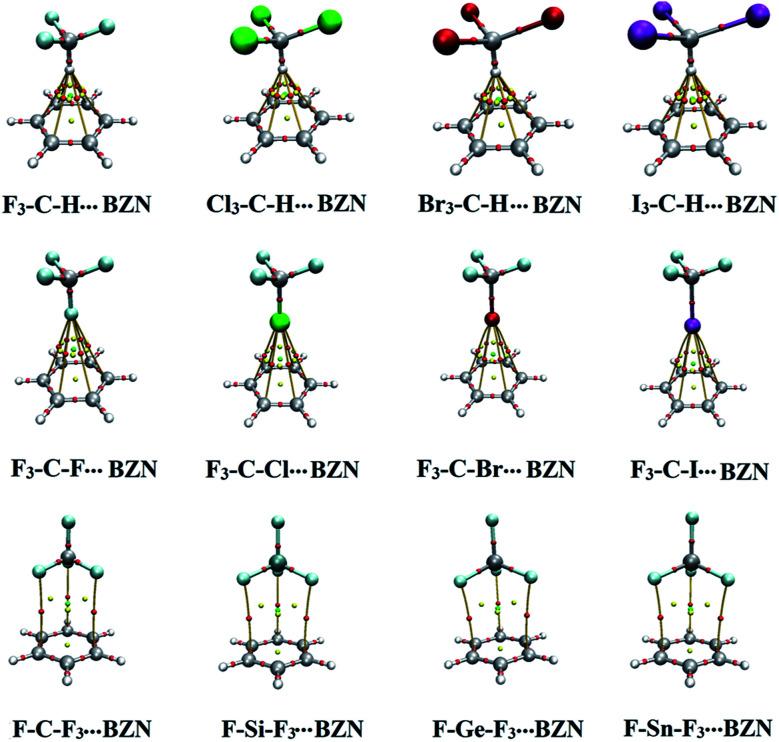
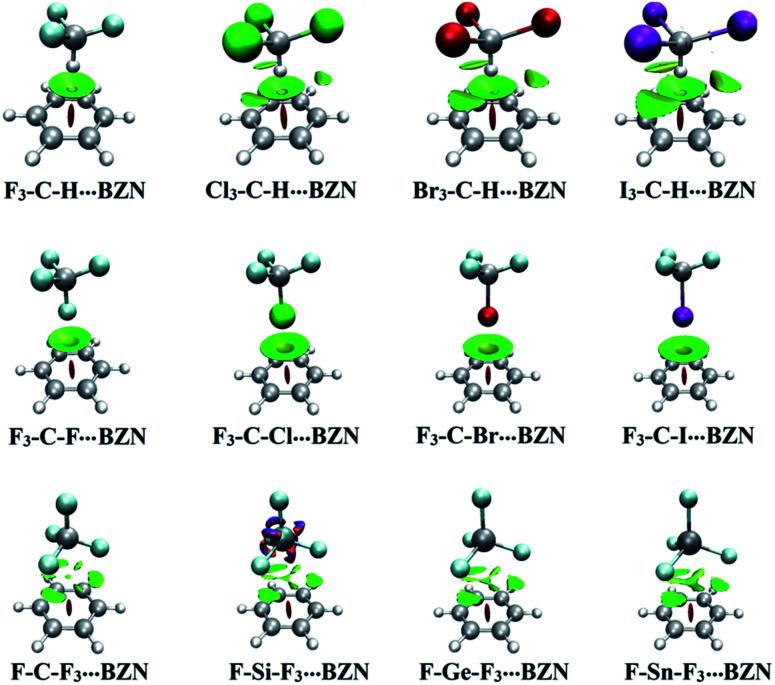
Recently, noncovalent interactions in complexes and crystals have attracted considerable interest. The current study was thus designed to gain a better understanding of three seminal types of noncovalent interactions, namely: hydrogen, halogen and tetrel interactions with π-systems. This study was performed on three models of Lewis acids: X-C-H, F-C-X and F-T-F (where X = F, Cl, Br and I; and T = C, Si, Ge and Sn) and three π-systems as Lewis bases: benzene (BZN), 1,3,5-trifluorobenzene (TFB) and hexafluorobenzene (HFB). Quantum mechanical calculations, including geometrical optimization, molecular electrostatic potential (MEP), maximum positive electrostatic potential ( ), Point-of-Charge (PoC), potential energy surface (PES), quantum theory of atoms in molecules (QTAIM) and noncovalent interaction (NCI) calculations, were carried out at the MP2/aug cc-pVDZ level of theory. The binding energies were additionally benchmarked at the CCSD(T)/CBS level. The results showed that: (i) the binding energies of the X-C-H⋯π-system complexes were unexpectedly inversely correlated with the values on the hydrogen atom but directly correlated with the X atomic sizes; (ii) the binding energies for the F-C-X⋯π-system and F-T-F⋯π-system complexes were correlated with the σ-hole magnitudes of the X and T atoms, respectively; and (iii) for the F-C-F⋯π-system complexes, the binding energy was as strong as the π-system was electron-deficient, indicating the dominating nucleophilic character of the fluorine atom. NCI analysis showed that the unexpected trend of X-C-H⋯π-system binding energies could be attributed to additional attractive interactions between the X atoms in the X-C-H molecule and the carbon atoms of the π-system. Furthermore, the I-Sn-H molecule was employed as a case study of hydrogen, halogen and tetrel interactions with π-systems. It was found that hydrogen and halogen interactions of the I-Sn-H molecule correlated with the electron-richness of the π-system. In contrast, tetrel interactions correlated with the electron deficiency of the π-system.
最近,配合物和晶体中的非共价相互作用引起了广泛关注。因此,本研究旨在更好地理解三种重要的非共价相互作用类型,即:与π体系的氢、卤素和碳族元素相互作用。本研究针对三种路易斯酸模型进行:X-C-H、F-C-X和F-T-F(其中X = F、Cl、Br和I;T = C、Si、Ge和Sn)以及三种作为路易斯碱的π体系:苯(BZN)、1,3,5-三氟苯(TFB)和六氟苯(HFB)。在MP2/aug cc-pVDZ理论水平上进行了量子力学计算,包括几何优化、分子静电势(MEP)、最大正静电势( )、电荷点(PoC)、势能面(PES)、分子中原子的量子理论(QTAIM)和非共价相互作用(NCI)计算。结合能还在CCSD(T)/CBS水平上进行了基准测试。结果表明:(i)X-C-H⋯π体系配合物的结合能与氢原子上的 值意外地呈负相关,但与X原子大小呈正相关;(ii)F-C-X⋯π体系和F-T-F⋯π体系配合物的结合能分别与X和T原子的σ-空穴大小相关;(iii)对于F-C-F⋯π体系配合物,π体系越缺电子,结合能越强,表明氟原子具有主导的亲核特性。NCI分析表明,X-C-H⋯π体系结合能的意外趋势可归因于X-C-H分子中的X原子与π体系的碳原子之间的额外吸引相互作用。此外,以I-Sn-H分子为例研究了与π体系的氢、卤素和碳族元素相互作用。发现I-Sn-H分子的氢和卤素相互作用与π体系的富电子性相关。相反,碳族元素相互作用与π体系的缺电子性相关。

 Zotero 插件