
正电子发射断层扫描心肌成纤维细胞激活蛋白活性与心血管疾病的关系。
Relationship Between Cardiac Fibroblast Activation Protein Activity by Positron Emission Tomography and Cardiovascular Disease.
机构信息
Department of Cardiology, Angiology, and Pneumology (M.B.H., F.R., D.F., H.A.K., F.L., L.H.L.), Heidelberg University Hospital, Germany.
German Centre for Cardiovascular Research (DZHK), Heidelberg/Mannheim partner site, Germany (M.B.H., F.R., D.F., H.A.K., F.L., L.H.L.).
出版信息
Circ Cardiovasc Imaging. 2020 Sep;13(9):e010628. doi: 10.1161/CIRCIMAGING.120.010628. Epub 2020 Sep 11.
BACKGROUND
FAP (fibroblast activation protein) plays an important role in cardiac wound healing and remodeling. Although initially developed as a theranostic ligand for metastasized cancer, FAPI (FAP inhibitor) tracers have recently been used to study cardiac remodeling following myocardial infarction in small-animal models. The aim of the study was to evaluate the activity of FAP via FAPI-positron emission tomography-computed tomography scans in human hearts.
METHODS
FAPI-positron emission tomography-computed tomography scans of 229 patients of 2 consecutive cohorts (modeling cohort: n=185; confirmatory cohort: n=44) suffering from metastasized cancer were analyzed applying the American Heart Association 17-segment model of the left ventricle. Logistic regression models were created using data from the modeling cohort. Multivariate regression models were established using Akaike information criterion in a step-down approach.
RESULTS
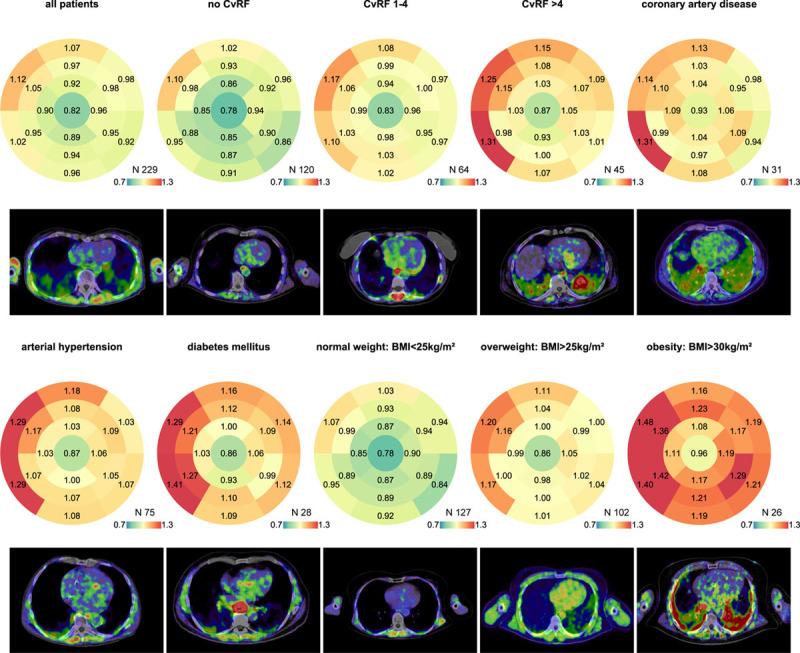
Fourteen percent of patients had preexisting coronary artery disease (n=31), 33% arterial hypertension (n=75), and 12% diabetes mellitus type II (n=28). Forty-three percent had been treated with platin derivatives (n=100), 14% with anthracyclines (n=32), and 10% had a history of prior radiation to the chest (n=23). High left ventricular FAPI signals correlated with the presence of cardiovascular risk factors (odds ratio [OR], 4.3, =0.0029), a focal myocardial signal pattern (OR, 3.9, =0.0068), diabetes mellitus type II (OR, 4.1, =0.046), and beta-blocker use (OR, 3.8, =0.049) in univariate regression models. In a multivariate analysis, increased signal intensity was significantly higher in patients with cardiovascular risk factors (overweight [OR, 2.6, =0.023], diabetes mellitus type II [OR, 2.9, =0.041], certain chemotherapies [platinum derivatives; OR, 3.0, =0.034], and a history of radiation to the chest [OR, 3.5, =0.024]). A focal enrichment pattern was more frequently observed in patients with known cardiovascular risk factors (<0.0001).
CONCLUSIONS
FAPI-positron emission tomography-computed tomography scans represent a new imaging modality to investigate cardiac FAP. High signal intensities correlate with cardiovascular risk factors and metabolic disease.
背景
成纤维细胞激活蛋白(fibroblast activation protein,FAP)在心脏创伤愈合和重塑中起着重要作用。尽管最初被开发为转移性癌症的治疗诊断配体,但 FAPI(FAP 抑制剂)示踪剂最近已被用于研究小型动物模型中心肌梗死后的心脏重塑。本研究旨在通过 FAPI 正电子发射断层扫描-计算机断层扫描(positron emission tomography-computed tomography,PET-CT)评估人类心脏中的 FAP 活性。
方法
对连续 2 个队列(建模队列:n=185;验证队列:n=44)中患有转移性癌症的 229 名患者的 FAPI-PET-CT 扫描进行分析,采用美国心脏协会(American Heart Association)左心室 17 节段模型。使用建模队列的数据创建逻辑回归模型。使用逐步降维方法的赤池信息量准则(Akaike information criterion)建立多变量回归模型。
结果
14%的患者(n=31)存在预先存在的冠状动脉疾病,33%(n=75)患有动脉高血压,12%(n=28)患有 2 型糖尿病。43%(n=100)接受过顺铂衍生物治疗,14%(n=32)接受过蒽环类药物治疗,10%(n=23)曾接受过胸部放疗。左心室 FAPI 信号升高与心血管危险因素(比值比[odds ratio,OR],4.3,=0.0029)、局灶性心肌信号模式(OR,3.9,=0.0068)、2 型糖尿病(OR,4.1,=0.046)和β受体阻滞剂的使用(OR,3.8,=0.049)相关。在多变量分析中,心血管危险因素患者的信号强度显著升高(超重[OR,2.6,=0.023]、2 型糖尿病[OR,2.9,=0.041]、特定化疗药物[顺铂衍生物;OR,3.0,=0.034]和胸部放疗史[OR,3.5,=0.024])。在已知有心血管危险因素的患者中,局灶性富集模式更为常见(<0.0001)。
结论
FAPI-PET-CT 扫描代表了一种新的心脏 FAP 成像方式。高信号强度与心血管危险因素和代谢性疾病相关。

 Zotero 插件