
CD63作为基于纳米乳剂的功能磁共振成像以及向活化心肌成纤维细胞递送药物的新靶点。
CD63 as novel target for nanoemulsion-based F MRI imaging and drug delivery to activated cardiac fibroblasts.
作者信息
Euan Martínez Arlen Aurora, Bergmann Ann Kathrin, Tellkamp Frederik, Schott-Verdugo Stephan, Bouvain Pascal, Steinhausen Julia, Bahr Jasmin, Kmietczyk Vivien, Bencun Maja, Flögel Ulrich, Distler Jörg H W, Krueger Marcus, Völkers Mirko, Czekelius Constantin, Gohlke Holger, Temme Sebastian, Hesse Julia, Schrader Jürgen
机构信息
Department of Molecular Cardiology, Medical Faculty and University Hospital Düsseldorf, Heinrich Heine University Düsseldorf, Düsseldorf, Germany.
Crozet-Medical GmbH, Düsseldorf, Germany.
出版信息
Theranostics. 2025 Jan 1;15(1):1-18. doi: 10.7150/thno.96990. eCollection 2025.
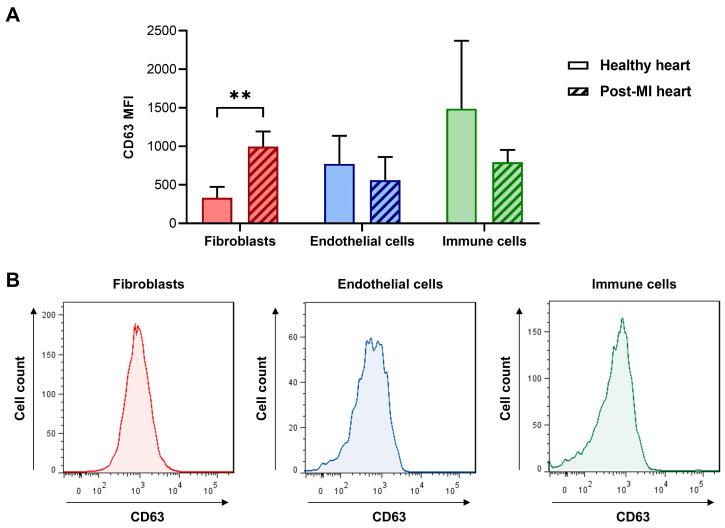
Cardiac fibroblasts are activated following myocardial infarction (MI) and cardiac fibrosis is a major driver of the growing burden of heart failure. A non-invasive targeting method for activated cardiac fibroblasts would be advantageous because of their importance for imaging and therapy. Targeting was achieved by linking a 7-amino acid peptide (EP9) to a perfluorocarbon-containing nanoemulsion (PFC-NE) for visualization by F-combined with H-MRI. and H/F MRI was performed on a Bruker 9.4 T AVANCE III wide-bore nuclear magnetic resonance spectrometer. Photoaffinity labeling (diazirine photolinker) and mass spectrometry were used to identify the peptide-binding protein. Molecular modeling studies used ColabFold and AlphaFold 3. EP9-decorated liposomes containing modified mRNA for luciferase (mRNA-LUC) were used for the study of the cellular uptake process. After injection of EP9-PFC-NE, the in-vivo F signal localized to the infarcted area of the heart and was EP9-specific, as verified by the use of a mutated peptide. The plasma half-life of the nanoemulsion was 20 h and electron microscopy identified cardiac fibroblasts and epicardial stromal cells to be the main populations for cellular uptake. Photoaffinity labeling identified the tetraspanin CD63 as the main EP9-binding protein, which was supported by CD63-EP9 modeling data. Expression of CD63 was significantly upregulated in infarct-activated fibroblasts of mice and humans. Cellular uptake may involve caveolae and/or clathrin-coated pits as suggested by scRNAseq data. Uptake studies with mRNA-LUC-loaded EP9-PFC-NE confirmed internalization after binding to fibroblast CD63. CD63 was identified to contain a specific EP9 binding motive that triggers endocytosis of EP9-PFC-NE in activated cardiac fibroblasts. This targeted nanoemulsion can therefore be used for imaging and has the potential for fibroblast-specific drug delivery.
心肌梗死后心脏成纤维细胞被激活,心脏纤维化是心力衰竭负担不断加重的主要驱动因素。由于其对成像和治疗的重要性,一种针对激活的心脏成纤维细胞的非侵入性靶向方法将具有优势。通过将一种7氨基酸肽(EP9)与含全氟化碳的纳米乳剂(PFC-NE)相连来实现靶向,以便通过F联合H-MRI进行可视化。在布鲁克9.4 T AVANCE III宽孔径核磁共振光谱仪上进行H/F MRI。使用光亲和标记(重氮酮光交联剂)和质谱来鉴定肽结合蛋白。分子建模研究使用了ColabFold和AlphaFold 3。含有荧光素酶修饰mRNA(mRNA-LUC)的EP9修饰脂质体用于细胞摄取过程的研究。注射EP9-PFC-NE后,体内F信号定位于心脏梗死区域且具有EP9特异性,这通过使用突变肽得到验证。纳米乳剂的血浆半衰期为20小时,电子显微镜鉴定心脏成纤维细胞和心外膜基质细胞是细胞摄取的主要群体。光亲和标记鉴定四跨膜蛋白CD63为主要的EP9结合蛋白,这得到了CD63-EP9建模数据的支持。CD63的表达在小鼠和人类梗死激活的成纤维细胞中显著上调。如scRNAseq数据所示,细胞摄取可能涉及小窝和/或网格蛋白包被小窝。用载有mRNA-LUC的EP9-PFC-NE进行的摄取研究证实,与成纤维细胞CD63结合后发生内化。已鉴定出CD63含有特定的EP9结合基序,该基序触发激活的心脏成纤维细胞中EP9-PFC-NE的内吞作用。因此,这种靶向纳米乳剂可用于成像,并具有成纤维细胞特异性药物递送的潜力。


 Zotero 插件