
一种用于多通道 TMS 阵列的 3 轴线圈设计。
A 3-axis coil design for multichannel TMS arrays.
机构信息
Athinoula A. Martinos Center for Biomedical Imaging, Department of Radiology, Harvard Medical School, Massachusetts General Hospital, Charlestown, MA 02129, USA.
Athinoula A. Martinos Center for Biomedical Imaging, Department of Radiology, Harvard Medical School, Massachusetts General Hospital, Charlestown, MA 02129, USA.
出版信息
Neuroimage. 2021 Jan 1;224:117355. doi: 10.1016/j.neuroimage.2020.117355. Epub 2020 Sep 9.
PURPOSE
Multichannel Transcranial Magnetic Stimulation (mTMS) arrays enable multiple sites to be stimulated simultaneously or sequentially under electronic control without moving the system's stimulation coils. Here, we build and characterize the performance of a novel modular 3-axis TMS coil that can be utilized as a unit element in large-scale multichannel TMS arrays.
METHODS
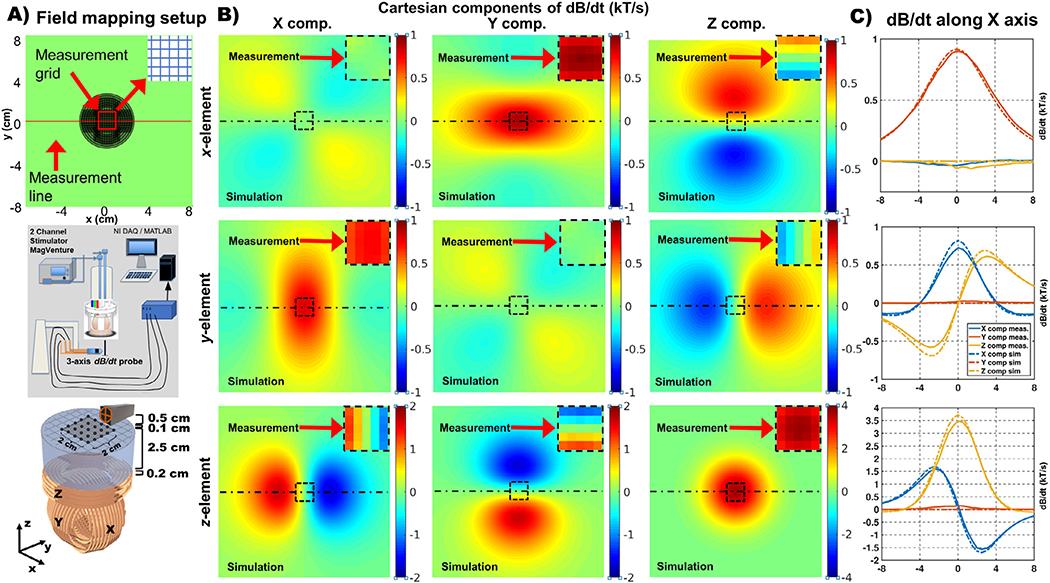
We determined the basic physical characteristics of the 3-axis TMS coil x-, y- and z-elements using a custom 2-channel programmable stimulator prototype. We mapped the temporal rate-of-change of the induced magnetic field (dB/dt) on a 2D plane parallel to the coil surface (including an extended line for full spatial coverage) and compared those values with predictions from magnetic field simulations. Temperature measurements were carried out to assess the incorporated air-cooling method. We measured the mutual and self-inductances of the x/y/z-elements to assess coupling between them. Additionally, we measured and calculated the coupling between z-elements in the array configuration. Finally, we performed electric field simulations to evaluate the stimulation intensity and focality of the coil and compared the results to conventional TMS coils as well as demonstrated suitability of the 3-axis coil for a multichannel array configuration.
RESULTS
The experimentally obtained dB/dt values validated the computational model of the 3-axis coil and therefore confirmed that both the coil and stimulator system are operating as intended. The air-cooling system was effective for brief high-frequency pulse trains and extended single- and paired-pulse TMS protocols. The electromagnetic simulations suggested that an array of the 3-axis coils would have comparable stimulation intensity to conventional TMS coils, therefore enabling clearly suprathreshold stimulation of the human brain. The recorded coil coupling between the x/y/z-elements was < 1% and the maximal coupling between z-elements in the array configuration was 1.8% and 3.4% for the measured and calculated values, respectively.
CONCLUSION
We presented a 3-axis coil intended for multichannel TMS arrays. The electromagnetic measurements and simulations verified that the coil fabrication met the desired specifications and that the inductive coupling between the elements was negligible. The air-cooled 3-axis TMS coil appears suitable to be used as an element in multichannel TMS arrays.
目的
多通道经颅磁刺激(mTMS)阵列可在不移动系统刺激线圈的情况下,通过电子控制同时或顺序刺激多个部位。在这里,我们构建并表征了一种新型模块化三轴 TMS 线圈的性能,该线圈可作为大型多通道 TMS 阵列中的单元元件使用。
方法
我们使用定制的双通道可编程刺激器原型确定了 3 轴 TMS 线圈 x、y 和 z 元件的基本物理特性。我们在与线圈表面平行的 2D 平面上绘制了感应磁场的时变率(dB/dt),并将这些值与磁场模拟的预测值进行了比较。进行了温度测量以评估所采用的空气冷却方法。我们测量了 x/y/z 元件的互感和自感,以评估它们之间的耦合。此外,我们还测量和计算了阵列配置中 z 元件之间的耦合。最后,我们进行了电场模拟,以评估线圈的刺激强度和聚焦性,并将结果与传统 TMS 线圈进行了比较,并证明了 3 轴线圈适用于多通道阵列配置。
结果
实验获得的 dB/dt 值验证了 3 轴线圈的计算模型,从而证实了线圈和刺激器系统都按预期运行。空气冷却系统对于短暂的高频脉冲串和扩展的单脉冲和成对脉冲 TMS 协议有效。电磁模拟表明,3 轴线圈阵列将具有与传统 TMS 线圈相当的刺激强度,因此能够清楚地对人脑进行超阈值刺激。记录的 x/y/z 元件之间的线圈耦合<1%,而在阵列配置中 z 元件之间的最大耦合为测量值的 1.8%和计算值的 3.4%。
结论
我们提出了一种用于多通道 TMS 阵列的 3 轴线圈。电磁测量和模拟验证了线圈制造符合所需规格,并且元件之间的感应耦合可以忽略不计。风冷 3 轴 TMS 线圈似乎适合用作多通道 TMS 阵列中的元件。




 Zotero 插件