
黏液屏障、黏蛋白和肠道微生物群:理想的黏糊搭档?
Mucus barrier, mucins and gut microbiota: the expected slimy partners?
机构信息
Metabolism and Nutrition Research Group, Louvain Drug Research Institute, Walloon Excellence in Life Sciences and BIOtechnology (WELBIO), UCLouvain, Université catholique de Louvain, Brussels, Belgium.
Metabolism and Nutrition Research Group, Louvain Drug Research Institute, Walloon Excellence in Life Sciences and BIOtechnology (WELBIO), UCLouvain, Université catholique de Louvain, Brussels, Belgium
出版信息
Gut. 2020 Dec;69(12):2232-2243. doi: 10.1136/gutjnl-2020-322260. Epub 2020 Sep 11.
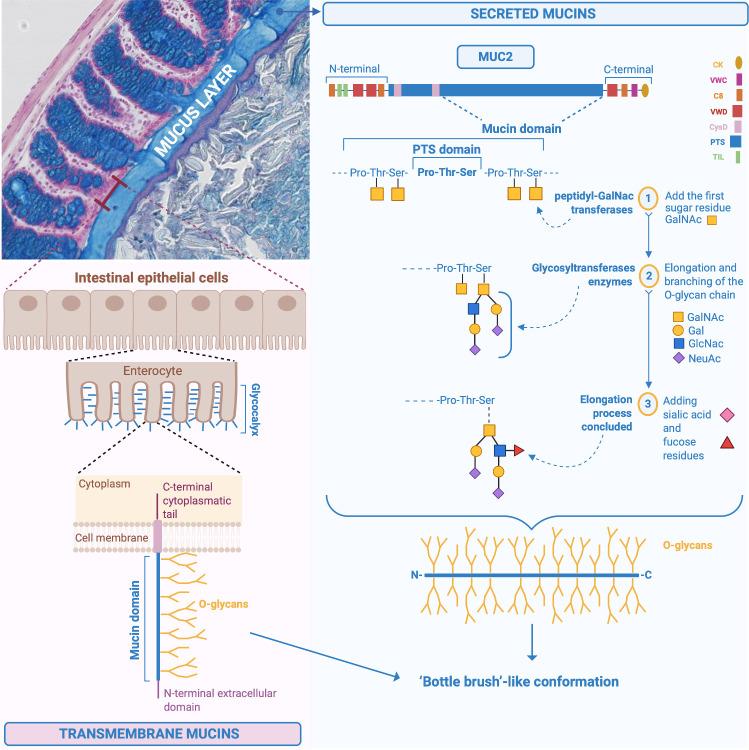
The gastrointestinal tract is often considered as a key organ involved in the digestion of food and providing nutrients to the body for proper maintenance. However, this system is composed of organs that are extremely complex. Among the different parts, the intestine is viewed as an incredible surface of contact with the environment and is colonised by hundreds of trillions of gut microbes. The role of the gut barrier has been studied for decades, but the exact mechanisms involved in the protection of the gut barrier are various and complementary. Among them, the integrity of the mucus barrier is one of the first lines of protection of the gastrointestinal tract. In the past, this 'slimy' partner was mostly considered a simple lubricant for facilitating the progression of the food bolus and the stools in the gut. Since then, different researchers have made important progress, and currently, the regulation of this mucus barrier is gaining increasing attention from the scientific community. Among the factors influencing the mucus barrier, the microbiome plays a major role in driving mucus changes. Additionally, our dietary habits (ie, high-fat diet, low-fibre/high-fibre diet, food additives, pre- probiotics) influence the mucus at different levels. Given that the mucus layer has been linked with the appearance of diseases, proper knowledge is highly warranted. Here, we debate different aspects of the mucus layer by focusing on its chemical composition, regulation of synthesis and degradation by the microbiota as well as some characteristics of the mucus layer in both physiological and pathological situations.
胃肠道通常被认为是参与食物消化并为身体提供营养以进行适当维持的关键器官。然而,这个系统由极其复杂的器官组成。在不同的部分中,肠道被视为与环境接触的不可思议的表面,并被数百万亿的肠道微生物定植。肠道屏障的作用已经研究了几十年,但参与肠道屏障保护的确切机制是多种多样且互补的。其中,黏液屏障的完整性是胃肠道的第一道防线之一。在过去,这个“粘稠”的伙伴主要被认为是一种简单的润滑剂,有助于食物团块和肠道粪便的推进。从那时起,不同的研究人员已经取得了重要进展,目前,科学界越来越关注对这种黏液屏障的调节。在影响黏液屏障的因素中,微生物组在驱动黏液变化方面起着主要作用。此外,我们的饮食习惯(例如高脂肪饮食、低纤维/高纤维饮食、食物添加剂、预益生菌)在不同层面上影响黏液。鉴于黏液层与疾病的出现有关,因此需要有适当的认识。在这里,我们通过关注其化学组成、微生物群对合成和降解的调节以及黏液层在生理和病理情况下的一些特征来讨论黏液层的不同方面。



 Zotero 插件