
基于埃索美拉唑的预处理策略调控靶向纳米载体与单核吞噬细胞系统的相互作用。
Regulating Interactions Between Targeted Nanocarriers and Mononuclear Phagocyte System via an Esomeprazole-Based Preconditioning Strategy.
机构信息
Beijing Key Laboratory of Molecular Pharmaceutics and New Drug Delivery Systems, State Key Laboratory of Natural and Biomimetic Drugs, School of Pharmaceutical Sciences, Peking University, Beijing 100191, People's Republic of China.
School of Pharmaceutical Sciences, Guangzhou Medical University, Guangzhou, 511436, People's Republic of China.
出版信息
Int J Nanomedicine. 2020 Aug 25;15:6385-6399. doi: 10.2147/IJN.S258054. eCollection 2020.
PURPOSE
The mononuclear phagocyte system (MPS) presents a formidable obstacle that hampers the delivery of various nanopreparations to tumors. Therefore, there is an urgent need to improve the off-MPS targeting ability of nanomedicines. In the present study, we present a novel preconditioning strategy to substantially increase the circulation times and tumor targeting of nanoparticles by regulating nanocarrier-MPS interactions.
METHODS
In vitro, the effect of different vacuolar H-ATPase inhibitors on macrophage uptake of targeted or nontargeted lipid vesicles was evaluated. Specifically, the clinically approved proton-pump inhibitor esomeprazole (ESO) was selected as a preconditioning agent. Then, we further investigated the blocking effect of ESO on the macrophage endocytosis of nanocarriers. In vivo, ESO was first intravenously administered into A549-tumor-bearing nude mice, and 24 h later, the c(RGDm7)-modified vesicles co-loaded with doxorubicin and gefitinib were intravenously injected.
RESULTS
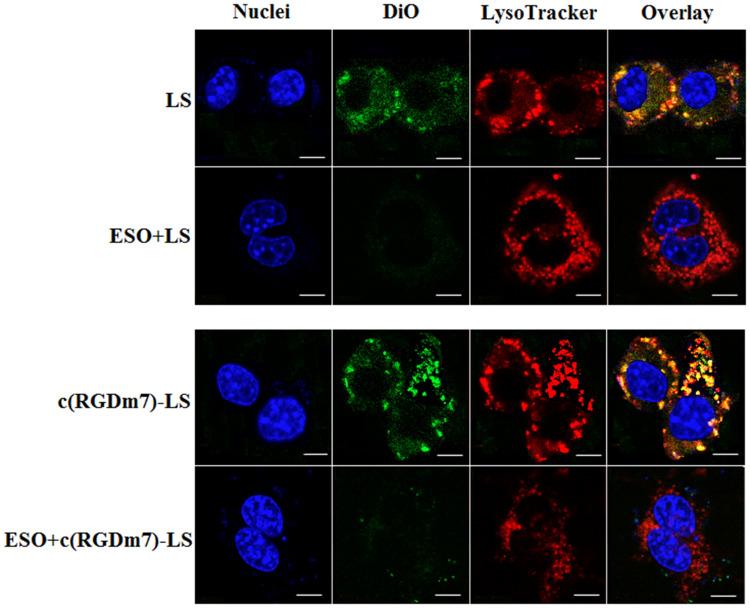
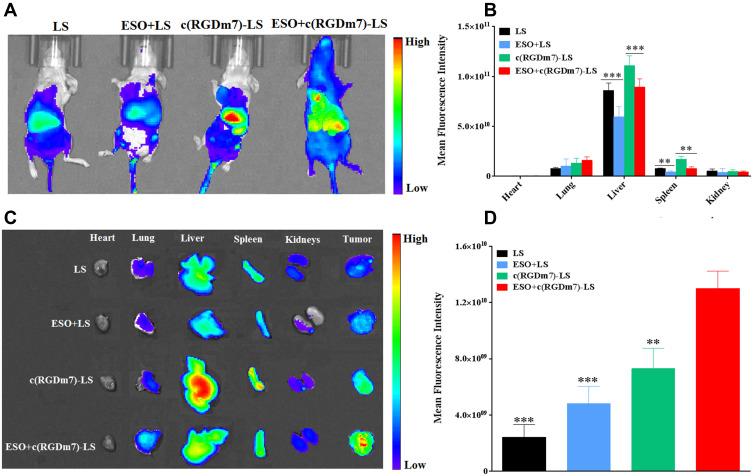
In vitro, ESO was found to reduce the interactions between macrophages and c(RGDm7)-modified vesicles by interfering with the latter's lysosomal trafficking. Studies conducted in vivo confirmed that ESO pretreatment greatly decreased the liver and spleen distribution of the targeted vesicles, enhanced their tumor accumulation, and improved the therapeutic outcome of the drug-loaded nanomedicines.
CONCLUSION
Our findings indicate that ESO can regulate the nanoparticle-MPS interaction, which provides a feasible option for enhancing the off-MPS targeting of nanomedicines.
目的
单核吞噬细胞系统 (MPS) 构成了一个巨大的障碍,阻碍了各种纳米制剂向肿瘤的递药。因此,迫切需要提高纳米药物的非 MPS 靶向能力。在本研究中,我们提出了一种新的预处理策略,通过调节纳米载体与 MPS 的相互作用,显著增加纳米颗粒的循环时间和肿瘤靶向性。
方法
在体外,评估了不同的液泡型 H+-ATP 酶抑制剂对靶向或非靶向脂质体被巨噬细胞摄取的影响。具体而言,选择临床批准的质子泵抑制剂埃索美拉唑 (ESO) 作为预处理剂。然后,我们进一步研究了 ESO 对巨噬细胞内吞纳米载体的阻断作用。在体内,首先将 ESO 静脉注射到 A549 肿瘤荷瘤裸鼠体内,24 小时后,静脉注射共载多柔比星和吉非替尼的 c(RGDm7) 修饰的囊泡。
结果
在体外,ESO 被发现通过干扰囊泡的溶酶体运输来减少巨噬细胞与 c(RGDm7) 修饰的囊泡之间的相互作用。体内研究证实,ESO 预处理可显著减少靶向囊泡在肝和脾中的分布,增强其在肿瘤中的积累,并改善载药纳米药物的治疗效果。
结论
我们的研究结果表明,ESO 可以调节纳米颗粒与 MPS 的相互作用,为增强纳米药物的非 MPS 靶向性提供了一种可行的选择。





 Zotero 插件