
线粒体 DNA 拷贝数与心房颤动事件。
Mitochondrial DNA copy number and incident atrial fibrillation.
机构信息
Departments of Epidemiology and Medicine, and Welch Center for Prevention, Epidemiology, and Clinical Research, Johns Hopkins University Bloomberg School of Public Health, 2024 E. Monument Street, Room 2-645, Baltimore, MD, 21205, USA.
Departments of Biostatistics and Medicine, University of Washington, Seattle, WA, USA.
出版信息
BMC Med. 2020 Sep 16;18(1):246. doi: 10.1186/s12916-020-01715-6.
BACKGROUND
Mechanistic studies suggest that mitochondria DNA (mtDNA) dysfunction may be associated with increased risk of atrial fibrillation (AF). The association between mtDNA copy number (mtDNA-CN) and incident AF in the general population, however, remains unknown.
METHODS
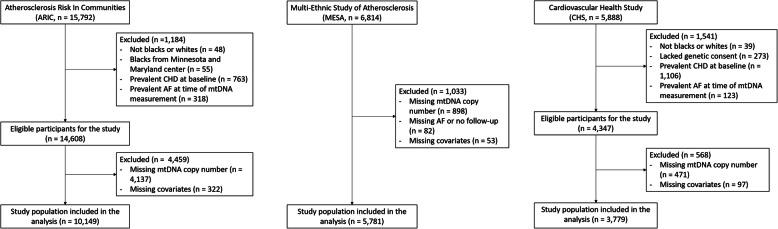
We conducted prospective analyses of 19,709 participants from the Atherosclerosis Risk in Communities Study (ARIC), the Multi-Ethnic Study of Atherosclerosis (MESA), and the Cardiovascular Health Study (CHS). mtDNA-CN from the peripheral blood was calculated from probe intensities on the Affymetrix Genome-Wide Human single nucleotide polymorphisms (SNP) Array 6.0 in ARIC and MESA and from multiplexed real-time quantitative polymerase chain reaction (qPCR) in CHS. Incident AF cases were identified through electrocardiograms, review of hospital discharge codes, Medicare claims, and death certificates.
RESULTS
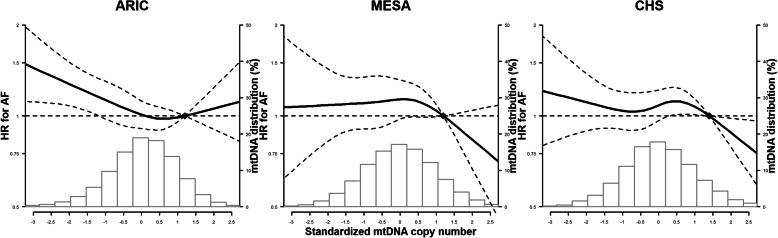
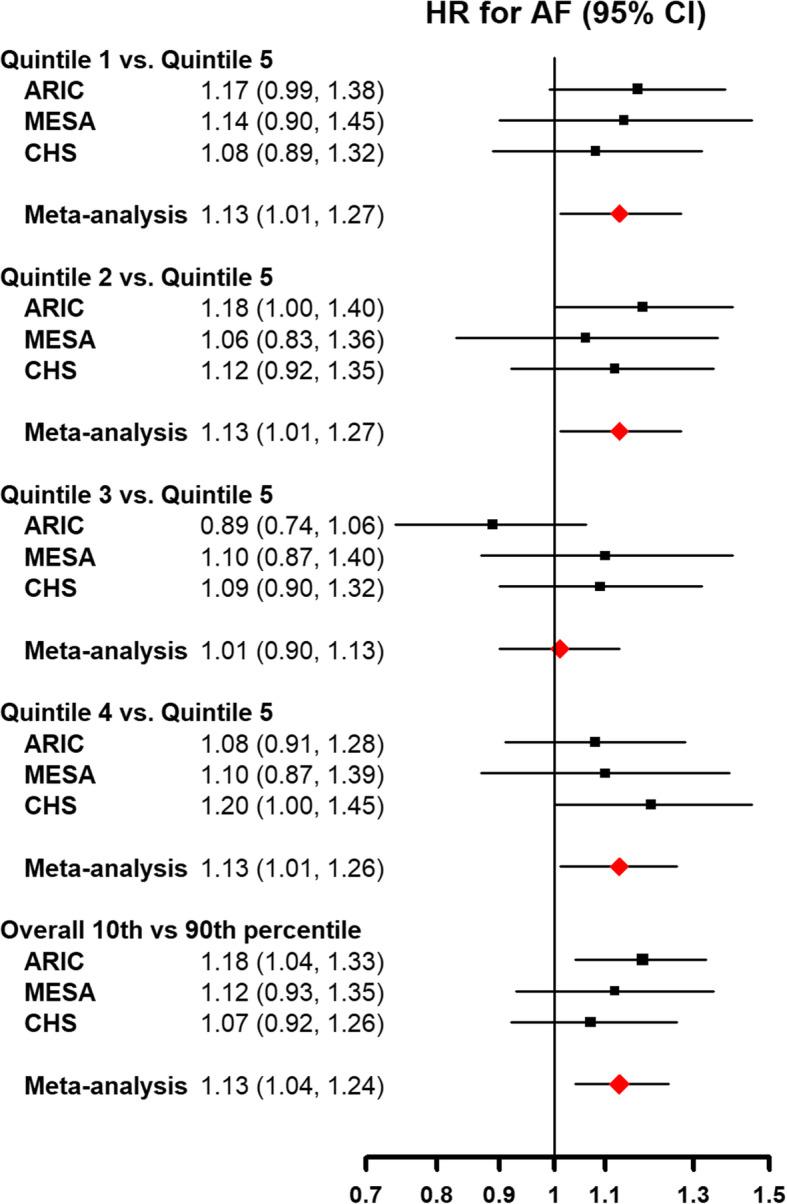
The median follow-up time was 21.4 years in ARIC, 12.9 years in MESA, and 11.0 years in CHS, during which 4021 participants developed incident atrial fibrillation (1761 in ARIC, 790 in MESA, and 1470 in CHS). In fully adjusted models, participants with the lowest quintile of mitochondria DNA copy number had an overall 13% increased risk (95% CI 1 to 27%) of incident atrial fibrillation compared to those with the highest quintile. Dose-response spline analysis also showed an inverse association between mitochondria DNA copy number and hazard for atrial fibrillation for all three cohorts. These associations were consistent across subgroups.
CONCLUSIONS
Mitochondria DNA copy number was inversely associated with the risk of AF independent of traditional cardiovascular risk factors. These findings implicate mitochondria DNA copy number as a novel risk factor for atrial fibrillation. Further research is warranted to understand the underlying mechanisms and to evaluate the role of mitochondria DNA copy number in the management of atrial fibrillation risk.
背景
机制研究表明,线粒体 DNA(mtDNA)功能障碍可能与心房颤动(AF)风险增加有关。然而,一般人群中 mtDNA 拷贝数(mtDNA-CN)与 AF 事件之间的关联尚不清楚。
方法
我们对来自动脉粥样硬化风险社区研究(ARIC)、多民族动脉粥样硬化研究(MESA)和心血管健康研究(CHS)的 19709 名参与者进行了前瞻性分析。ARIC 和 MESA 中 mtDNA-CN 来自 Affymetrix 全基因组人类单核苷酸多态性(SNP)阵列 6.0 上的探针强度,CHS 中则来自多重实时定量聚合酶链反应(qPCR)。通过心电图、医院出院代码、医疗保险索赔和死亡证明来确定 AF 事件。
结果
ARIC 的中位随访时间为 21.4 年,MESA 为 12.9 年,CHS 为 11.0 年,在此期间,4021 名参与者发生了心房颤动(ARIC 中 1761 例,MESA 中 790 例,CHS 中 1470 例)。在完全调整的模型中,与最高 quintile 相比,mtDNA 拷贝数最低 quintile 的参与者发生心房颤动的风险总体增加了 13%(95%CI 1 至 27%)。剂量反应样条分析也显示 mtDNA 拷贝数与三个队列心房颤动风险之间存在反比关系。这些关联在亚组中是一致的。
结论
mtDNA 拷贝数与 AF 风险呈负相关,独立于传统心血管危险因素。这些发现表明 mtDNA 拷贝数是心房颤动的一个新的危险因素。需要进一步研究以了解潜在的机制,并评估 mtDNA 拷贝数在心房颤动风险管理中的作用。
 Zotero 插件