
附带损害:COVID-19 大流行对院外心脏骤停系统护理的隐性影响。
Collateral damage: Hidden impact of the COVID-19 pandemic on the out-of-hospital cardiac arrest system-of-care.
机构信息
Centre for Research and Evaluation, Ambulance Victoria, Blackburn North, Victoria, Australia; Department of Epidemiology and Preventive Medicine, Monash University, Melbourne, Victoria, Australia; Baker Heart and Diabetes Institute, Melbourne, Victoria, Australia.
Centre for Research and Evaluation, Ambulance Victoria, Blackburn North, Victoria, Australia; Department of Epidemiology and Preventive Medicine, Monash University, Melbourne, Victoria, Australia; Department of Paramedicine, Monash University, Frankston, Victoria, Australia.
出版信息
Resuscitation. 2020 Nov;156:157-163. doi: 10.1016/j.resuscitation.2020.09.017. Epub 2020 Sep 19.
AIM
Out-of-hospital cardiac arrest (OHCA) during COVID-19 has been reported by countries with high case numbers and overwhelmed healthcare services. Imposed restrictions and treatment precautions may have also influenced OHCA processes-of-care. We investigated the impact of the COVID-19 pandemic period on incidence, characteristics, and survival from OHCA in Victoria, Australia.
METHODS
Using data from the Victorian Ambulance Cardiac Arrest Registry, we compared 380 adult OHCA patients who received resuscitation between 16th March 2020 and 12th May 2020, with 1218 cases occurring during the same dates in 2017-2019. No OHCA patients were COVID-19 positive. Arrest incidence, characteristics and survival rates were compared. Regression analysis was performed to understand the independent effect of the pandemic period on survival.
RESULTS
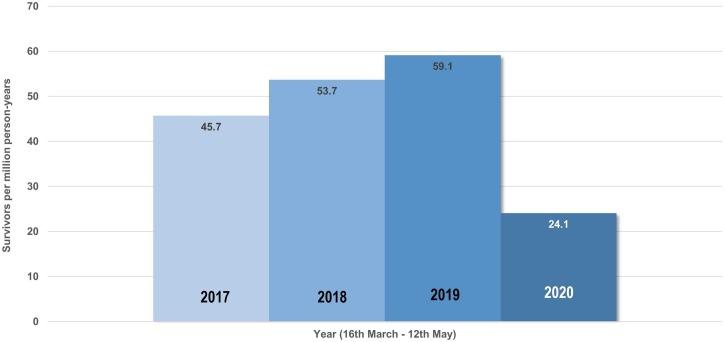
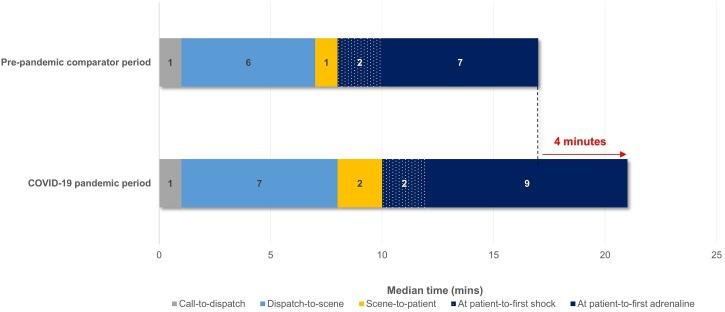
Incidence of OHCA did not differ during the pandemic period. However, initiation of resuscitation by Emergency Medical Services (EMS) significantly decreased (46.9% versus 40.6%, p = 0.001). Arrests in public locations decreased in the pandemic period (20.8% versus 10.0%; p < 0.001), as did initial shocks by public access defibrillation/first-responders (p = 0.037). EMS caseload decreased during the pandemic period, however, delays to key interventions (time-to-first defibrillation, time-to-first epinephrine) significantly increased. Survival-to-discharge decreased by 50% during the pandemic period (11.7% versus 6.1%; p = 0.002). Survivors per million person-years dropped in 2020, resulting in 35 excess deaths per million person-years. On adjusted analysis, the pandemic period remained associated with a 50% reduction in survival-to-discharge.
CONCLUSION
The COVID-19 pandemic period did not influence OHCA incidence but appears to have disrupted the system-of-care in Australia. However, this could not completely explain reductions in survival.
目的
高病例数和医疗服务不堪重负的国家报告了 COVID-19 期间的院外心脏骤停 (OHCA)。实施的限制和治疗预防措施也可能影响 OHCA 的治疗过程。我们调查了 COVID-19 大流行期间对澳大利亚维多利亚州 OHCA 的发生率、特征和存活率的影响。
方法
使用维多利亚救护车心脏骤停登记处的数据,我们比较了 2020 年 3 月 16 日至 5 月 12 日期间接受复苏治疗的 380 名成年 OHCA 患者与 2017-2019 年同期发生的 1218 例病例。没有 COVID-19 阳性的 OHCA 患者。比较了发病、特征和存活率。进行回归分析以了解大流行期间对生存率的独立影响。
结果
大流行期间 OHCA 的发生率没有差异。然而,紧急医疗服务(EMS)开始复苏的比例显着下降(46.9%比 40.6%,p=0.001)。大流行期间,在公共场所发生的骤停减少(20.8%比 10.0%;p<0.001),公共接入除颤/第一响应者的初始电击也减少(p=0.037)。大流行期间 EMS 工作量减少,但关键干预措施(首次除颤、首次肾上腺素)的延迟显着增加。大流行期间出院存活率下降 50%(11.7%比 6.1%;p=0.002)。2020 年每百万人口幸存者人数下降,导致每百万人口每年增加 35 例超额死亡。在调整分析中,大流行期间与出院存活率降低 50%仍然相关。
结论
COVID-19 大流行期间并未影响 OHCA 的发病率,但似乎扰乱了澳大利亚的医疗保健系统。然而,这并不能完全解释存活率的降低。

 Zotero 插件