
组织动力学光谱成像:异质癌症组织的功能成像。
Tissue dynamics spectroscopic imaging: functional imaging of heterogeneous cancer tissue.
机构信息
Purdue Univ., United States.
Tulane Univ., United States.
出版信息
J Biomed Opt. 2020 Sep;25(9). doi: 10.1117/1.JBO.25.9.096006.
SIGNIFICANCE
Tumor heterogeneity poses a challenge for the chemotherapeutic treatment of cancer. Tissue dynamics spectroscopy captures dynamic contrast and can capture the response of living tissue to applied therapeutics, but the current analysis averages over the complicated spatial response of living biopsy samples.
AIM
To develop tissue dynamics spectroscopic imaging (TDSI) to map the heterogeneous spatial response of tumor tissue to anticancer drugs.
APPROACH
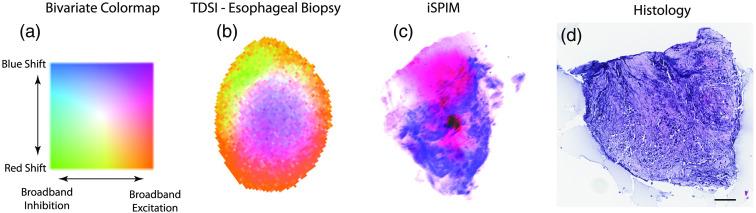
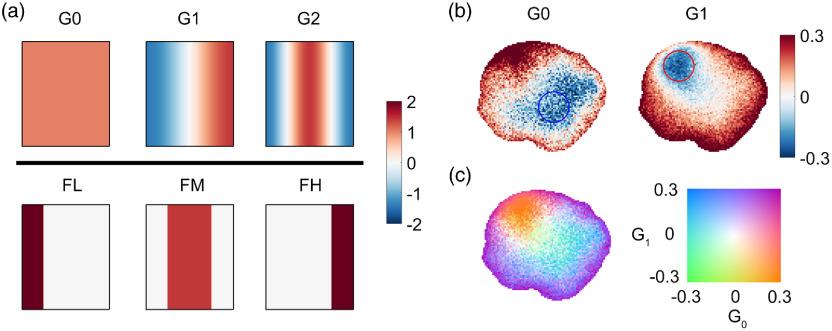
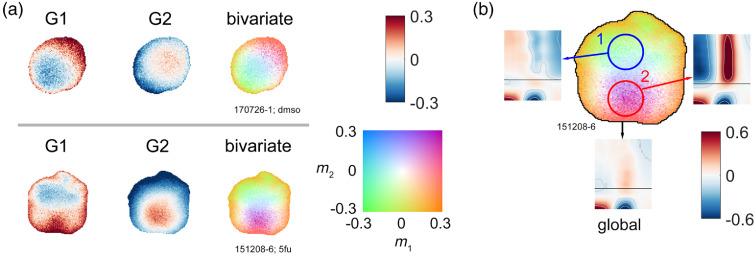
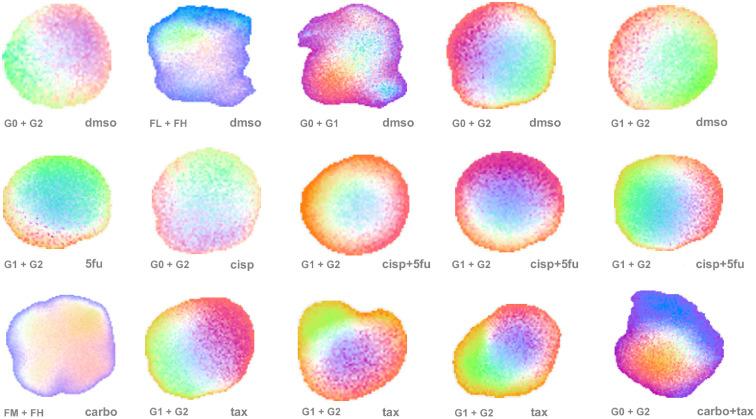
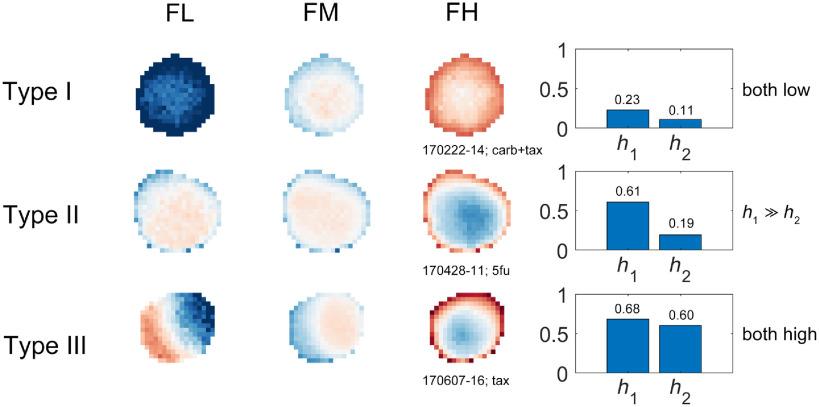
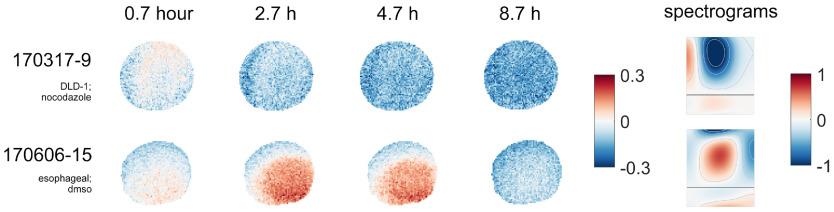
TDSI is applied to tumor spheroids grown from cell lines and to ex vivo living esophageal biopsy samples. Doppler fluctuation spectroscopy is performed on a voxel basis to extract spatial maps of biodynamic biomarkers. Functional images and bivariate spatial maps are produced using a bivariate color merge to represent the spatial distribution of pairs of signed drug-response biodynamic biomarkers.
RESULTS
We have mapped the spatial variability of drug responses within biopsies and have tracked sample-to-sample variability. Sample heterogeneity observed in the biodynamic maps is associated with histological heterogeneity observed using inverted selective-plane illumination microscopy.
CONCLUSION
We have demonstrated the utility of TDSI as a functional imaging method to measure tumor heterogeneity and its potential for use in drug-response profiling.
意义
肿瘤异质性对癌症的化学治疗构成了挑战。组织动力学光谱学可以捕捉动态对比,并能捕捉活体组织对应用治疗的反应,但目前的分析方法平均了活体活检样本复杂的空间反应。
目的
开发组织动力学光谱成像(TDSI)以绘制肿瘤组织对抗癌药物的异质空间反应图。
方法
将 TDSI 应用于从细胞系生长的肿瘤球体和离体的活食管活检样本。在体素基础上进行多普勒波动光谱分析,以提取生物动力学生物标志物的空间图谱。使用双变量颜色合并生成功能图像和双变量空间图谱,以表示一对有符号药物反应生物动力学生物标志物的空间分布。
结果
我们已经绘制了活检内药物反应的空间可变性,并跟踪了样本间的可变性。在生物动力学图谱中观察到的样本异质性与使用倒置选择性平面照明显微镜观察到的组织学异质性有关。
结论
我们已经证明了 TDSI 作为一种功能成像方法在测量肿瘤异质性及其在药物反应分析中的应用潜力。

 Zotero 插件