
南非出生队列中生命早期呼吸道合胞病毒下呼吸道感染:流行病学及对肺部健康的影响。
Early-life respiratory syncytial virus lower respiratory tract infection in a South African birth cohort: epidemiology and effect on lung health.
机构信息
Department of Paediatrics and Child Heath, Red Cross War Memorial Children's Hospital and South African Medical Research Council Unit on Child and Adolescent Health, University of Cape Town, Cape Town, South Africa.
Department of Paediatrics and Child Heath, Red Cross War Memorial Children's Hospital and South African Medical Research Council Unit on Child and Adolescent Health, University of Cape Town, Cape Town, South Africa.
出版信息
Lancet Glob Health. 2020 Oct;8(10):e1316-e1325. doi: 10.1016/S2214-109X(20)30251-5.
BACKGROUND
Respiratory syncytial virus (RSV) is a major cause of lower respiratory tract infection (LRTI) in children. Early-life RSV LRTI might affect long-term health but there are few data from low-income and middle-income countries. We investigated the epidemiology and effect of early-life RSV LRTI on lung health in a South African birth cohort.
METHODS
We conducted the Drakenstein Child Health Study (DCHS), an ongoing birth cohort longitudinal study in the Western Cape province, South Africa. We enrolled pregnant women aged 18 years or older during their second trimester of pregnancy at two public health clinics. We followed up study children from birth to 2 years. The primary outcome of the study was LRTI and RSV LRTI. LRTI and wheezing episodes were identified through active surveillance; respiratory samples were tested for RSV and other pathogens. Wheezing was longitudinally identified by caregiver report and ascertainment at health facilities. Lung function was measured from 6 weeks to 2 years. We analysed the associations between RSV LRTI and subsequent LRTI, wheezing, and lung function using generalised estimating equations and mixed-effects linear regression.
FINDINGS
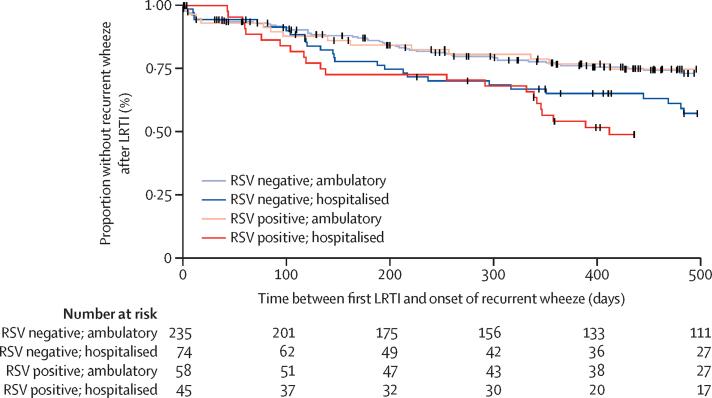
We enrolled 1137 mothers between March 5, 2012, and March 31, 2015. Among their 1143 infants, accruing 2093 child-years of follow-up, there were 851 cases of LRTI (incidence 0·41 episodes per child-year, 95% CI 0·38-0·43). Admission to hospital owing to LRTI occurred in 169 (20%) cases (incidence 0·08 episodes per child-year, 0·07-0·09), with a case-fatality ratio of 0·5%. RSV was detected in 164 (21%) of 785 LRTI events with a specimen available for qPCR, an incidence of 0·08 episodes per child-year (0·07-0·09); highest at age 0-6 months (0·15 episodes per child-year, 0·12-0·19). Children with a first RSV LRTI were three times as likely to develop recurrent LRTI compared with those with non-RSV LRTI (0·32 [0·22-0·48] vs 0·10 [0·07- 0·16] episodes per child-year; p<0·0001), particularly following hospitalised RSV LRTI. RSV LRTI and hospitalisation for all-cause LRTI were independently associated with recurrent wheezing (adjusted incident rate ratio 1·41, 95% CI 1·25-1·59, for RSV LRTI and 1·48, 1·30-1·68, for hospitalisation). LRTI or recurrent LRTI was associated with impaired lung function, but a similar outcome was observed following RSV LRTI or non-RSV LRTI. All-cause LRTI was associated with an average 3% higher respiratory rate (95% CI 0·01-0·06; p=0·013) and lower compliance (-0·1, -0·18 to 0·02) at 2 years compared with no LRTI. Recurrent LRTI was associated with further increased respiratory rate (0·01, 0·001-0·02), resistance (0·77 hPa s L, 0·07-1·47), and lower compliance (-0·6 mL hPa, -0·09 to -0·02) with each additional event.
INTERPRETATION
RSV LRTI was common in young infants and associated with recurrent LRTI, particularly after hospitalised RSV. Hospitalisation for all-cause LRTI, especially for RSV-LRTI, was associated with recurrent wheezing. Impairments in lung function followed LRTI or recurrent episodes, but were not specific to RSV. New preventive strategies for RSV might have an effect on long-term lung health.
FUNDING
Bill & Melinda Gates Foundation; South African Medical Research Council; National Research Foundation South Africa; National Institutes of Health, Human Heredity and Health in Africa; Wellcome Trust.
背景
呼吸道合胞病毒(RSV)是儿童下呼吸道感染(LRTI)的主要病因。婴儿期 RSV LRTI 可能会影响长期健康,但来自低收入和中等收入国家的数据很少。我们在南非一个出生队列中调查了 RSV LRTI 的发病情况及其对肺健康的影响。
方法
我们开展了 Drakenstein 儿童健康研究(DCHS),这是南非西开普省正在进行的一项出生队列纵向研究。我们在两家公共卫生诊所招募了妊娠 18 岁或以上的孕妇,在妊娠中期进行研究。我们从出生开始对研究儿童进行随访,随访时间至 2 岁。本研究的主要结局为 LRTI 和 RSV LRTI。通过主动监测确定 LRTI 和喘息发作;对呼吸道样本进行 RSV 和其他病原体检测。通过照顾者报告和在医疗机构进行的评估,纵向确定喘息。从 6 周龄到 2 岁进行肺功能测量。我们使用广义估计方程和混合效应线性回归分析 RSV LRTI 与随后的 LRTI、喘息和肺功能之间的关系。
结果
我们于 2012 年 3 月 5 日至 2015 年 3 月 31 日招募了 1137 位母亲,其 1143 名婴儿共累计 2093 个儿童年随访时间,发生 851 例 LRTI(发病率为 0.41 例/儿童年,95%CI 0.38-0.43)。因 LRTI 住院的有 169 例(20%)(发病率为 0.08 例/儿童年,0.07-0.09),病死率为 0.5%。在可进行 qPCR 检测的 785 例 LRTI 事件中,检测到 RSV 的有 164 例(21%),发病率为 0.08 例/儿童年(0.07-0.09);0-6 月龄最高(0.15 例/儿童年,0.12-0.19)。与非 RSV LRTI 相比,首次 RSV LRTI 患儿再次发生 LRTI 的可能性是其 3 倍(0.32 [0.22-0.48] 比 0.10 [0.07-0.16] 例/儿童年;p<0.0001),尤其是在 RSV LRTI 住院的情况下。RSV LRTI 和所有病因引起的 LRTI 住院均与反复喘息相关(调整后发病率比值为 1.41,95%CI 1.25-1.59,RSV LRTI;1.48,1.30-1.68,所有病因引起的 LRTI 住院)。LRTI 或反复 LRTI 与肺功能受损相关,但 RSV LRTI 或非 RSV LRTI 引起的结局相似。与无 LRTI 相比,所有病因引起的 LRTI 与呼吸频率平均升高 3%(95%CI 0.01-0.06;p=0.013)和顺应性降低 0.1%(-0.1,-0.18 至 0.02)相关。与无 LRTI 相比,反复 LRTI 与呼吸频率进一步增加(0.01,0.001-0.02)、阻力(0.77 hPa s L,0.07-1.47)和顺应性降低(0.6 mL hPa,-0.09 至 -0.02)相关,且每增加一次 LRTI 事件,上述指标的变化幅度就会进一步增加。
结论
婴儿时期 RSV LRTI 很常见,与反复 LRTI 相关,尤其是在 RSV 住院的情况下。所有病因引起的 LRTI 住院,尤其是 RSV-LRTI 住院,与反复喘息有关。肺功能受损与 LRTI 或反复发生有关,但与 RSV 无关。针对 RSV 的新预防策略可能对长期肺健康有影响。
资金
比尔及梅琳达·盖茨基金会;南非医学研究理事会;南非国家研究基金会;美国国立卫生研究院,人类遗传与健康在非洲;惠康信托基金会。

 Zotero 插件