
基于m6A RNA甲基化调节因子的宫颈鳞状细胞癌预后预测特征的开发与验证
Development and Validation of an m6A RNA Methylation Regulator-Based Signature for Prognostic Prediction in Cervical Squamous Cell Carcinoma.
作者信息
Pan Jingxin, Xu Lichao, Pan Hongda
机构信息
Department of Internal Medicine, The Second Affiliated Hospital of Fujian Medical University, Quanzhou, China.
Department of Interventional Radiology, Fudan University Shanghai Cancer Center, Shanghai, China.
出版信息
Front Oncol. 2020 Aug 21;10:1444. doi: 10.3389/fonc.2020.01444. eCollection 2020.
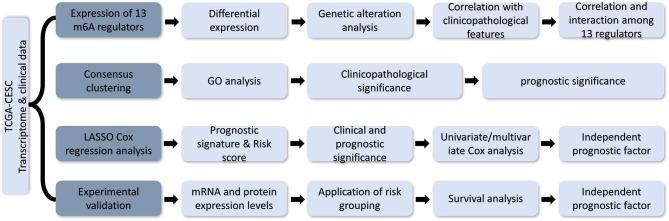
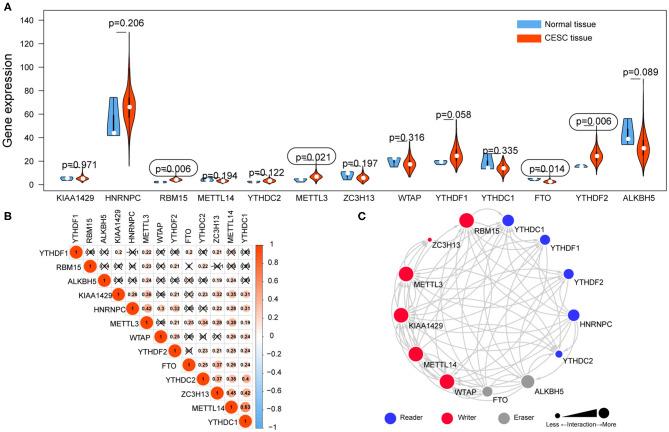
Cervical squamous cell carcinoma (CESC) is one of the most common causes of cancer-related death worldwide. N6-methyladenosine (m6A) plays an important role in various cellular responses by regulating mRNA biology. This study aimed to develop and validate an m6A RNA methylation regulator-based signature for prognostic prediction in CESC. Clinical and survival data as well as RNA sequencing data of 13 m6A RNA methylation regulators were obtained from The Cancer Genome Atlas (TCGA) CESC database. Consensus clustering was performed to identify different CESC clusters based on the differential expression of the regulators. LASSO Cox regression analysis was used to generate a prognostic signature based on m6A RNA methylation regulator expression. The effect of the signature was further explored by univariate and multivariate Cox analyses. Four regulators (RBM15, METTL3, FTO, and YTHDF2) were identified to be aberrantly expressed in CESC tissues. A prognostic signature that includes ZC3H13, YTHDC1, and YTHDF1 was developed, which can act as an independent prognostic indicator. Significant differences of survival rate and clinicopathological features were found between the high- and low-risk groups. The results of bioinformatics analysis were then validated in the clinical CESC cohort by qRT-PCR and immunohistochemistry staining. In the present study, we developed and validated an m6A RNA methylation regulator-based prognostic signature, which might provide useful insights regarding the development and prognosis of CESC.
宫颈鳞状细胞癌(CESC)是全球癌症相关死亡的最常见原因之一。N6-甲基腺苷(m6A)通过调节mRNA生物学在各种细胞反应中发挥重要作用。本研究旨在开发并验证一种基于m6A RNA甲基化调节因子的特征,用于CESC的预后预测。从癌症基因组图谱(TCGA)的CESC数据库中获取了13种m6A RNA甲基化调节因子的临床和生存数据以及RNA测序数据。基于调节因子的差异表达进行一致性聚类,以识别不同的CESC簇。使用LASSO Cox回归分析基于m6A RNA甲基化调节因子的表达生成预后特征。通过单变量和多变量Cox分析进一步探讨该特征的作用。发现四种调节因子(RBM15、METTL3、FTO和YTHDF2)在CESC组织中异常表达。开发了一种包括ZC3H13、YTHDC1和YTHDF1的预后特征,其可作为独立的预后指标。在高风险组和低风险组之间发现了生存率和临床病理特征的显著差异。然后通过qRT-PCR和免疫组织化学染色在临床CESC队列中验证了生物信息学分析的结果。在本研究中,我们开发并验证了一种基于m6A RNA甲基化调节因子的预后特征,这可能为CESC的发生发展和预后提供有用的见解。



 Zotero 插件