
乌拉圭的奶牛犊是布鲁氏菌病动物源性亚型的宿主,对地表水构成潜在污染风险。
Dairy Calves in Uruguay Are Reservoirs of Zoonotic Subtypes of and Pose a Potential Risk of Surface Water Contamination.
作者信息
Caffarena Rubén Darío, Meireles Marcelo Vasconcelos, Carrasco-Letelier Leonidas, Picasso-Risso Catalina, Santana Bruna Nicoleti, Riet-Correa Franklin, Giannitti Federico
机构信息
Instituto Nacional de Investigación Agropecuaria (INIA), Plataforma de Investigación en Salud Animal, Estación Experimental INIA La Estanzuela, Colonia, Uruguay.
Facultad de Veterinaria, Universidad de la República, Montevideo, Uruguay.
出版信息
Front Vet Sci. 2020 Aug 21;7:562. doi: 10.3389/fvets.2020.00562. eCollection 2020.
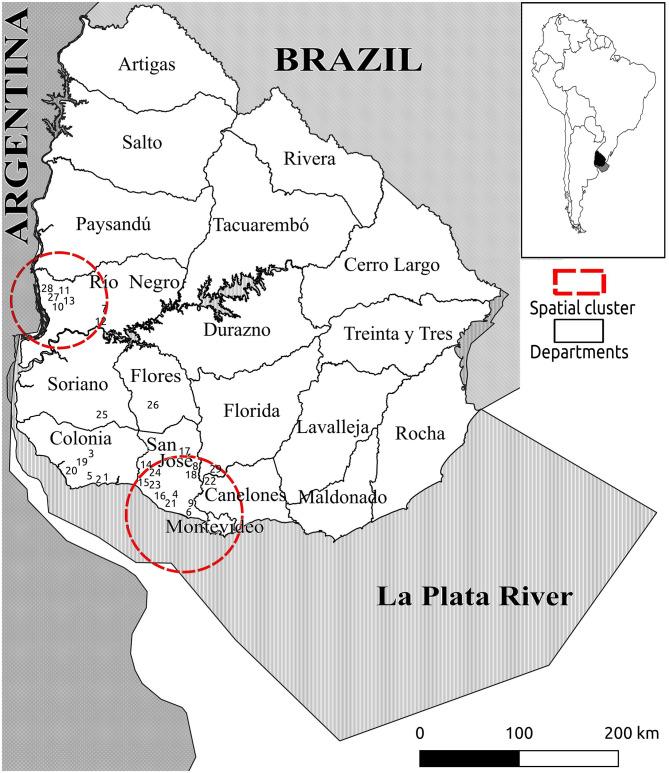
, a major cause of diarrhea in calves, is of concern given its zoonotic potential. Numerous outbreaks of human cryptosporidiosis caused by genetic subtypes are reported yearly worldwide, with livestock or water being frequently identified sources of infection. Although cryptosporidiosis has been reported from human patients in Uruguay, particularly children, epidemiologic information is scant and the role of cattle as reservoirs of zoonotic subtypes of has not been explored. In this study, we aimed to (a)-identify subtypes infecting dairy calves in Uruguay (including potentially zoonotic subtypes), (b)-assess their association with calf diarrhea, (c)-evaluate their spatial clustering, and (d)-assess the distance of infected calves to surface watercourses draining the farmlands and determine whether these watercourses flow into public water treatment plants. Feces of 255 calves that had tested positive for spp. by antigen ELISA were selected. Samples had been collected from 29 dairy farms in seven Uruguayan departments where dairy farming is concentrated and represented 170 diarrheic and 85 non-diarrheic calves. Selected samples were processed by nested PCRs targeting the 18S rRNA and gp60 genes followed by sequencing to identify subtypes. Of seven subtypes detected in 166 calves, five (identified in 143 calves on 28/29 farms) had been identified in humans elsewhere and have zoonotic potential. Subtype IIaA15G2R1 was the most frequent (53.6%; 89/166), followed by IIaA20G1R1 (24.1%; 40/166), IIaA22G1R1 (11.4%; 19/166), IIaA23G1R1 (3.6%; 6/166), IIaA17G2R1 (3%; 5/166), IIaA21G1R1 (2.4%; 4/166), and IIaA16G1R1 (1.8%; 3/166). There were no significant differences in the proportions of diarrheic and non-diarrheic calves infected with any of the subtypes. Two spatial clusters were detected, one of which overlapped with Uruguay's capital city and its main water treatment plant (Aguas Corrientes), harvesting surface water to supply ~1,700,000 people. Infected calves on all farms were within 20-900 m of a natural surface watercourse draining the farmland, 10 of which flowed into six water treatment plants located 9-108 km downstream. Four watercourses flowed downstream into Aguas Corrientes. Calves are reservoirs of zoonotic subtypes in Uruguay and pose a public health risk.
隐孢子虫是犊牛腹泻的主要病因,鉴于其具有人畜共患病潜力,令人担忧。全球每年都有许多由隐孢子虫基因亚型引起的人类隐孢子虫病暴发报告,家畜或水常被确定为感染源。尽管乌拉圭已报告人类患者感染隐孢子虫病,尤其是儿童,但流行病学信息匮乏,且牛作为隐孢子虫人畜共患病亚型储存宿主的作用尚未得到探索。在本研究中,我们旨在:(a)确定感染乌拉圭奶牛犊牛的隐孢子虫亚型(包括潜在的人畜共患病亚型);(b)评估它们与犊牛腹泻的关联;(c)评估它们的空间聚集情况;(d)评估感染犊牛到流经农田的地表水道的距离,并确定这些水道是否流入公共水处理厂。选择了255头通过抗原ELISA检测隐孢子虫属呈阳性的犊牛的粪便。样本采集自乌拉圭七个奶牛养殖集中的省份的29个奶牛场,包括170头腹泻犊牛和85头非腹泻犊牛。对选定样本进行针对18S rRNA和gp60基因的巢式PCR,随后进行测序以鉴定隐孢子虫亚型。在166头犊牛中检测到七种隐孢子虫亚型,其中五种(在28/29个农场的143头犊牛中鉴定出)在其他地方的人类中已被鉴定出且具有人畜共患病潜力。亚型IIaA15G2R1最为常见(53.6%;89/166),其次是IIaA20G1R1(24.1%;40/166)、IIaA22G1R1(11.4%;19/166)、IIaA23G1R1(3.6%;6/166)、IIaA17G2R1(3%;5/166)、IIaA21G1R1(2.4%;4/166)和IIaA16G1R1(1.8%;3/166)。感染任何隐孢子虫亚型的腹泻犊牛和非腹泻犊牛比例无显著差异。检测到两个空间聚集区,其中一个与乌拉圭首都及其主要水处理厂(阿瓜斯科连特斯)重叠,该厂采集地表水供应约170万人。所有农场的感染犊牛距离流经农田的天然地表水道20 - 900米,其中10条水道流入位于下游9 - 108公里处的六个水处理厂。四条水道向下游流入阿瓜斯科连特斯。在乌拉圭,犊牛是隐孢子虫人畜共患病亚型的储存宿主,对公共卫生构成风险。

 Zotero 插件