
患者对瑞士家庭医疗中高级执业护士角色的体验:一项定性研究。
Patients' experiences with the advanced practice nurse role in Swiss family practices: a qualitative study.
作者信息
Schönenberger Nicole, Sottas Beat, Merlo Christoph, Essig Stefan, Gysin Stefan
机构信息
Institute of Primary and Community Care Lucerne, Lucerne, Switzerland.
Department of Health Sciences and Medicine, University of Lucerne, Lucerne, Switzerland.
出版信息
BMC Nurs. 2020 Sep 23;19:90. doi: 10.1186/s12912-020-00482-2. eCollection 2020.
BACKGROUND
Considering shortages of general practitioners (GP) and strategies for improving the quality of health care provision, many countries have implemented interprofessional care models with advanced practice nurses (APN). International evidence suggests that APN care results in high patient satisfaction. In Switzerland, the role is still new, and the patient perspective has not yet been researched. Our aim was therefore to explore patients' experiences with the APN role in Swiss family practices.
METHODS
We conducted 22 semi-structured interviews in four different family practices with patients aged 18 to 97 suffering from minor acute to multiple chronic diseases, and who had at least one consultation with an APN. All interviews were audiotaped, transcribed verbatim, and analysed using qualitative content analysis.
RESULTS
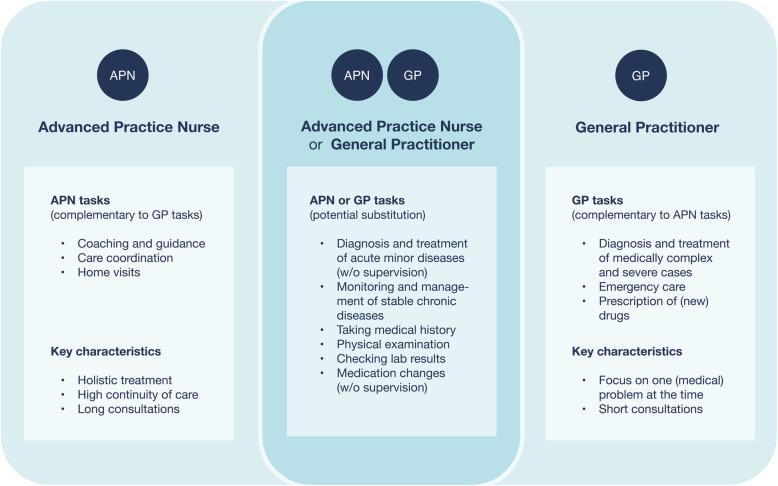
The analysis resulted in five themes: Despite the unfamiliarity, all patients were willing to be consulted by an APN because it was recommended by their GP (1); after several encounters, most participants perceived differences between the APN and the GP consultation in terms of the length and style of the consultations as well as the complexity of their tasks (2); the interviewees emphasised coaching, guidance, care coordination, and GP-assisting tasks as APN core competencies and attributed the characteristics , , and to the APN role (3); most patients especially valued home visits and the holistic approach of the APNs, but they also noticed that in certain cases GP supervision was required (4); and due to the close collaboration between the APN and the GP, patients felt safe, well cared for and experienced improvements in physical and psychological well-being as well as in daily activities (5).
CONCLUSION
Our results suggested that patients value the APNs' competencies, despite their initial lack of role knowledge. Trust in the GP seemed to be the most important factor for patients' receptiveness toward the APN role. Overall, patients perceived an added value due to the enlargement of the scope of practice offered by APNs. The patient perspective might provide valuable insights for further APN role implementation in Swiss family practices.
背景
鉴于全科医生短缺以及提高医疗服务质量的策略,许多国家已实施由高级实践护士(APN)参与的跨专业护理模式。国际证据表明,APN护理能带来较高的患者满意度。在瑞士,这一角色仍较新,患者的看法尚未得到研究。因此,我们的目的是探讨瑞士家庭医疗中患者对APN角色的体验。
方法
我们在四个不同的家庭医疗诊所对年龄在18至97岁之间、患有轻度急性病至多种慢性病且至少与一名APN进行过一次咨询的患者进行了22次半结构化访谈。所有访谈均进行录音,逐字转录,并采用定性内容分析法进行分析。
结果
分析得出五个主题:尽管不熟悉,但所有患者都愿意接受APN的咨询,因为这是他们的全科医生推荐的(1);经过几次接触后,大多数参与者认为APN咨询与全科医生咨询在咨询时长和风格以及任务复杂性方面存在差异(2);受访者强调指导、引导、护理协调和协助全科医生的任务是APN的核心能力,并将某些特征归因于APN角色(3);大多数患者特别重视家访和APN的整体护理方法,但他们也注意到在某些情况下需要全科医生的监督(4);由于APN与全科医生之间的密切合作,患者感到安全、得到了很好的照顾,并且在身心健康以及日常活动方面都有改善(5)。
结论
我们的结果表明,尽管患者最初对APN角色缺乏了解,但他们重视APN的能力。对全科医生的信任似乎是患者接受APN角色的最重要因素。总体而言,患者认为APN扩大的执业范围带来了附加价值。患者的看法可能为瑞士家庭医疗中进一步实施APN角色提供有价值的见解。
 Zotero 插件