
多种疾病并存与他汀类药物用于心血管疾病一级预防的处方:法国全科医疗的一项横断面研究
Multimorbidity and statin prescription for primary prevention of cardiovascular diseases: A cross-sectional study in general practice in France.
作者信息
Onaisi Racha, Dumont Roxane, Hasselgard-Rowe Jennifer, Safar David, Haller Dagmar M, Maisonneuve Hubert
机构信息
Department of General Practice, University of Bordeaux, Bordeaux, France.
Unit of Population Epidemiology, Division of Primary Care Medicine, Geneva University Hospitals, Geneva, Switzerland.
出版信息
Front Med (Lausanne). 2023 Jan 9;9:1089050. doi: 10.3389/fmed.2022.1089050. eCollection 2022.
BACKGROUND
Statins are a first line, evidence-based yet underprescribed treatment for cardiovascular primary prevention. In primary care settings, multimorbidity is a complex situation which makes it difficult to apply prevention guidelines.
AIM
To assess the associations between multimorbidity and prescription of statins in accordance with the 2016 ESC recommendations ("appropriate prescription"), and to identify the factors and conditions associated with these prescriptions.
DESIGN AND SETTING
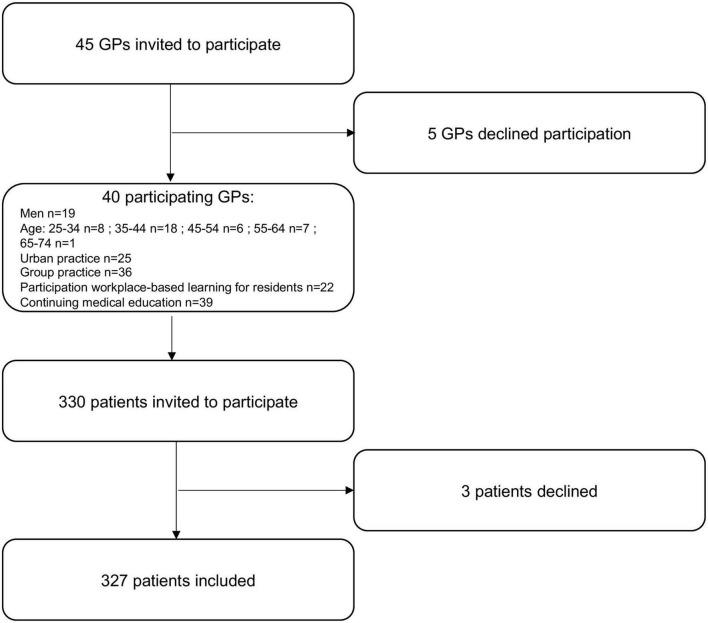
Cross-sectional prospective study in the French region of Rhône-Alpes among 40 general practitioners and their patients.
METHODS
We examined the association between appropriate statin prescription and several patient characteristics, including multimorbidity, using multivariate logistic regression models.
RESULTS
Between August 2017 and February 2019, 327 patients were included in the study. Seventy-four (22.6%) were on statin medication and 199 (60.9%) exhibited multimorbidity, defined as ≥2 diseases. Only 22.5% of eligible patients were prescribed statins for primary prevention. Diabetes was most strongly associated with appropriate statin prescription (aOR 8.10, CI 95: 3.81-17.80). Multimorbidity was not associated with appropriate statin prescription (aOR 1.31, CI 95: 0.54-3.26), except in the presence of diabetes which defined diabetic multimorbidity (aOR 10.46, CI 95: 4.87-23.35). Conversely, non-diabetic multimorbidity was associated with lower odds of being appropriately prescribed a statin (aOR 0.26, CI 95: 0.12-0.56).
CONCLUSION
Multimorbidity, in itself, does not seem to be a determinant factor for appropriate statin prescription. The latter appears to be determined by a patient's type of multimorbidity, especially the presence or not of diabetes. Differentiating between diabetic and non-diabetic multimorbidity may be a pragmatic way for GPs to improve primary prevention in a patient-centered and shared decision-making approach.
背景
他汀类药物是心血管疾病一级预防的一线循证治疗药物,但处方量不足。在基层医疗环境中,多病共存是一种复杂情况,使得预防指南难以应用。
目的
根据2016年欧洲心脏病学会(ESC)的建议(“适当处方”)评估多病共存与他汀类药物处方之间的关联,并确定与这些处方相关的因素和条件。
设计与背景
在法国罗纳-阿尔卑斯地区对40名全科医生及其患者进行的横断面前瞻性研究。
方法
我们使用多变量逻辑回归模型研究了适当的他汀类药物处方与包括多病共存在内的几个患者特征之间的关联。
结果
2017年8月至2019年2月期间,327名患者纳入研究。74名(22.6%)正在服用他汀类药物,199名(60.9%)表现出多病共存,定义为≥2种疾病。只有22.5%的符合条件的患者因一级预防而被处方他汀类药物。糖尿病与适当的他汀类药物处方关联最为密切(调整后比值比[aOR]8.10,95%置信区间[CI]:3.81-17.80)。多病共存与适当的他汀类药物处方无关(aOR 1.3l,95%CI:0.54-3.26),但存在糖尿病即糖尿病性多病共存的情况除外(aOR 10.46,95%CI:4.87-23.35)。相反,非糖尿病性多病共存与适当处方他汀类药物的几率较低相关(aOR 0.26,95%CI:0.12-0.56)。
结论
多病共存本身似乎不是适当他汀类药物处方的决定因素。后者似乎由患者的多病共存类型决定,尤其是是否存在糖尿病。区分糖尿病性和非糖尿病性多病共存可能是全科医生以患者为中心和采用共同决策方法改善一级预防的实用方法。
 Zotero 插件