
新冠病毒感染后免疫功能障碍,尤其是在重症患者中。
Immune dysfunction following COVID-19, especially in severe patients.
机构信息
Department of Emergency Medicine and Zhejiang Provincial Key Laboratory for Diagnosis and Treatment of Aging and Physic-Chemical Injury Diseases, The First Affiliated Hospital, School of Medicine, Zhejiang University, 79 Qingchun Road, Hangzhou, 310003, Zhejiang, People's Republic of China.
State Key Laboratory for Diagnosis and Treatment of Infectious Diseases, The First Affiliated Hospital, School of Medicine, Zhejiang University, 79 Qingchun Road, Hangzhou, 310003, Zhejiang, People's Republic of China.
出版信息
Sci Rep. 2020 Sep 28;10(1):15838. doi: 10.1038/s41598-020-72718-9.
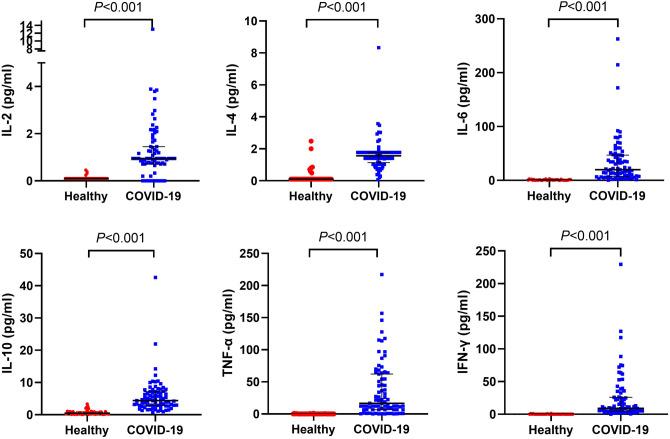
The coronavirus disease 2019 (COVID-19) has been spreading worldwide. Severe cases quickly progressed with unfavorable outcomes. We aim to investigate the clinical features of COVID-19 and identify the risk factors associated with its progression. Data of confirmed SARS-CoV-2-infected patients and healthy participants were collected. Thirty-seven healthy people and 79 confirmed patients, which include 48 severe patients and 31 mild patients, were recruited. COVID-19 patients presented with dysregulated immune response (decreased T, B, and NK cells and increased inflammatory cytokines). Also, they were found to have increased levels of white blood cell, neutrophil count, and D-dimer in severe cases. Moreover, lymphocyte, CD4 T cell, CD8 T cell, NK cell, and B cell counts were lower in the severe group. Multivariate logistic regression analysis showed that CD4 cell count, neutrophil-to-lymphocyte ratio (NLR) and D-dimer were risk factors for severe cases. Both CT score and clinical pulmonary infection score (CPIS) were associated with disease severity. The receiver operating characteristic (ROC) curve analysis has shown that all these parameters and scores had quite a high predictive value. Immune dysfunction plays critical roles in disease progression. Early and constant surveillance of complete blood cell count, T lymphocyte subsets, coagulation function, CT scan and CPIS was recommended for early screening of severe cases.
新型冠状病毒病 2019(COVID-19)正在全球范围内传播。重症病例迅速进展,预后不佳。我们旨在探讨 COVID-19 的临床特征,并确定与疾病进展相关的危险因素。收集了确诊的 SARS-CoV-2 感染患者和健康参与者的数据。共招募了 37 名健康人和 79 名确诊患者,其中包括 48 名重症患者和 31 名轻症患者。COVID-19 患者表现出免疫反应失调(T、B 和 NK 细胞减少,炎症细胞因子增加)。此外,在重症患者中发现白细胞、中性粒细胞计数和 D-二聚体水平升高。此外,重症组的淋巴细胞、CD4 T 细胞、CD8 T 细胞、NK 细胞和 B 细胞计数较低。多变量逻辑回归分析表明,CD4 细胞计数、中性粒细胞与淋巴细胞比值(NLR)和 D-二聚体是重症的危险因素。CT 评分和临床肺部感染评分(CPIS)均与疾病严重程度相关。受试者工作特征(ROC)曲线分析表明,所有这些参数和评分均具有较高的预测价值。免疫功能障碍在疾病进展中起关键作用。建议早期持续监测全血细胞计数、T 淋巴细胞亚群、凝血功能、CT 扫描和 CPIS,以早期筛查重症病例。




 Zotero 插件