
成骨细胞系细胞中的维生素 D 受体对于 1α,25(OH)2D3 的促分解代谢活性是必需的。
The Vitamin D Receptor in Osteoblast-Lineage Cells Is Essential for the Proresorptive Activity of 1α,25(OH)2D3 In Vivo.
机构信息
Graduate School of Oral Medicine, Matsumoto Dental University, Shiojiri, Nagano, Japan.
Department of Oral Histology, Matsumoto Dental University, Shiojiri, Nagano, Japan.
出版信息
Endocrinology. 2020 Nov 1;161(11). doi: 10.1210/endocr/bqaa178.
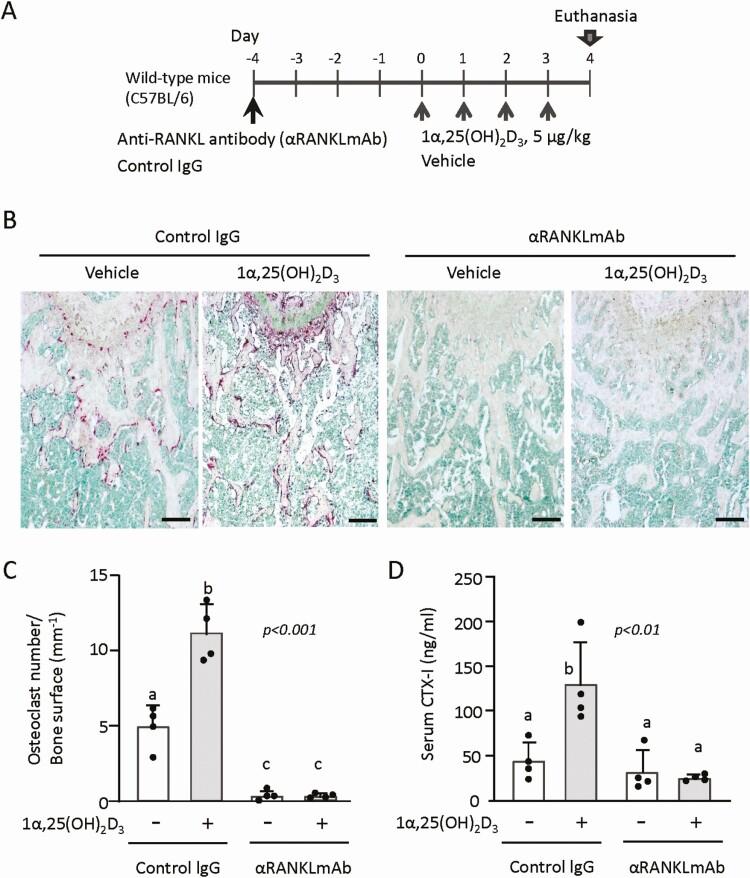
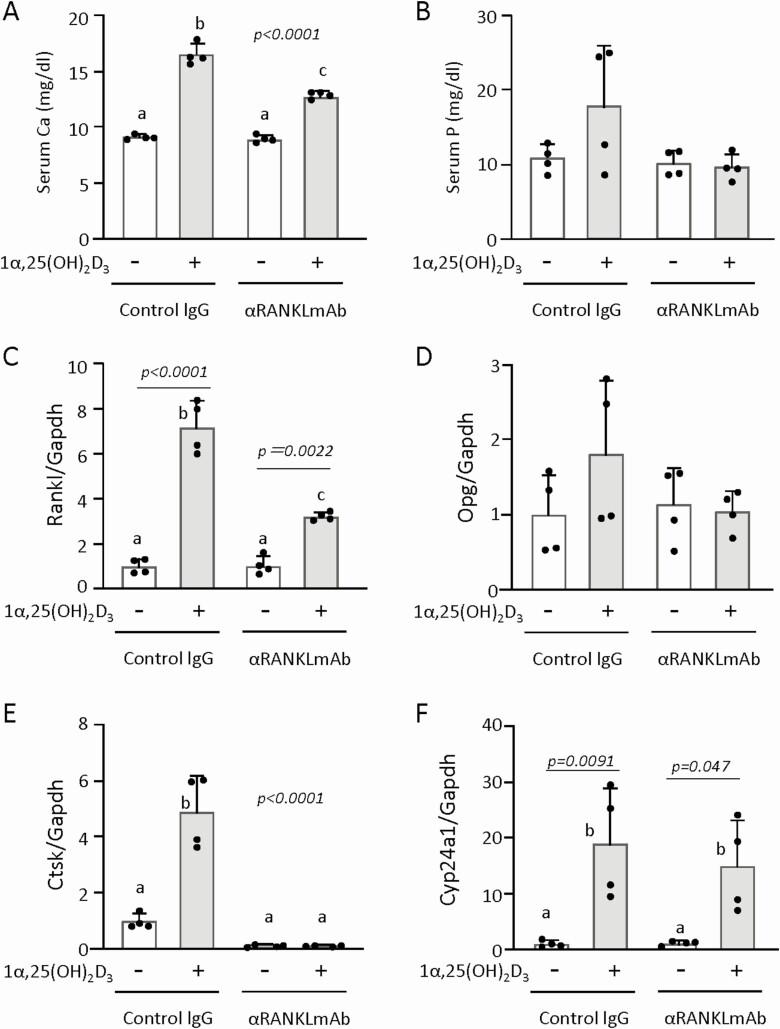
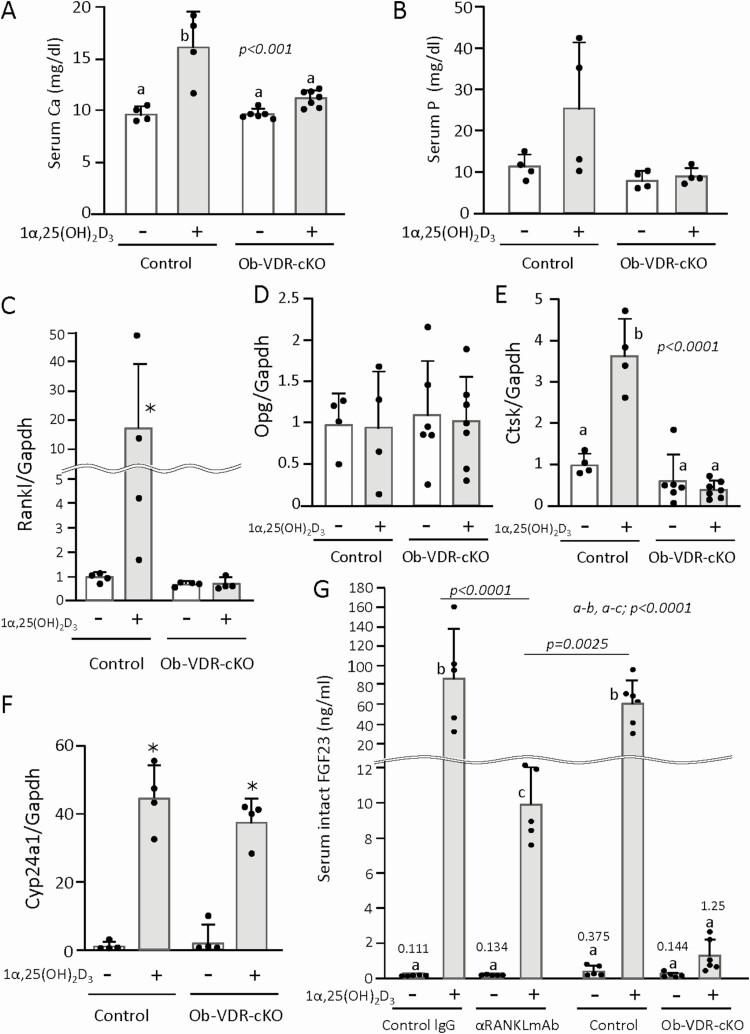
We previously reported that daily administration of a pharmacological dose of eldecalcitol, an analog of 1α,25-dihydroxyvitamin D3 [1α,25(OH)2D3], increased bone mass by suppressing bone resorption. These antiresorptive effects were found to be mediated by the vitamin D receptor (VDR) in osteoblast-lineage cells. Using osteoblast-lineage-specific VDR conditional knockout (Ob-VDR-cKO) mice, we examined whether proresorptive activity induced by the high-dose 1α,25(OH)2D3 was also mediated by VDR in osteoblast-lineage cells. Administration of 1α,25(OH)2D3 (5 μg/kg body weight/day) to wild-type mice for 4 days increased the number of osteoclasts in bone and serum concentrations of C-terminal crosslinked telopeptide of type I collagen (CTX-I, a bone resorption marker). The stimulation of bone resorption was concomitant with the increase in serum calcium (Ca) and fibroblast growth factor 23 (FGF23) levels, and decrease in body weight. This suggests that a toxic dose of 1α,25(OH)2D3 can induce bone resorption and hypercalcemia. In contrast, pretreatment of wild-type mice with neutralizing anti-receptor activator of NF-κB ligand (RANKL) antibody inhibited the 1α,25(OH)2D3-induced increase of osteoclast numbers in bone, and increase of CTX-I, Ca, and FGF23 levels in serum. The pretreatment with anti-RANKL antibody also inhibited the 1α,25(OH)2D3-induced decrease in body weight. Consistent with observations in mice conditioned with anti-RANKL antibody, the high-dose administration of 1α,25(OH)2D3 to Ob-VDR-cKO mice failed to significantly increase bone osteoclast numbers, serum CTX-I, Ca, or FGF23 levels, and failed to reduce the body weight. Taken together, this study demonstrated that the proresorptive, hypercalcemic, and toxic actions of high-dose 1α,25(OH)2D3 are mediated by VDR in osteoblast-lineage cells.
我们之前曾报道过,每日给予药理学剂量的依降钙素(1α,25-二羟维生素 D3 的类似物)可通过抑制骨吸收来增加骨量。这些抗吸收作用被发现是由成骨细胞系细胞中的维生素 D 受体(VDR)介导的。使用成骨细胞系特异性 VDR 条件性敲除(Ob-VDR-cKO)小鼠,我们检查了高剂量 1α,25-二羟维生素 D3 诱导的促吸收活性是否也通过成骨细胞系细胞中的 VDR 介导。给予野生型小鼠 1α,25-二羟维生素 D3(5 μg/kg 体重/天)4 天,可增加骨中破骨细胞的数量和血清Ⅰ型胶原 C 端交联肽(CTX-I,骨吸收标志物)的浓度。骨吸收的刺激伴随着血清钙(Ca)和成纤维细胞生长因子 23(FGF23)水平的升高和体重的减轻。这表明 1α,25-二羟维生素 D3 的毒性剂量可诱导骨吸收和高钙血症。相比之下,用中和性抗核因子-κB 配体受体激活剂(RANKL)抗体预处理野生型小鼠可抑制 1α,25-二羟维生素 D3 诱导的骨中破骨细胞数量增加,以及血清 CTX-I、Ca 和 FGF23 水平升高。用抗 RANKL 抗体预处理还可抑制 1α,25-二羟维生素 D3 诱导的体重减轻。与用抗 RANKL 抗体处理的小鼠观察结果一致,高剂量 1α,25-二羟维生素 D3 给予 Ob-VDR-cKO 小鼠不能显著增加骨中破骨细胞数量、血清 CTX-I、Ca 或 FGF23 水平,也不能降低体重。总之,本研究表明,高剂量 1α,25-二羟维生素 D3 的促吸收、高钙血症和毒性作用是由成骨细胞系细胞中的 VDR 介导的。




 Zotero 插件