
巴西的抑郁障碍:来自 2017 年全球疾病负担研究的结果。
Depressive disorders in Brazil: results from the Global Burden of Disease Study 2017.
机构信息
Faculdade de Medicina, Programa de Pós- Graduação em Saúde Pública, Universidade Federal de Minas Gerais, Belo Horizonte, MG, Brazil.
Departamento de Enfermagem Materno Infantil e Saúde Pública, Escola de Enfermagem, Universidade Federal de Minas Gerais, Belo Horizonte, MG, Brazil.
出版信息
Popul Health Metr. 2020 Sep 30;18(Suppl 1):6. doi: 10.1186/s12963-020-00204-5.
BACKGROUND
Depression is one of the major causes of disability worldwide. The objective of this study was to analyze the results of the Global Burden of Disease Study 2017 (GBD-2017) for depressive disorders in Brazil and its Federated Units (FUs) in 1990 and 2017.
METHODS
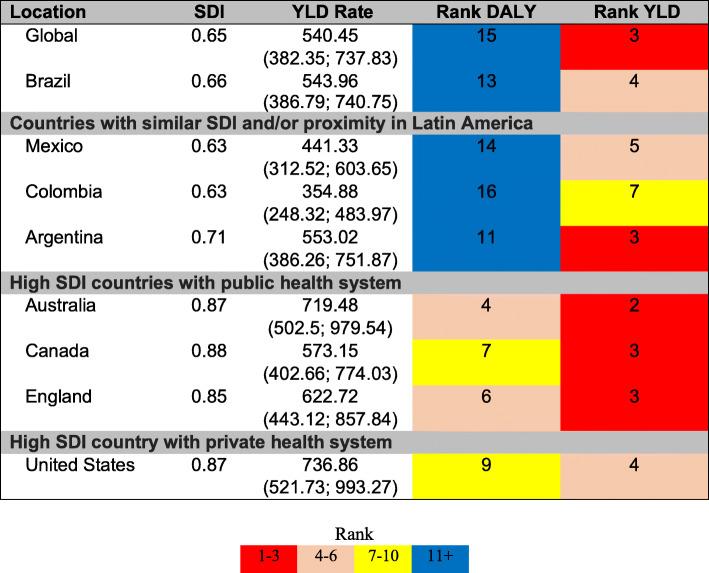
We used GBD-2017 study methodology to evaluate the prevalence estimates, the disability-adjusted life-year (DALY), and the years lived with disability (YLDs) for depressive disorders, which include major depressive disorder and dysthymia. The YLD estimates and the position of these disorders in the DALY and YLD rankings were compared to those of seven other countries. The observed versus expected YLD, based on the sociodemographic index (SDI), were compared.
RESULTS
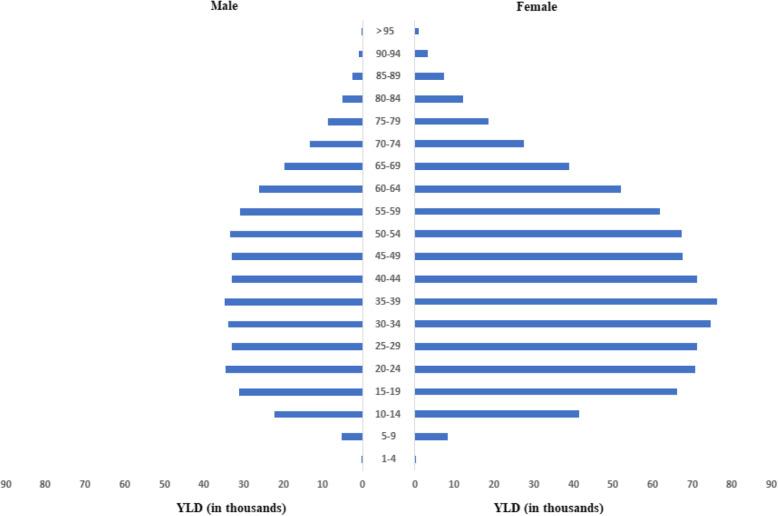
In GBD-2017, the prevalence of depressive disorders in Brazil was 3.30% (95% uncertainty interval [UI]: 3.08 to 3.57), ranging from 3.79% (3.53 to 4.09) in Santa Catarina to 2.78% in Pará (2.56 to 3.03), with significant differences between the Federated Units. From 1990 to 2017, there was an increase in number of YLD (55.19%, 49.57 to 60.73), but a decrease in the age-standardized rates (- 9.01%, - 11.66 to - 6.31). The highest proportion of YLD was observed in the age range of 15-64 years and among females. These disorders rank 4th and 13th as leading causes of YLD and DALY, respectively, in Brazil. In the other countries evaluated, the ranking of these disorders in the YLD classification was close to Brazil's, while in the DALY classification, there was higher variability. All countries had YLD rates similar to the overall rate. The observed/expected YLD ratio ranged from 0.81 in Pará to 1.16 in Santa Catarina. Morbidity of depressive disorders was not associated with SDI.
CONCLUSIONS
Depressive disorders have been responsible for a high disability burden since 1990, especially in adult women living in the Southern region of the country. The number of people affected by these disorders in the country tends to increase, requiring more investment in mental health aimed at advancements and quality of services. The epidemiological studies of these disorders throughout the national territory can contribute to this planning and to making the Brazilian health system more equitable.
背景
抑郁症是全球致残的主要原因之一。本研究旨在分析 2017 年全球疾病负担研究(GBD-2017)中巴西及其联邦单位(FU)1990 年和 2017 年抑郁障碍的结果。
方法
我们使用 GBD-2017 研究方法评估了抑郁障碍(包括重性抑郁障碍和心境恶劣障碍)的流行率估计值、残疾调整生命年(DALY)和伤残调整生命年(YLDs)。将 YLD 估计值和这些障碍在 DALY 和 YLD 排名中的位置与其他七个国家进行比较。根据社会人口指数(SDI)比较了观察到的与预期的 YLD 之间的差异。
结果
在 GBD-2017 中,巴西抑郁障碍的患病率为 3.30%(95%不确定区间[UI]:3.08 至 3.57),从圣卡塔琳娜州的 3.79%(3.53 至 4.09)到帕拉州的 2.78%(2.56 至 3.03)存在显著差异,各 FU 之间存在显著差异。1990 年至 2017 年,YLD 数量增加(55.19%,49.57 至 60.73),但年龄标准化率下降(-9.01%,-11.66 至-6.31)。YLD 比例最高的年龄段为 15-64 岁,女性居多。这些障碍在巴西分别位列 YLD 和 DALY 的第四位和第十三位。在评估的其他国家中,这些障碍在 YLD 分类中的排名与巴西相近,而在 DALY 分类中,差异更大。所有国家的 YLD 率与总体率相似。观察到的/预期 YLD 比值范围从帕拉州的 0.81 到圣卡塔琳娜州的 1.16。抑郁障碍的发病率与 SDI 无关。
结论
自 1990 年以来,抑郁障碍一直是一个主要的致残原因,特别是在该国南部地区的成年女性中。该国受这些障碍影响的人数呈上升趋势,需要更多投资于精神卫生,以提高服务质量和发展。在全国范围内开展这些障碍的流行病学研究有助于进行这种规划,并使巴西的卫生系统更加公平。


 Zotero 插件