
巴西国家以下各级别死亡登记完整性、成人死亡率和出生时预期寿命的比较分析。
Comparative analysis of completeness of death registration, adult mortality and life expectancy at birth in Brazil at the subnational level.
机构信息
Graduate Program in Demography, Universidade Federal de Minas Gerais, Av. Antonio Carlos, Belo Horizonte, 6627, Brazil.
Department of Demography and Actuarial Science, Universidade Federal do Rio Grande do Norte, Natal, Brazil.
出版信息
Popul Health Metr. 2020 Sep 30;18(Suppl 1):11. doi: 10.1186/s12963-020-00213-4.
BACKGROUND
Estimates of completeness of death registration are crucial to produce estimates of life tables and population projections and to estimate the burden of disease. They are an important step in assessing the quality of data. In the case of subnational data analysis in Brazil, it is important to consider spatial and temporal variation in the quality of mortality data. There are two main sources of data quality evaluation in Brazil, but there are few comparative studies and how they evolve over time. The aim of the paper is to compare and discuss alternative estimates of completeness of death registration, adult mortality (45q15) and life expectancy estimates produced by the National Statistics Office (IBGE), Institute for Health Metrics and Evaluation (IHME), and estimates presented in Queiroz et al. (2017) and Schmertmann and Gonzaga (2018), for 1980 and 2010.
METHODS
We provide a descriptive and comparative analysis of aforementioned estimates from four (4) sources of estimates at subnational level (26 states and one Federal District) in Brazil from two different points in time.
RESULTS
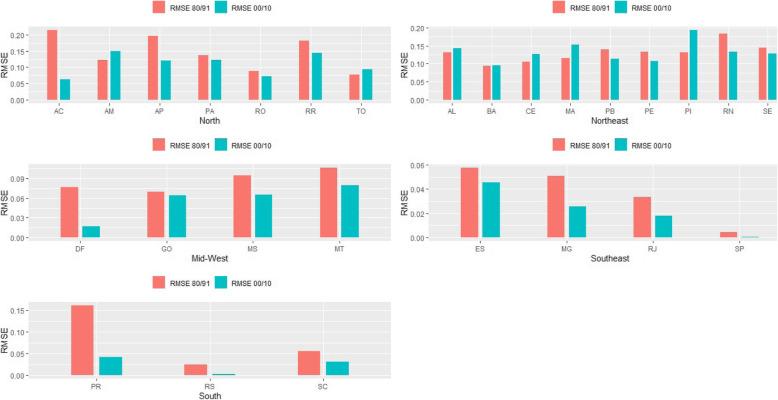
We found significant differences in estimates that affect both levels and trends of completeness of adult mortality in Brazil and states. IHME and Queiroz et al. (2017) estimates converge by 2010, but there are large differences when compared to estimates from the National Statistics Office (IBGE). Larger differences are observed for less developed states. We have showed that the quality of mortality data in Brazil has improved steadily overtime, but with large regional variations. However, we have observed that IBGE estimates show the lowest levels of completeness for the Northern of the country compared to other estimates. Choice of methods and approaches might lead to very unexpected results.
CONCLUSION
We produced a detailed comparative analysis of estimates of completeness of death registration from different sources and discuss the main results and possible explanations for these differences. We have also showed that new improved methods are still needed to study adult mortality in less developed countries and at a subnational level. More comparative studies are important in order to improve quality of estimates in Brazil.
背景
死亡登记完整性的估计对于生成生命表和人口预测以及估算疾病负担至关重要。它们是评估数据质量的重要步骤。在巴西的次国家级数据分析中,考虑死亡率数据质量的空间和时间变化非常重要。巴西有两个主要的数据质量评估来源,但很少有比较研究,也很少研究它们随时间的演变。本文的目的是比较和讨论国家统计局(IBGE)、健康计量与评估研究所(IHME)以及 Queiroz 等人(2017 年)和 Schmertmann 和 Gonzaga(2018 年)提出的替代方法来估计死亡登记完整性、成人死亡率(45q15)和预期寿命的估计值,这些方法适用于 1980 年和 2010 年巴西的次国家级数据。
方法
我们提供了一个描述性和比较性分析,比较了四个(4)来源的上述估计值,这些估计值适用于巴西的 26 个州和一个联邦区的次国家级水平,涵盖了两个不同的时间点。
结果
我们发现,这些估计值存在显著差异,影响了巴西和各州成人死亡率的完整性水平和趋势。到 2010 年,IHME 和 Queiroz 等人(2017 年)的估计值趋于一致,但与国家统计局(IBGE)的估计值相比存在较大差异。欠发达州的差异更大。我们已经表明,巴西的死亡率数据质量一直在稳步提高,但存在较大的地区差异。然而,我们发现,与其他估计值相比,IBGE 的估计值显示该国北部的死亡率完整性最低。方法和方法的选择可能会导致非常意外的结果。
结论
我们对来自不同来源的死亡登记完整性估计值进行了详细的比较分析,并讨论了这些差异的主要结果和可能的解释。我们还表明,仍需要新的改进方法来研究欠发达国家和次国家级的成人死亡率。更多的比较研究对于提高巴西的估计值质量非常重要。




 Zotero 插件