
对已发表的关于 COVID-19 感染病死率的研究数据的系统回顾和荟萃分析。
A systematic review and meta-analysis of published research data on COVID-19 infection fatality rates.
机构信息
Western Sydney Local Health District, Australia; University of Wollongong, Australia.
James Cook University, Australia; Tropical Public Health Service, Cairns, Australia.
出版信息
Int J Infect Dis. 2020 Dec;101:138-148. doi: 10.1016/j.ijid.2020.09.1464. Epub 2020 Sep 29.
UNLABELLED
An important unknown during the coronavirus disease-2019 (COVID-19) pandemic has been the infection fatality rate (IFR). This differs from the case fatality rate (CFR) as an estimate of the number of deaths and as a proportion of the total number of cases, including those who are mild and asymptomatic. While the CFR is extremely valuable for experts, IFR is increasingly being called for by policy makers and the lay public as an estimate of the overall mortality from COVID-19.
METHODS
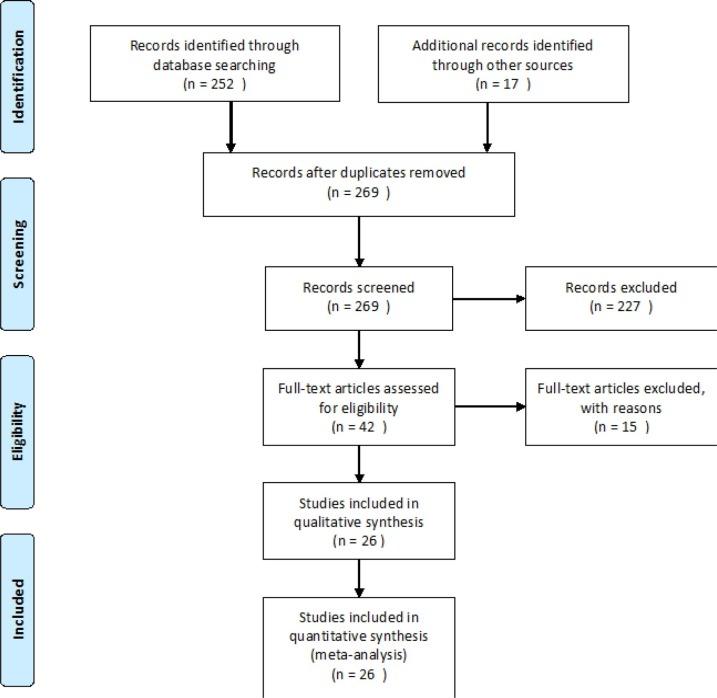
Pubmed, Medline, SSRN, and Medrxiv were searched using a set of terms and Boolean operators on 25/04/2020 and re-searched on 14/05/2020, 21/05/2020 and 16/06/2020. Articles were screened for inclusion by both authors. Meta-analysis was performed in Stata 15.1 by using the metan command, based on IFR and confidence intervals extracted from each study. Google/Google Scholar was used to assess the grey literature relating to government reports.
RESULTS
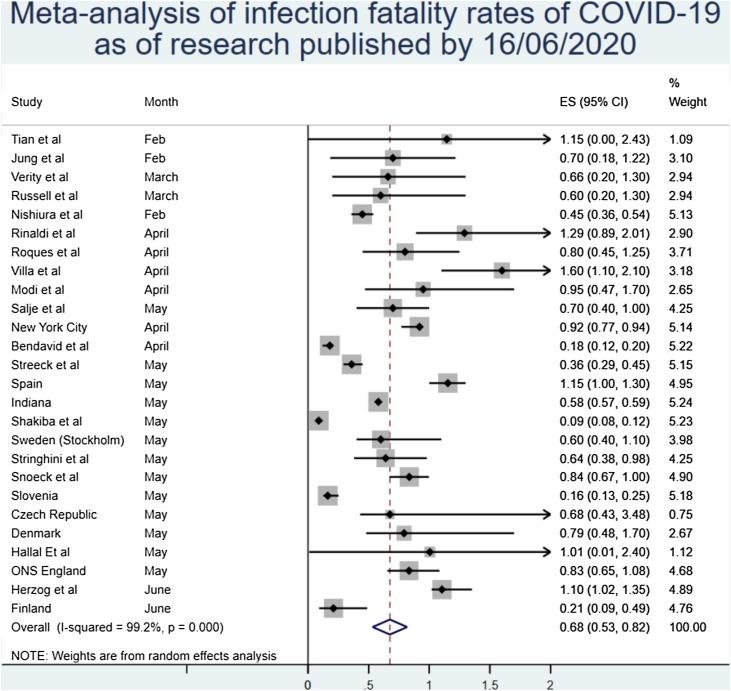
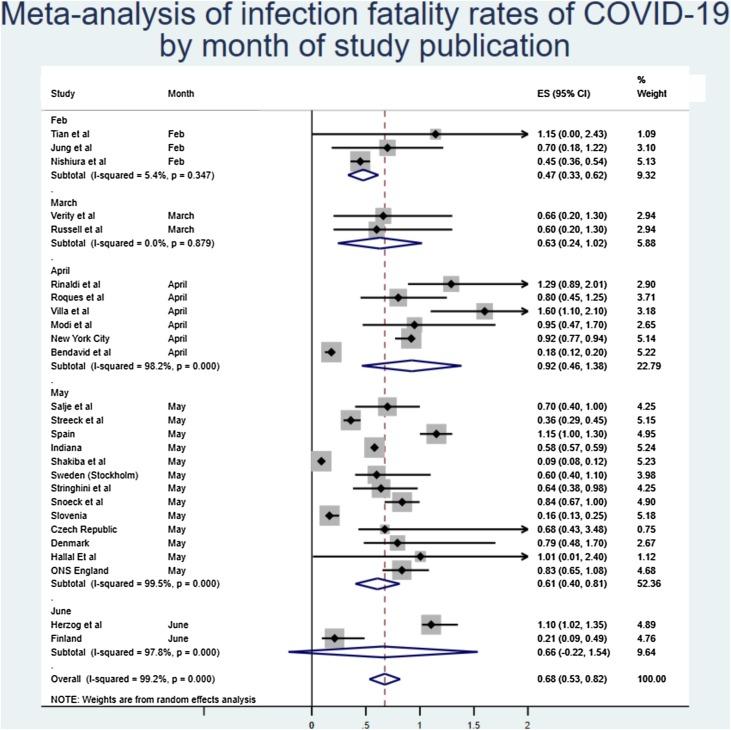
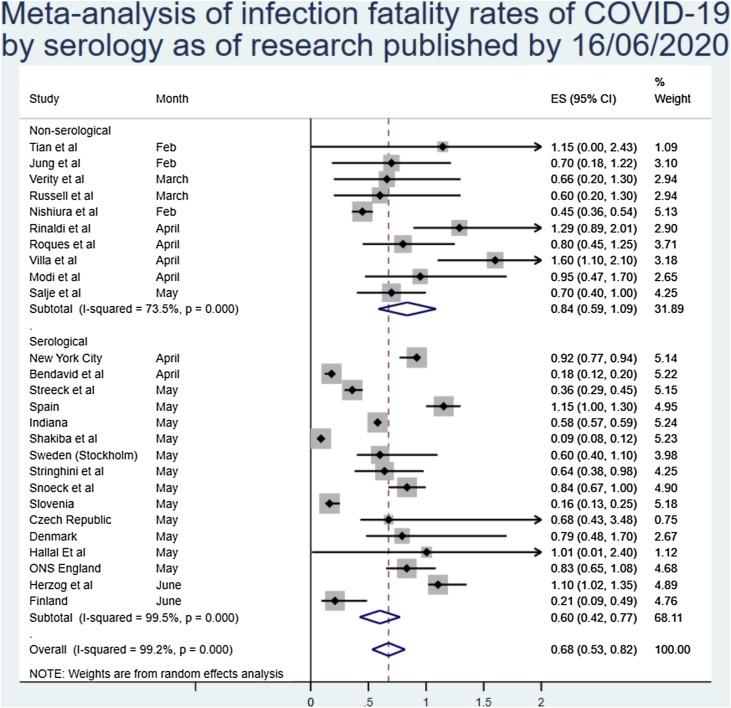
After exclusions, there were 24 estimates of IFR included in the final meta-analysis, from a wide range of countries, published between February and June 2020. The meta-analysis demonstrated a point estimate of IFR of 0.68% (0.53%-0.82%) with high heterogeneity (p < 0.001).
CONCLUSION
Based on a systematic review and meta-analysis of published evidence on COVID-19 until July 2020, the IFR of the disease across populations is 0.68% (0.53%-0.82%). However, due to very high heterogeneity in the meta-analysis, it is difficult to know if this represents a completely unbiased point estimate. It is likely that, due to age and perhaps underlying comorbidities in the population, different places will experience different IFRs due to the disease. Given issues with mortality recording, it is also likely that this represents an underestimate of the true IFR figure. More research looking at age-stratified IFR is urgently needed to inform policymaking on this front.
目的
在 2019 年冠状病毒病(COVID-19)大流行期间,一个重要的未知因素是感染病死率(IFR)。这与病死率(CFR)不同,CFR 是对死亡人数的估计,并作为包括轻症和无症状患者在内的总病例数的比例。虽然 CFR 对专家来说非常有价值,但 IFR 越来越多地被政策制定者和公众要求作为 COVID-19 总死亡率的估计。
方法
2020 年 4 月 25 日,使用一组术语和布尔运算符在 Pubmed、Medline、SSRN 和 Medrxiv 上进行了搜索,并于 2020 年 5 月 14 日、5 月 21 日和 6 月 16 日再次进行了搜索。两位作者对文章进行了筛选以纳入研究。使用 Stata 15.1 中的 metan 命令对 IFR 和从每项研究中提取的置信区间进行了荟萃分析。Google/Google Scholar 用于评估与政府报告相关的灰色文献。
结果
排除后,共有 24 项 IFR 估计值纳入最终荟萃分析,来自 2020 年 2 月至 6 月期间的多个国家。荟萃分析显示,疾病的 IFR 点估计值为 0.68%(0.53%-0.82%),异质性很高(p<0.001)。
结论
根据对截至 2020 年 7 月 COVID-19 已发表证据的系统回顾和荟萃分析,该疾病在人群中的 IFR 为 0.68%(0.53%-0.82%)。然而,由于荟萃分析中的高度异质性,很难知道这是否代表完全无偏的点估计。由于人口的年龄和潜在的合并症,不同的地方可能会因疾病而经历不同的 IFR。由于死亡记录存在问题,这也可能代表对真实 IFR 数字的低估。迫切需要开展更多研究,对 IFR 进行年龄分层,为这方面的政策制定提供信息。


 Zotero 插件