
德国超级传播事件中 SARS-CoV2 的感染病死率。
Infection fatality rate of SARS-CoV2 in a super-spreading event in Germany.
机构信息
Institute of Virology, University Hospital, University of Bonn, Bonn, Germany.
German Center for Infection Research (DZIF), Partner Site Bonn-Cologne, Braunschweig, Germany.
出版信息
Nat Commun. 2020 Nov 17;11(1):5829. doi: 10.1038/s41467-020-19509-y.
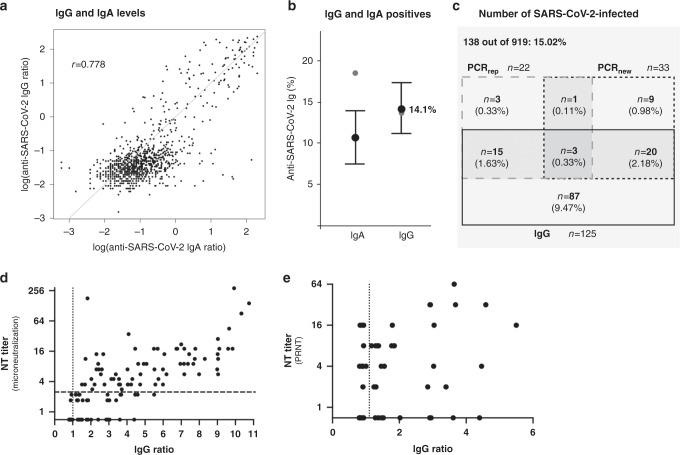
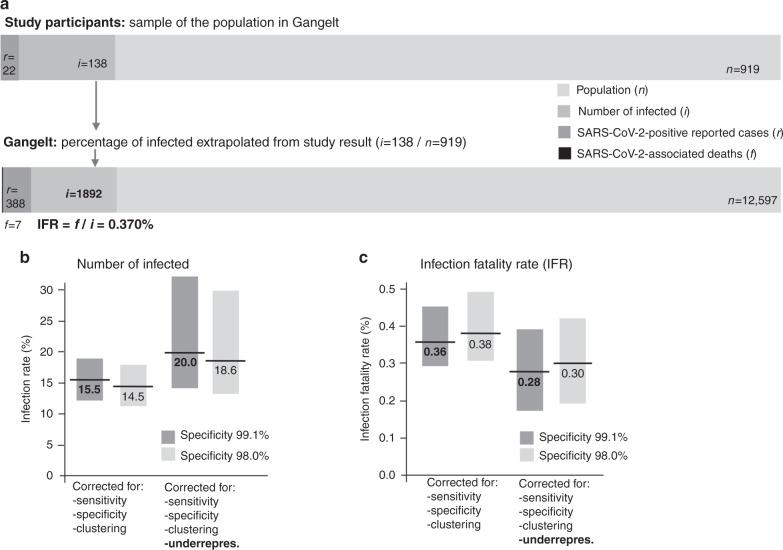
A SARS-CoV2 super-spreading event occurred during carnival in a small town in Germany. Due to the rapidly imposed lockdown and its relatively closed community, this town was seen as an ideal model to investigate the infection fatality rate (IFR). Here, a 7-day seroepidemiological observational study was performed to collect information and biomaterials from a random, household-based study population. The number of infections was determined by IgG analyses and PCR testing. We found that of the 919 individuals with evaluable infection status, 15.5% (95% CI:[12.3%; 19.0%]) were infected. This is a fivefold higher rate than the reported cases for this community (3.1%). 22.2% of all infected individuals were asymptomatic. The estimated IFR was 0.36% (95% CI:[0.29%; 0.45%]) for the community and 0.35% [0.28%; 0.45%] when age-standardized to the population of the community. Participation in carnival increased both infection rate (21.3% versus 9.5%, p < 0.001) and number of symptoms (estimated relative mean increase 1.6, p = 0.007). While the infection rate here is not representative for Germany, the IFR is useful to estimate the consequences of the pandemic in places with similar healthcare systems and population characteristics. Whether the super-spreading event not only increases the infection rate but also affects the IFR requires further investigation.
德国一小镇的狂欢节期间发生了一起严重急性呼吸综合征冠状病毒 2 型(SARS-CoV2)超级传播事件。由于迅速实施的封锁措施和相对封闭的社区,这个小镇被视为调查感染病死率(IFR)的理想模型。在这里,进行了一项为期 7 天的血清流行病学观察研究,以从随机的、基于家庭的研究人群中收集信息和生物材料。通过 IgG 分析和 PCR 检测确定感染人数。我们发现,在可评估感染状况的 919 人中,有 15.5%(95%CI:[12.3%;19.0%])感染。这是该社区报告病例的五倍(3.1%)。所有感染个体中有 22.2%为无症状感染。社区的估计 IFR 为 0.36%(95%CI:[0.29%;0.45%]),年龄标准化后为 0.35%[0.28%;0.45%]。参加狂欢节会增加感染率(21.3%比 9.5%,p<0.001)和症状数量(估计相对平均增加 1.6,p=0.007)。虽然这里的感染率不能代表德国的情况,但 IFR 有助于估计具有类似医疗体系和人口特征的地方的大流行后果。超级传播事件是否不仅增加了感染率,还影响了 IFR,这需要进一步调查。





 Zotero 插件