
角膜中与 COVID-19 相关的线粒体基因和 ACE2 的共表达。
Co-Expression of Mitochondrial Genes and ACE2 in Cornea Involved in COVID-19.
机构信息
School of Ophthalmology & Optometry and Eye Hospital, Wenzhou Medical University, Wenzhou, China.
National Clinical Research Center for Ocular Disease, Wenzhou, China.
出版信息
Invest Ophthalmol Vis Sci. 2020 Oct 1;61(12):13. doi: 10.1167/iovs.61.12.13.
PURPOSE
The coronavirus disease 2019 (COVID-19) pandemic severely challenges public health and necessitates the need for increasing our understanding of COVID-19 pathogenesis, especially host factors facilitating virus infection and propagation. The aim of this study was to investigate key factors for cellular susceptibility to severe acute respiratory syndrome-coronavirus 2 (SARS-CoV-2) infection in the ocular surface cells.
METHODS
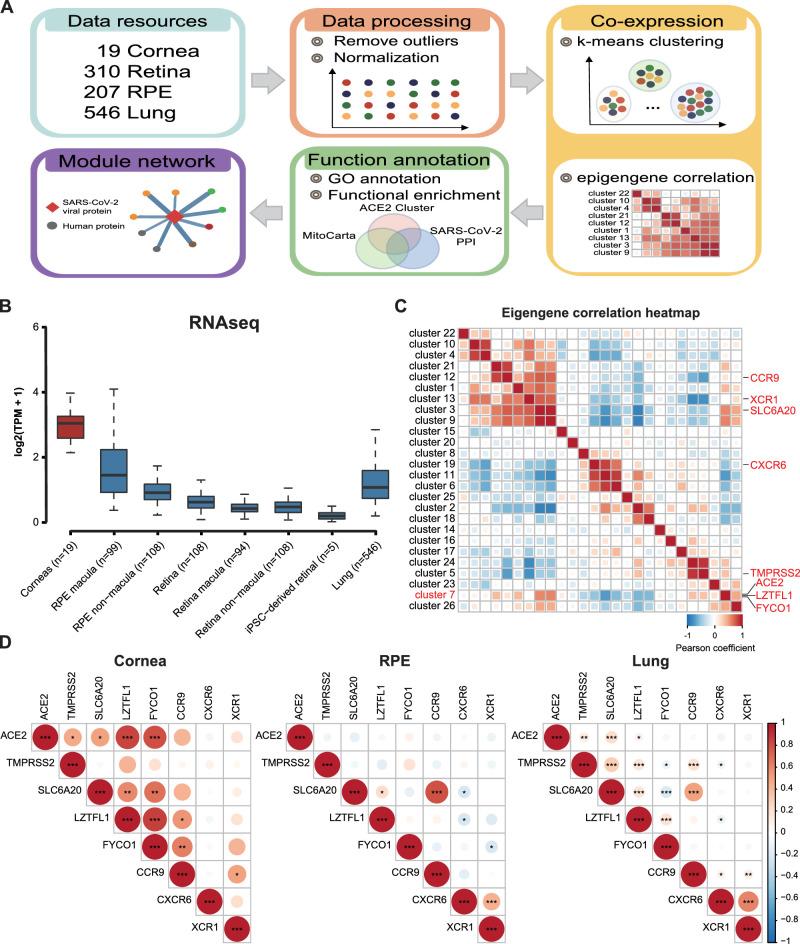
We combined co-expression and SARS-CoV-2 interactome network to predict key genes at COVID-19 in ocular infection based on the premise that genes underlying a disease are often functionally related and functionally related genes are often co-expressed.
RESULTS
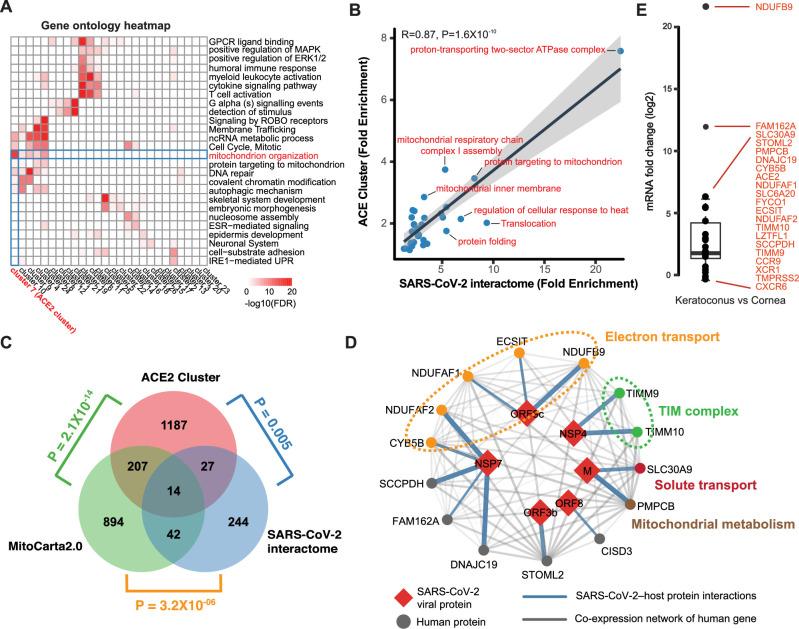
The co-expression network was constructed by mapping the well-known angiotensin converting enzyme (ACE2), TMPRSS2, and host susceptibility genes implicated in COVID-19 genomewide association study (GWAS) onto a cornea, retinal pigment epithelium, and lung. We found a significant co-expression module of these genes in the cornea, revealing that cornea is potential extra-respiratory entry portal of SARS-CoV-2. Strikingly, both co-expression and interaction networks show a significant enrichment in mitochondrial function, which are the hub of cellular oxidative homeostasis, inflammation, and innate immune response. We identified a corneal mitochondrial susceptibility module (CMSM) of 14 mitochondrial genes by integrating ACE2 co-expression cluster and SARS-CoV-2 interactome. The gene ECSIT, as a cytosolic adaptor protein involved in inflammatory responses, exhibits the strongest correlation with ACE2 in CMSM, which has shown to be an important risk factor for SARS-CoV-2 infection and prognosis.
CONCLUSIONS
Our co-expression and protein interaction network analysis uncover that the mitochondrial function related genes in cornea contribute to the dissection of COVID-19 susceptibility and potential therapeutic interventions.
目的
2019 年冠状病毒病(COVID-19)大流行严重挑战公共卫生,需要提高我们对 COVID-19 发病机制的认识,尤其是宿主因素促进病毒感染和传播。本研究旨在研究眼表细胞中严重急性呼吸综合征冠状病毒 2(SARS-CoV-2)感染的细胞易感性的关键因素。
方法
我们结合共表达和 SARS-CoV-2 相互作用网络,根据疾病的基础基因通常是功能相关的,功能相关的基因通常是共表达的前提,预测眼感染 COVID-19 的关键基因。
结果
共表达网络是通过将已知的血管紧张素转换酶(ACE2)、TMPRSS2 和宿主易感性基因映射到角膜、视网膜色素上皮和肺,构建 COVID-19 全基因组关联研究(GWAS)中的 SARS-CoV-2。我们发现这些基因在角膜中有一个显著的共表达模块,表明角膜是 SARS-CoV-2 的潜在的非呼吸进入门户。引人注目的是,共表达和相互作用网络都显示出对线粒体功能的显著富集,线粒体功能是细胞氧化还原稳态、炎症和先天免疫反应的核心。我们通过整合 ACE2 共表达簇和 SARS-CoV-2 相互作用网络,鉴定出 14 个线粒体基因的角膜线粒体易感性模块(CMSM)。细胞溶质衔接蛋白 ECSIT 参与炎症反应,在 CMSM 中与 ACE2 表现出最强的相关性,这表明它是 SARS-CoV-2 感染和预后的重要危险因素。
结论
我们的共表达和蛋白质相互作用网络分析揭示了角膜中线粒体功能相关基因有助于解析 COVID-19 的易感性和潜在的治疗干预。
 Zotero 插件