
托珠单抗用于机械通气的2019冠状病毒病患者后的临床结局
Clinical Outcomes Following Tocilizumab Administration in Mechanically Ventilated Coronavirus Disease 2019 Patients.
作者信息
Sirimaturos Michael, Gotur Deepa B, Patel Samir J, Dreucean Diane, Jakowenko Nicholas, Cooper Megan H, Brahmbhatt Nishal, Graviss Edward A, Nguyen Duc T, Pingali Sai Ravi, Lin Jiejian, Musick William L
机构信息
Department of Pharmacy, Houston Methodist Hospital, Houston, TX.
Department of Medicine, Houston Methodist Hospital, Houston, TX.
出版信息
Crit Care Explor. 2020 Oct 1;2(10):e0232. doi: 10.1097/CCE.0000000000000232. eCollection 2020 Oct.
UNLABELLED
Effective treatments for the critically ill patient with novel coronavirus disease 2019 are desperately needed. Given the role of cytokine release syndrome in the pathogenesis of coronavirus disease 2019-associated respiratory distress, therapies aimed at mitigating cytokine release, such as the interleukin-6 receptor-inhibiting monoclonal antibody tocilizumab, represent potential treatment strategies. Therefore, we examined the outcomes of critically ill coronavirus disease 2019 patients treated with tocilizumab and factors associated with clinical improvement.
DESIGN
A retrospective cohort analysis of 21-day outcomes for consecutive mechanically ventilated patients treated with tocilizumab from March 24, 2020, to May 4, 2020.
SETTING
Nine ICUs at six hospitals within a hospital system in Houston, Texas, United States.
PATIENTS
The first 62 coronavirus disease 2019 patients on invasive mechanical ventilation who were treated with tocilizumab, which was considered for all patients with severe disease.
INTERVENTIONS
Tocilizumab was administered either at a weight-based dose of 4-8 mg/kg or at a flat dose of 400 mg, with repeat administration in some patients at the physician's discretion.
MEASUREMENTS AND MAIN RESULTS
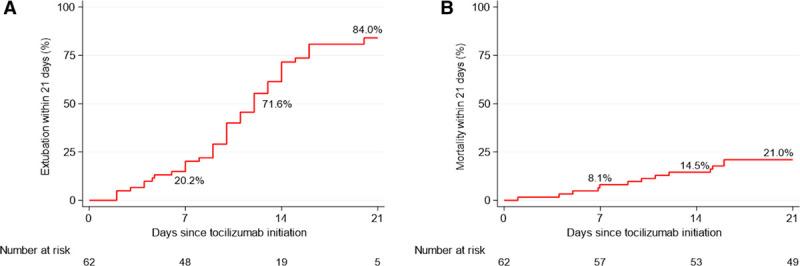
The primary outcomes were mortality and clinical improvement, defined as extubation. By day 21 post-tocilizumab, clinical improvement occurred in 36 patients (58%) and 13 patients (21%) died. In both univariable and multivariable analyses, age less than 60 years was associated with clinical improvement. Transient transaminitis was the most common adverse reaction, occurring in 25 patients (40%).
CONCLUSIONS
Based on clinical outcomes and mortality rates seen in previous reports of mechanically ventilated patients, tocilizumab, as part of the management strategy for severe coronavirus disease 2019, represents a promising option. These findings support the need for evaluation of tocilizumab in a randomized controlled trial.
未标注
目前迫切需要针对新型冠状病毒肺炎危重症患者的有效治疗方法。鉴于细胞因子释放综合征在新型冠状病毒肺炎相关呼吸窘迫发病机制中的作用,旨在减轻细胞因子释放的疗法,如抑制白细胞介素-6受体的单克隆抗体托珠单抗,代表了潜在的治疗策略。因此,我们研究了接受托珠单抗治疗的新型冠状病毒肺炎危重症患者的预后以及与临床改善相关的因素。
设计
对2020年3月24日至2020年5月4日连续接受托珠单抗治疗的机械通气患者的21天预后进行回顾性队列分析。
地点
美国得克萨斯州休斯顿一个医院系统内六家医院的九个重症监护病房。
患者
首批62例接受有创机械通气且接受托珠单抗治疗的新型冠状病毒肺炎患者,所有重症患者均考虑使用该药物。
干预措施
托珠单抗以基于体重的4 - 8mg/kg剂量或400mg固定剂量给药,部分患者由医生酌情决定重复给药。
测量指标和主要结果
主要结局指标为死亡率和临床改善情况,临床改善定义为拔管。至托珠单抗治疗后第21天,36例患者(58%)实现临床改善,13例患者(21%)死亡。在单变量和多变量分析中,年龄小于60岁与临床改善相关。短暂性转氨酶升高是最常见的不良反应,25例患者(40%)出现该情况。
结论
基于既往机械通气患者报告中的临床结局和死亡率,托珠单抗作为重症新型冠状病毒肺炎管理策略的一部分,是一个有前景的选择。这些发现支持在随机对照试验中对托珠单抗进行评估的必要性。

 Zotero 插件