
204 个国家和地区 1990-2019 年 369 种疾病和伤害导致的全球负担:2019 年全球疾病负担研究的系统分析。
Global burden of 369 diseases and injuries in 204 countries and territories, 1990-2019: a systematic analysis for the Global Burden of Disease Study 2019.
出版信息
Lancet. 2020 Oct 17;396(10258):1204-1222. doi: 10.1016/S0140-6736(20)30925-9.
BACKGROUND
In an era of shifting global agendas and expanded emphasis on non-communicable diseases and injuries along with communicable diseases, sound evidence on trends by cause at the national level is essential. The Global Burden of Diseases, Injuries, and Risk Factors Study (GBD) provides a systematic scientific assessment of published, publicly available, and contributed data on incidence, prevalence, and mortality for a mutually exclusive and collectively exhaustive list of diseases and injuries.
METHODS
GBD estimates incidence, prevalence, mortality, years of life lost (YLLs), years lived with disability (YLDs), and disability-adjusted life-years (DALYs) due to 369 diseases and injuries, for two sexes, and for 204 countries and territories. Input data were extracted from censuses, household surveys, civil registration and vital statistics, disease registries, health service use, air pollution monitors, satellite imaging, disease notifications, and other sources. Cause-specific death rates and cause fractions were calculated using the Cause of Death Ensemble model and spatiotemporal Gaussian process regression. Cause-specific deaths were adjusted to match the total all-cause deaths calculated as part of the GBD population, fertility, and mortality estimates. Deaths were multiplied by standard life expectancy at each age to calculate YLLs. A Bayesian meta-regression modelling tool, DisMod-MR 2.1, was used to ensure consistency between incidence, prevalence, remission, excess mortality, and cause-specific mortality for most causes. Prevalence estimates were multiplied by disability weights for mutually exclusive sequelae of diseases and injuries to calculate YLDs. We considered results in the context of the Socio-demographic Index (SDI), a composite indicator of income per capita, years of schooling, and fertility rate in females younger than 25 years. Uncertainty intervals (UIs) were generated for every metric using the 25th and 975th ordered 1000 draw values of the posterior distribution.
FINDINGS
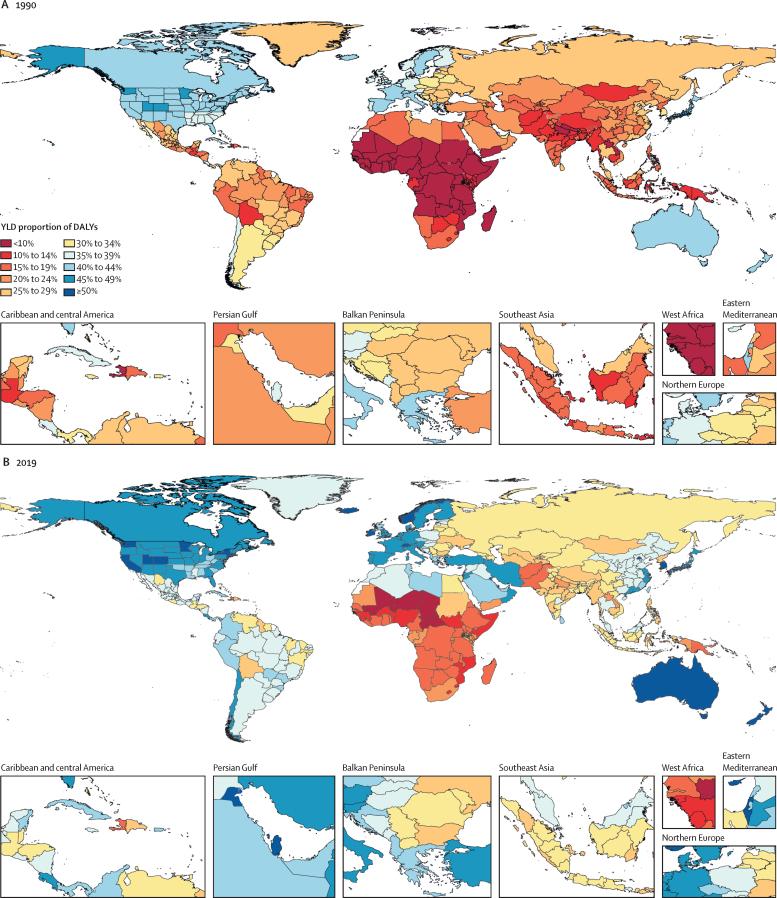
Global health has steadily improved over the past 30 years as measured by age-standardised DALY rates. After taking into account population growth and ageing, the absolute number of DALYs has remained stable. Since 2010, the pace of decline in global age-standardised DALY rates has accelerated in age groups younger than 50 years compared with the 1990-2010 time period, with the greatest annualised rate of decline occurring in the 0-9-year age group. Six infectious diseases were among the top ten causes of DALYs in children younger than 10 years in 2019: lower respiratory infections (ranked second), diarrhoeal diseases (third), malaria (fifth), meningitis (sixth), whooping cough (ninth), and sexually transmitted infections (which, in this age group, is fully accounted for by congenital syphilis; ranked tenth). In adolescents aged 10-24 years, three injury causes were among the top causes of DALYs: road injuries (ranked first), self-harm (third), and interpersonal violence (fifth). Five of the causes that were in the top ten for ages 10-24 years were also in the top ten in the 25-49-year age group: road injuries (ranked first), HIV/AIDS (second), low back pain (fourth), headache disorders (fifth), and depressive disorders (sixth). In 2019, ischaemic heart disease and stroke were the top-ranked causes of DALYs in both the 50-74-year and 75-years-and-older age groups. Since 1990, there has been a marked shift towards a greater proportion of burden due to YLDs from non-communicable diseases and injuries. In 2019, there were 11 countries where non-communicable disease and injury YLDs constituted more than half of all disease burden. Decreases in age-standardised DALY rates have accelerated over the past decade in countries at the lower end of the SDI range, while improvements have started to stagnate or even reverse in countries with higher SDI.
INTERPRETATION
As disability becomes an increasingly large component of disease burden and a larger component of health expenditure, greater research and development investment is needed to identify new, more effective intervention strategies. With a rapidly ageing global population, the demands on health services to deal with disabling outcomes, which increase with age, will require policy makers to anticipate these changes. The mix of universal and more geographically specific influences on health reinforces the need for regular reporting on population health in detail and by underlying cause to help decision makers to identify success stories of disease control to emulate, as well as opportunities to improve.
FUNDING
Bill & Melinda Gates Foundation.
背景
在全球议程转变、非传染性疾病和伤害以及传染病受到更多关注的时代,国家一级关于病因趋势的可靠证据至关重要。全球疾病、伤害和危险因素研究(GBD)系统地评估了已发表的、公开的和提供的数据,这些数据涉及疾病和伤害的发病率、患病率和死亡率,以及相互排斥和完全穷尽的疾病和伤害清单。
方法
GBD 估算了 369 种疾病和伤害在 204 个国家和地区的性别和年龄别发病率、患病率、死亡率、寿命损失年数(YLLs)、残疾生活年数(YLDs)和伤残调整生命年(DALYs)。输入数据来自人口普查、家庭调查、民事登记和生命统计、疾病登记、卫生服务使用、空气污染监测器、卫星成像、疾病报告和其他来源。使用死因综合模型和时空高斯过程回归计算特定病因死亡率和病因分数。通过与 GBD 人口、生育率和死亡率估计相匹配的方式,对特定病因死亡进行调整。将死亡人数乘以每个年龄的标准预期寿命,以计算 YLLs。使用贝叶斯元回归建模工具 DisMod-MR 2.1 确保了大多数病因的发病率、患病率、缓解率、超额死亡率和特定病因死亡率之间的一致性。将疾病和伤害的相互排斥的后遗症的患病率乘以残疾权重,以计算 YLDs。我们在社会人口指数(SDI)的背景下考虑了结果,SDI 是一个综合指标,包含人均收入、受教育年限和 25 岁以下女性的生育率。使用后验分布的第 25 和第 975 个有序的 1000 个抽取值生成每个指标的不确定性区间(UI)。
结果
过去 30 年来,衡量全球卫生状况的年龄标准化 DALY 率稳步提高。考虑到人口增长和老龄化因素后,DALY 的绝对数量保持稳定。自 2010 年以来,50 岁以下年龄组的全球年龄标准化 DALY 率下降速度加快,与 1990-2010 年期间相比,0-9 岁年龄组的年下降率最高。2019 年,在 10 岁以下儿童中,六种传染病是 DALY 的十大原因之一:下呼吸道感染(排名第二)、腹泻病(第三)、疟疾(第五)、脑膜炎(第六)、百日咳(第九)和性传播感染(在这个年龄组中,完全由先天梅毒构成;排名第十)。在 10-24 岁的青少年中,三种伤害原因是 DALY 的主要原因:道路伤害(排名第一)、自我伤害(第三)和人际暴力(第五)。在 10-24 岁人群中排名前十的五个原因也是 25-49 岁人群中排名前十的原因:道路伤害(排名第一)、艾滋病毒/艾滋病(第二)、下腰痛(第四)、头痛障碍(第五)和抑郁障碍(第六)。2019 年,缺血性心脏病和中风是 50-74 岁和 75 岁及以上年龄组 DALY 的头号原因。自 1990 年以来,非传染性疾病和伤害导致的 YLDs 占疾病总负担的比例显著增加。2019 年,有 11 个国家的非传染性疾病和伤害导致的 YLDs 占所有疾病负担的一半以上。在 SDI 低端国家,年龄标准化 DALY 率在过去十年中加速下降,而在 SDI 较高的国家,改善已经开始停滞甚至逆转。
解释
随着残疾成为疾病负担越来越大的组成部分,以及医疗支出的更大组成部分,需要更多的研发投资来确定新的、更有效的干预策略。随着全球人口老龄化的加速,应对残疾后果的卫生服务需求(随着年龄的增长而增加)将要求政策制定者预测这些变化。普遍存在的和更具地域特色的健康影响的混合,强化了定期详细报告人口健康状况和潜在病因的必要性,以帮助决策者确定值得效仿的疾病控制成功案例,并寻找改进的机会。
资金来源
比尔和梅琳达·盖茨基金会。


 Zotero 插件