
新冠疫情:考虑衰老和虚弱因素,最大化未来疫苗接种治疗效果
Covid-19 Pandemic: Maximizing Future Vaccination Treatments Considering Aging and Frailty.
作者信息
Palermo Sara
机构信息
Department of Psychology, University of Turin, Turin, Italy.
European Innovation Partnership on Active and Healthy Aging, Bruxelles, Belgium.
出版信息
Front Med (Lausanne). 2020 Sep 18;7:558835. doi: 10.3389/fmed.2020.558835. eCollection 2020.
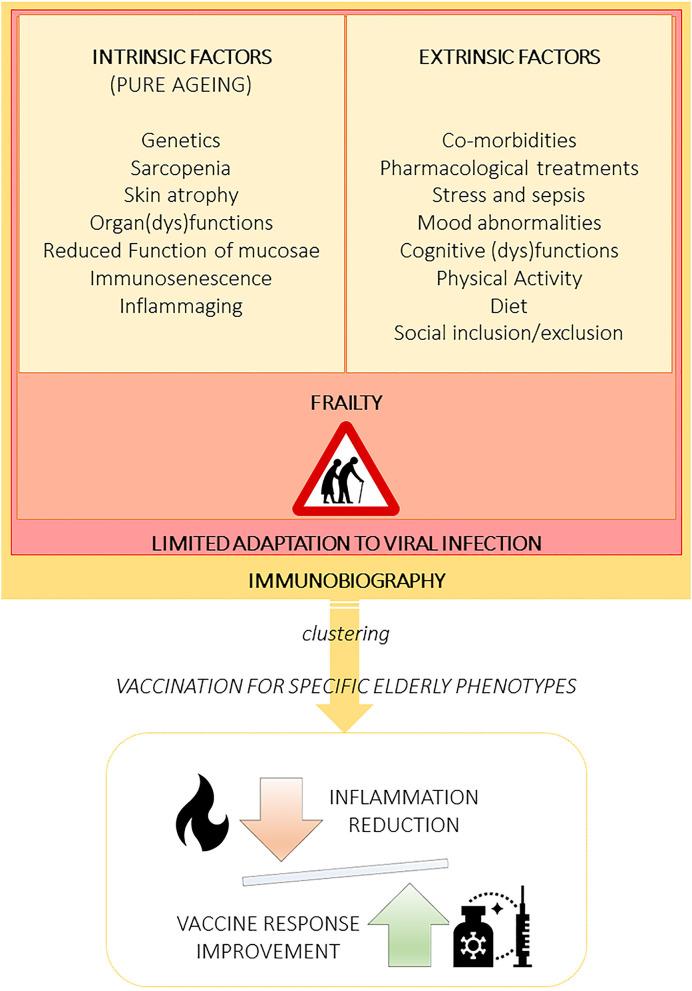
The COVID-19 pandemic is proving to be a multiplier of inequalities. Especially toward the elderly population. A voiceless scream that comes from geriatrics, nursing homes, hospices from all over Italy. They call it the silent massacre: from North to South, the bulletin of coronavirus positive-or already deceased-elderly people continues to grow exponentially without a chance to counter it. Population aging and chronicity are a question that needs to be addressed. Frailty is the most challenging expression of population aging, with major consequences for public health and clinical practice. It is a geriatric syndrome which consists in a state of higher vulnerability to stressors attributed to a lower homeostatic reserve due to an age-related multisystem physiological change. People over 60, and especially over 80, are particularly vulnerable to severe or fatal infection. Moreover, the age-related dysregulation of the immune system in the elderly (i.e., immunosenescence and inflammaging) results in poorer responses to vaccination. Physical frailty is an effective health indicator and it has previously shown to predict the response to the seasonal flu vaccine. These findings suggest that assessing frailty in the elderly may identify those who are less likely to respond to immunization and be at higher risk for COVID-19 and its complications. Moreover, cognitive frailty and neurocognitive disorders, mental health and reduced awareness of illness negatively impact on adherence to complex medication regimens among elderly patients. A worldwide research and development blueprint have been initiated to accelerate the development of vaccines and therapeutics for the COVID-19 outbreak. Considered the above, I suggest the importance to consider aging in thinking about future Civud-19 vaccination and treatment, focusing on the possible impact of physical and cognitive frailty.
事实证明,新冠疫情加剧了不平等现象。尤其是对老年人群体而言。这是来自意大利各地老年医学机构、养老院、临终关怀机构无声的呐喊。他们称之为“无声的大屠杀”:从北到南,新冠病毒检测呈阳性或已死亡的老年人名单呈指数级增长,却无力应对。人口老龄化和慢性病问题亟待解决。衰弱是人口老龄化最具挑战性的表现形式,对公共卫生和临床实践产生重大影响。它是一种老年综合征,由于与年龄相关的多系统生理变化导致体内稳态储备降低,从而使个体对压力源的易感性更高。60岁以上的人,尤其是80岁以上的人,特别容易受到严重或致命感染。此外,老年人免疫系统与年龄相关的失调(即免疫衰老和炎症衰老)导致对疫苗接种的反应较差。身体衰弱是一种有效的健康指标,此前已证明它可以预测对季节性流感疫苗的反应。这些发现表明,评估老年人的衰弱程度可能有助于识别那些对免疫接种反应较差、感染新冠病毒及其并发症风险较高的人群。此外,认知衰弱和神经认知障碍、心理健康以及对疾病认识的降低,都会对老年患者坚持复杂药物治疗方案产生负面影响。为加速针对新冠疫情的疫苗和治疗方法的研发,已启动了一项全球研发蓝图。考虑到上述情况,我认为在思考未来新冠疫苗接种和治疗时,考虑老龄化问题很重要,应关注身体和认知衰弱可能产生的影响。

 Zotero 插件