
干细胞治疗早期股骨头坏死的疗效和安全性:系统评价和随机对照试验的荟萃分析。
Efficacy and safety of stem cell therapy for the early-stage osteonecrosis of femoral head: a systematic review and meta-analysis of randomized controlled trials.
机构信息
Affiliated Hospital of Jiangsu University, Jiefang Road No.438, Zhenjiang, 212001, Jiangsu, China.
School of Medicine, Jiangsu University, Zhenjiang, Jiangsu, China.
出版信息
Stem Cell Res Ther. 2020 Oct 19;11(1):445. doi: 10.1186/s13287-020-01956-5.
BACKGROUND
Osteonecrosis of femoral head (ONFH) is a seriously degenerative disease with no effective therapies to slow its progression. Several studies have reported short-term efficacy of stem cells on early-stage ONFH. However, its long-term effect was still unclear especially on progression events. This study was performed to evaluate the long-term efficacy and safety of stem cells and analyze its optimal age group and cell number.
METHODS
Our review was registered on PROSPERO ( http://www.crd.york.ac.uk/PROSPERO ), registration number CRD42020136094. Following PRISMA guideline, we searched 8 electronic databases on January 5, 2020, and rigorous random controlled trials (RCTs) utilizing stem cell therapy on early-stage ONFH were included. Quality and bias were analyzed. Pooled analysis was performed to assess difference between various outcomes.
RESULTS
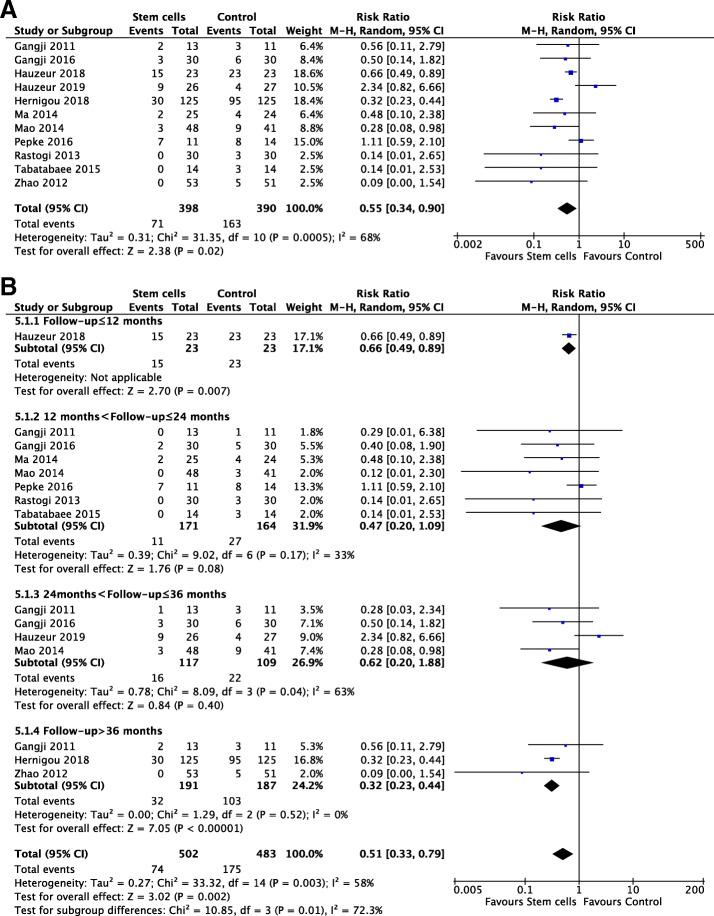
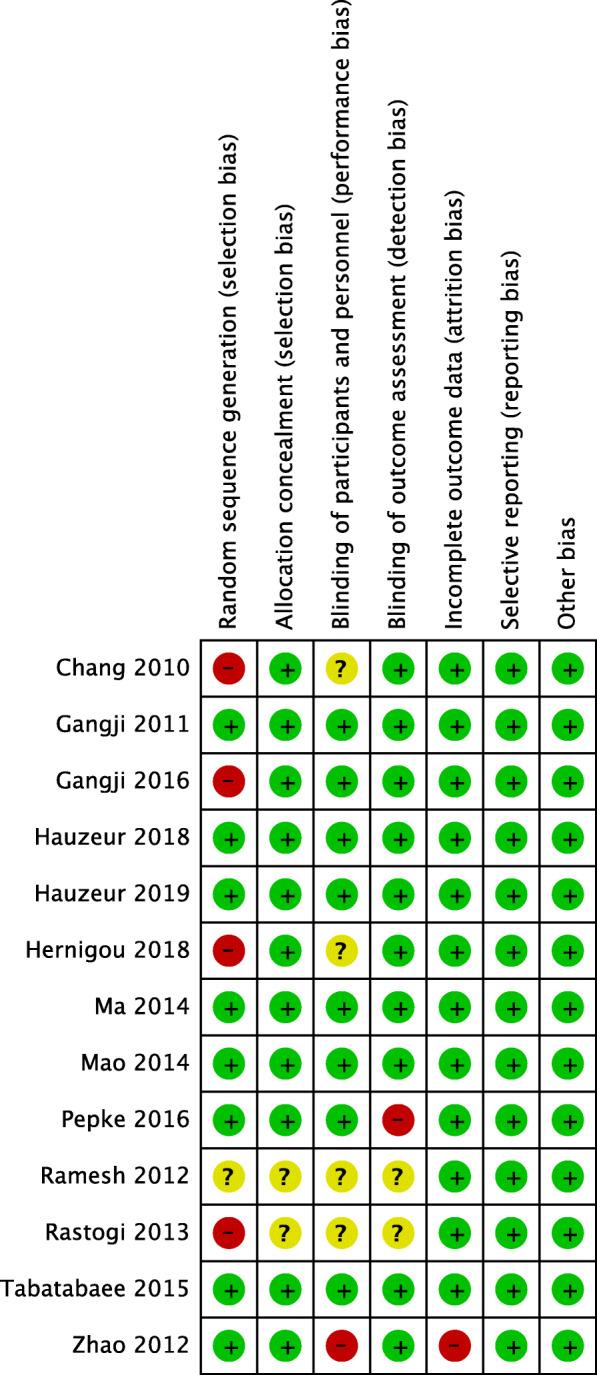
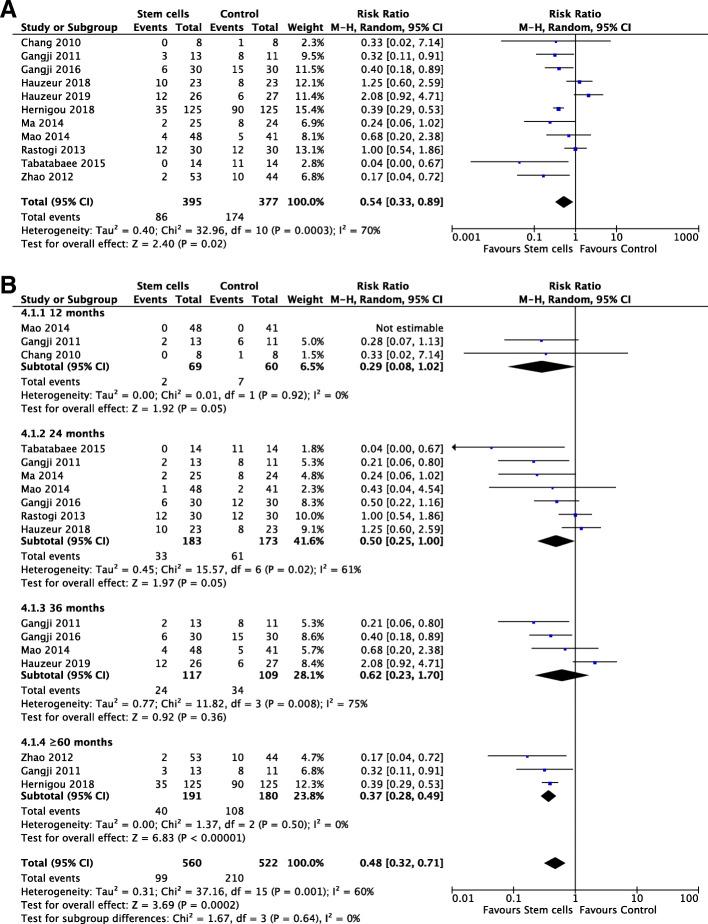
A total of 13 RCTs (619 patients with 855 hips) were included. The application of stem cells significantly delayed collapse of femoral head(I, 70%; RR, 0.54; 95% CI, 0.33 to 0.89; P < .00001) and total hip replacement (THR) (I, 68%; RR, 0.55; 95% CI, 0.34 to 0.90; P = .02) in the long term. It effectively decreased the events of collapse of femoral head (≥ 60 months) (I, 0%; RR, 0.37; 95% CI, 0.28 to 0.49; P < .00001) and THR (> 36 months) (I, 0%; RR, 0.32; 95% CI, 0.23 to 0.44; P < .00001). There existed a beneficial effect for patients under 40 (Collapse of femoral head: I, 56%; RR, 0.41; 95% CI, 0.23 to 0.76; P = .004) (THR: I, 0%; RR, 0.31; 95% CI, 0.23 to 0.42; P < .00001). In addition, quantity of stem cells at 10 magnitude had better effects on disease progression events (I, 0%; RR, 0.34; 95%CI, 0.16 to 0.74; P = .007). Besides, there were no significant differences on adverse events between the stem cell group and control group (I, 0%; RR, 0.82; 95% CI, 0.39 to 1.73; P = .60).
CONCLUSION
Our findings build solid evidence that stem cell therapy could be expected to have a long-term effect on preventing early-stage ONFH patients from progression events, such as collapse of femoral head and total hip replacement. Furthermore, patients under 40 may be an ideal age group and the optimal cell number could be at 10 magnitude for this therapy. Further studies including strict RCTs are required to evaluate a clear effect of stem cells on ideal patient profile and the procedures of implantation.
背景
股骨头坏死(ONFH)是一种严重的退行性疾病,目前尚无有效的治疗方法来减缓其进展。一些研究报告了干细胞对早期 ONFH 的短期疗效。然而,其长期效果仍不清楚,尤其是在进展事件方面。本研究旨在评估干细胞的长期疗效和安全性,并分析其最佳年龄组和细胞数量。
方法
我们的综述已在 PROSPERO(http://www.crd.york.ac.uk/PROSPERO)上注册,注册号为 CRD42020136094。按照 PRISMA 指南,我们于 2020 年 1 月 5 日在 8 个电子数据库中进行了搜索,并纳入了利用干细胞治疗早期 ONFH 的严格随机对照试验(RCT)。对质量和偏倚进行了分析。采用荟萃分析评估了不同结局之间的差异。
结果
共纳入 13 项 RCT(619 例患者,855 髋)。干细胞的应用显著延缓了股骨头塌陷(I,70%;RR,0.54;95%CI,0.33 至 0.89;P<0.00001)和全髋关节置换术(THR)(I,68%;RR,0.55;95%CI,0.34 至 0.90;P=0.02)的长期进展。它有效地降低了股骨头塌陷(≥60 个月)(I,0%;RR,0.37;95%CI,0.28 至 0.49;P<0.00001)和 THR(>36 个月)(I,0%;RR,0.32;95%CI,0.23 至 0.44;P<0.00001)的发生事件。对于 40 岁以下的患者,存在有益的效果(股骨头塌陷:I,56%;RR,0.41;95%CI,0.23 至 0.76;P=0.004)(THR:I,0%;RR,0.31;95%CI,0.23 至 0.42;P<0.00001)。此外,10 数量级的干细胞数量对疾病进展事件有更好的效果(I,0%;RR,0.34;95%CI,0.16 至 0.74;P=0.007)。此外,干细胞组与对照组之间的不良事件无显著差异(I,0%;RR,0.82;95%CI,0.39 至 1.73;P=0.60)。
结论
我们的研究结果为干细胞治疗在预防早期 ONFH 患者的进展事件(如股骨头塌陷和全髋关节置换术)方面具有长期疗效提供了有力证据。此外,40 岁以下的患者可能是一个理想的年龄组,这种治疗的最佳细胞数量可能为 10 数量级。需要进一步的包括严格 RCT 的研究来评估干细胞对理想患者特征和植入程序的明确效果。

 Zotero 插件