
不明原发灶头颈鳞状细胞癌调强放射治疗后的失败模式:选择性淋巴结及黏膜剂量覆盖的意义
Patterns of Failure After Intensity Modulated Radiation Therapy in Head and Neck Squamous Cell Carcinoma of Unknown Primary: Implication of Elective Nodal and Mucosal Dose Coverage.
作者信息
Kamal Mona, Mohamed Abdallah S R, Fuller Clifton David, Sturgis Erich M, Johnson Faye M, Morrison William H, Gunn G Brandon, Hutcheson Katherine A, Phan Jack, Volpe Stefania, Ng Sweet Ping, Phan Jae, Cardenas Carlos, Ferrarotto Renata, Frank Steven J, Rosenthal David I, Garden Adam S
机构信息
Department of Radiation Oncology, The University of Texas MD Anderson Cancer Center, Houston, Texas.
Department of Clinical Oncology and Nuclear Medicine, Faculty of Medicine, Ain Shams University, Cairo, Egypt.
出版信息
Adv Radiat Oncol. 2020 May 15;5(5):929-935. doi: 10.1016/j.adro.2020.04.025. eCollection 2020 Sep-Oct.
PURPOSE
We evaluated the geometric and dosimetric-based distribution of mucosal and nodal recurrences in patients with metastatic head and neck squamous cell carcinoma to cervical lymph nodes of unknown primary after intensity modulated radiation therapy using validated typology-indicative taxonomy.
METHODS AND MATERIALS
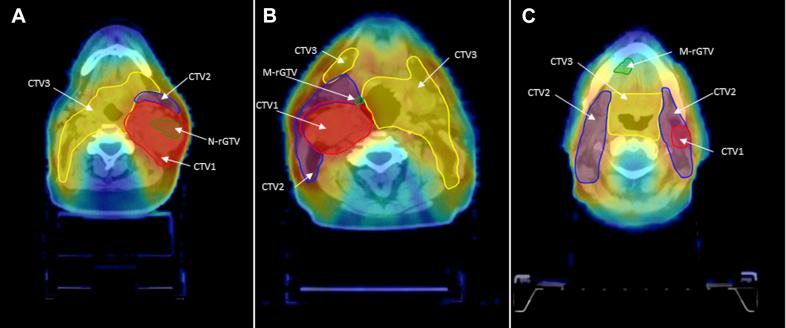
We reviewed the data of 260 patients who were irradiated between 2000 and 2015 and had a median follow-up time for surviving patients of 61 months. The mucosal and nodal recurrences were manually delineated on computed tomography images demonstrating the recurrences. The images were overlaid on the treatment plan using deformable image registration. The locations of the recurrences were determined relative to the original planning target volumes and doses using centroid-based approaches. Subsequently, the pattern of failures were classified into 5 types based on combined spatial and dosimetric criteria: A (central high dose), B (peripheral high dose), C (central elective dose), D (peripheral elective dose), and E (extraneous dose). For patients with type A failure with simultaneous nontype A lesions, the overall pattern of failures was defined as type A.
RESULTS
Thirty-two patients had mucosal or nodal recurrences. The most common clinical nodal stage was N2b (66%). Preradiation therapy neck dissections were performed in 6 patients. The median dose delivered to clinical tumor volume 1 was 66 Gy. The majority (84%) had total/partial pharyngeal mucosa elective irradiation. Twenty-three patients had nodal recurrences, 8 had mucosal recurrences, and 1 had both nodal and mucosal recurrences. Twenty-one patients (91%) had type A nodal failure, and 7 of the mucosal failures (89%) were type C.
CONCLUSIONS
The majority of nodal recurrences occurred within the high-dose area, demanding the need for identification of radioresistant areas within malignant nodes. Future studies should focus on either dose escalation of high-risk volumes or novel radiosensitizers.
目的
我们使用经过验证的类型指示分类法,评估了接受调强放射治疗后发生颈部淋巴结转移且原发灶不明的头颈部鳞状细胞癌患者黏膜和淋巴结复发的基于几何和剂量学的分布情况。
方法和材料
我们回顾了2000年至2015年间接受放疗的260例患者的数据,存活患者的中位随访时间为61个月。在显示复发情况的计算机断层扫描图像上手动勾勒出黏膜和淋巴结复发灶。使用可变形图像配准将图像叠加在治疗计划上。使用基于质心的方法确定复发灶相对于原始计划靶体积和剂量的位置。随后,根据空间和剂量学综合标准将失败模式分为5种类型:A(中心高剂量)、B(周边高剂量)、C(中心选择性剂量)、D(周边选择性剂量)和E(额外剂量)。对于同时存在非A类病变的A类失败患者,总体失败模式定义为A类。
结果
32例患者出现黏膜或淋巴结复发。最常见的临床淋巴结分期为N2b(66%)。6例患者在放疗前进行了颈部清扫术。临床靶体积1的中位剂量为66 Gy。大多数(84%)患者接受了全/部分咽黏膜选择性照射。23例患者出现淋巴结复发,8例出现黏膜复发,1例同时出现淋巴结和黏膜复发。21例(91%)患者出现A类淋巴结失败,7例黏膜失败中有89%为C类。
结论
大多数淋巴结复发发生在高剂量区域,需要识别恶性淋巴结内的放射抵抗区域。未来的研究应聚焦于高危体积的剂量增加或新型放射增敏剂。
 Zotero 插件