
通过调节pH值提高载体肽稳定性可改善胰岛素和PTH(1-34)在体外和体内的递送,而非通过强制载体肽-货物复合。
Increased Carrier Peptide Stability through pH Adjustment Improves Insulin and PTH(1-34) Delivery In Vitro and In Vivo Rather than by Enforced Carrier Peptide-Cargo Complexation.
作者信息
Kristensen Mie, Guldsmed Diedrichsen Ragna, Vetri Valeria, Foderà Vito, Mørck Nielsen Hanne
机构信息
Department of Pharmacy, Faculty of Health and Medical Sciences, University of Copenhagen, Universitetsparken 2, DK-2100 Copenhagen, Denmark.
Center for Biopharmaceuticals and Biobarriers in Drug Delivery, University of Copenhagen, Universitetsparken 2, DK-2100 Copenhagen, Denmark.
出版信息
Pharmaceutics. 2020 Oct 20;12(10):993. doi: 10.3390/pharmaceutics12100993.
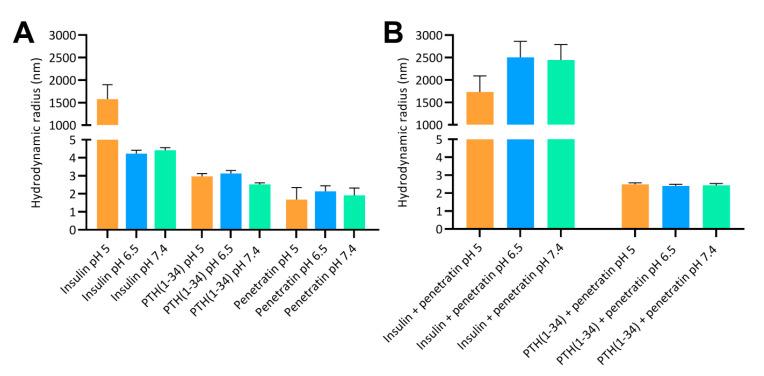
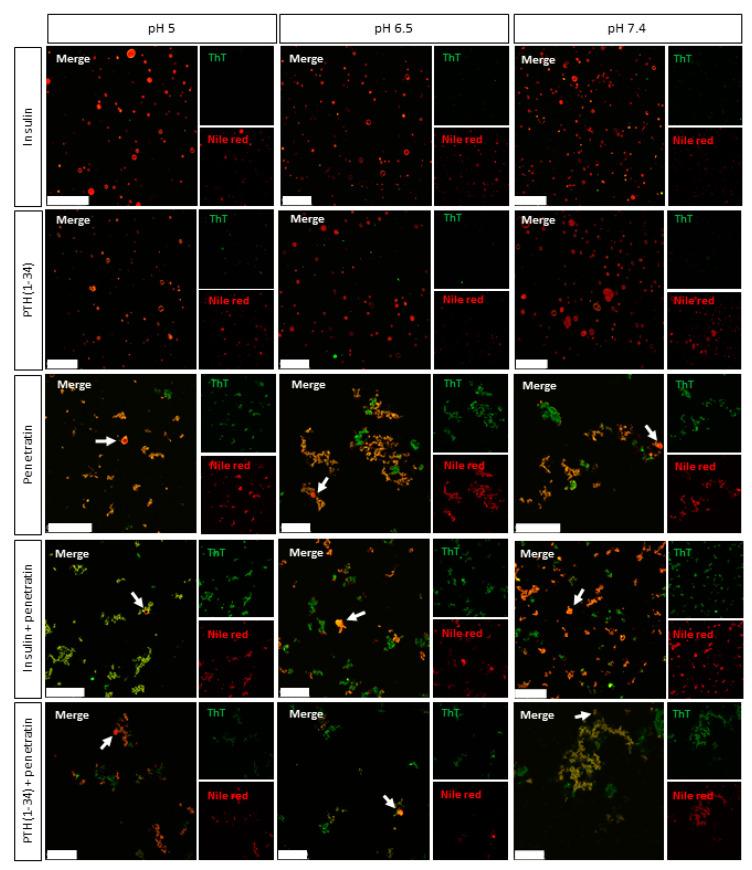
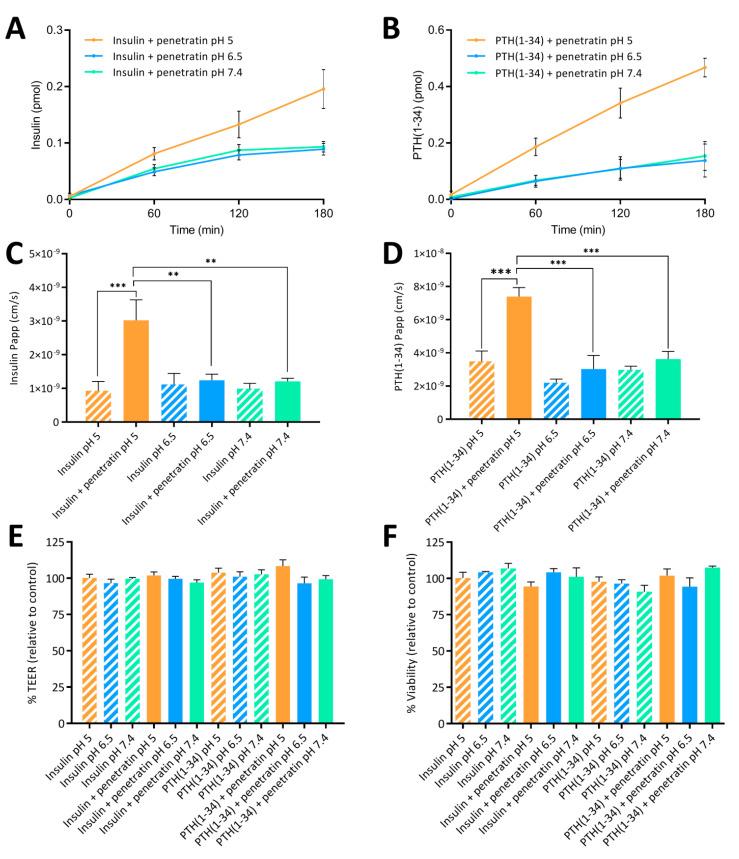
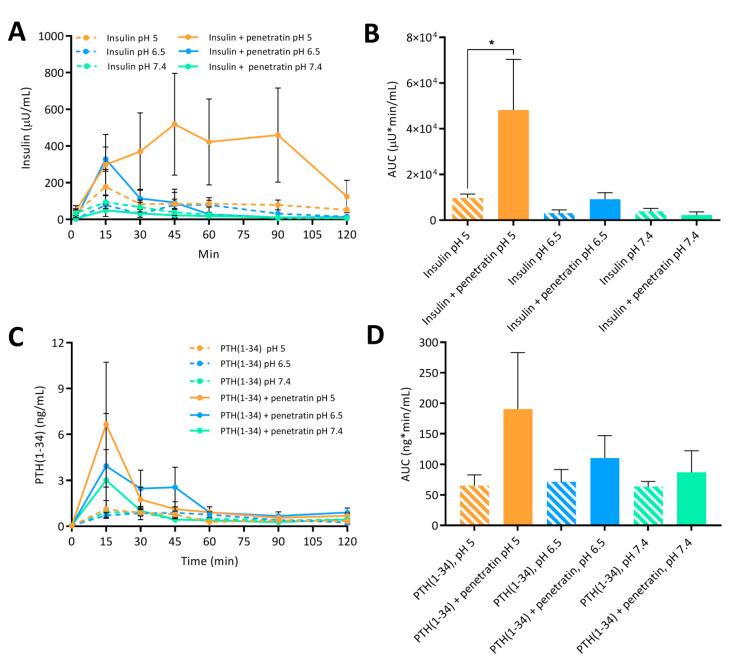
Oral delivery of therapeutic peptides is hampered by their large molecular size and labile nature, thus limiting their permeation across the intestinal epithelium. Promising approaches to overcome the latter include co-administration with carrier peptides. In this study, the cell-penetrating peptide penetratin was employed to investigate effects of co-administration with insulin and the pharmacologically active part of parathyroid hormone (PTH(1-34)) at pH 5, 6.5, and 7.4 with respect to complexation, enzymatic stability, and transepithelial permeation of the therapeutic peptide in vitro and in vivo. Complex formation between insulin or PTH(1-34) and penetratin was pH-dependent. Micron-sized complexes dominated in the samples prepared at pH-values at which penetratin interacts electrostatically with the therapeutic peptide. The association efficiency was more pronounced between insulin and penetratin than between PTH(1-34) and penetratin. Despite the high degree of complexation, penetratin retained its membrane activity when applied to liposomal structures. The enzymatic stability of penetratin during incubation on polarized Caco-2 cell monolayers was pH-dependent with a prolonged half-live determined at pH 5 when compared to pH 6.5 and 7.4. Also, the penetratin-mediated transepithelial permeation of insulin and PTH(1-34) was increased in vitro and in vivo upon lowering the sample pH from 7.4 or 6.5 to 5. Thus, the formation of penetratin-cargo complexes with several molecular entities is not prerequisite for penetratin-mediated transepithelial permeation a therapeutic peptide. Rather, a sample pH, which improves the penetratin stability, appears to optimize the penetratin-mediated transepithelial permeation of insulin and PTH(1-34).
治疗性肽的口服给药受到其较大分子大小和不稳定性质的阻碍,从而限制了它们穿过肠上皮的渗透。克服后者的有前景的方法包括与载体肽共同给药。在本研究中,使用细胞穿透肽穿膜肽来研究在pH 5、6.5和7.4条件下与胰岛素和甲状旁腺激素的药理活性部分(PTH(1-34))共同给药对治疗性肽在体外和体内的络合、酶稳定性及跨上皮渗透的影响。胰岛素或PTH(1-34)与穿膜肽之间的复合物形成是pH依赖性的。在穿膜肽与治疗性肽发生静电相互作用的pH值下制备的样品中,微米级复合物占主导。胰岛素与穿膜肽之间的缔合效率比PTH(1-34)与穿膜肽之间更显著。尽管络合程度很高,但穿膜肽应用于脂质体结构时仍保留其膜活性。穿膜肽在极化的Caco-2细胞单层上孵育期间的酶稳定性是pH依赖性的,与pH 6.5和7.4相比,在pH 5时半衰期延长。此外,将样品pH从7.4或6.5降低到5时,穿膜肽介导的胰岛素和PTH(1-34)的跨上皮渗透在体外和体内均增加。因此,与几种分子实体形成穿膜肽-货物复合物并非穿膜肽介导治疗性肽跨上皮渗透的先决条件。相反,提高穿膜肽稳定性的样品pH似乎能优化穿膜肽介导的胰岛素和PTH(1-34)的跨上皮渗透。



 Zotero 插件