
加权基因共表达网络分析揭示了与肥厚型心肌病诊断相关的关键生物标志物。
Weighted gene co-expression network analysis revealed key biomarkers associated with the diagnosis of hypertrophic cardiomyopathy.
机构信息
Department of Cardiovascular, The Third Central Hospital of Tianjin, Tianjin, China.
Department of Respiratory medicine, The Third Central Hospital of Tianjin, Tianjin, China.
出版信息
Hereditas. 2020 Oct 24;157(1):42. doi: 10.1186/s41065-020-00155-9.
OBJECTIVE
To reveal the molecular mechanism underlying the pathogenesis of HCM and find new effective therapeutic strategies using a systematic biological approach.
METHODS
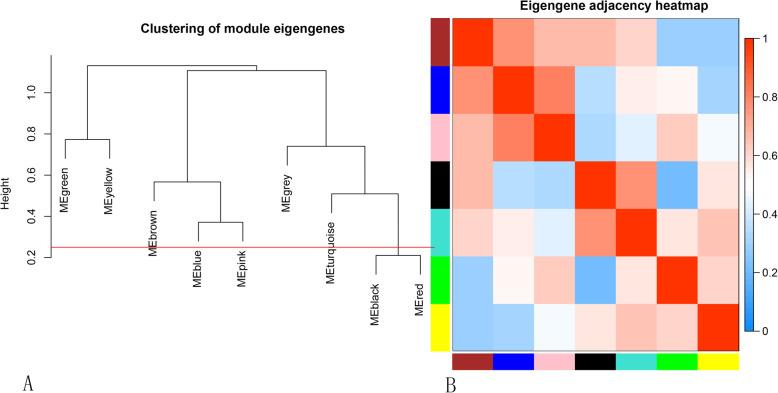
The WGCNA algorithm was applied to building the co-expression network of HCM samples. A sample cluster analysis was performed using the hclust tool and a co-expression module was constructed. The WGCNA algorithm was used to study the interactive connection between co-expression modules and draw a heat map to show the strength of interactions between modules. The genetic information of the respective modules was mapped to the associated GO terms and KEGG pathways, and the Hub Genes with the highest connectivity in each module were identified. The Wilcoxon test was used to verify the expression level of hub genes between HCM and normal samples, and the "pROC" R package was used to verify the possibility of hub genes as biomarkers. Finally, the potential functions of hub genes were analyzed by GSEA software.
RESULTS
Seven co-expression modules were constructed using sample clustering analysis. GO and KEGG enrichment analysis judged that the turquoise module is an important module. The hub genes of each module are RPL35A for module Black, FH for module Blue, PREI3 for module Brown, CREB1 for module Green, LOC641848 for module Pink, MYH7 for module Turquoise and MYL6 for module Yellow. The results of the differential expression analysis indicate that MYH7 and FH are considered true hub genes. In addition, the ROC curves revealed their high diagnostic value as biomarkers for HCM. Finally, in the results of the GSEA analysis, MYH7 and FH highly expressed genes were enriched with the "proteasome" and a "PPAR signaling pathway," respectively.
CONCLUSIONS
The MYH7 and FH genes may be the true hub genes of HCM. Their respective enriched pathways, namely the "proteasome" and the "PPAR signaling pathway," may play an important role in the development of HCM.
目的
采用系统生物学方法揭示肥厚型心肌病(HCM)发病机制的分子机制,寻找新的有效治疗策略。
方法
应用 WGCNA 算法构建 HCM 样本的共表达网络。使用 hclust 工具对样本进行聚类分析,构建共表达模块。应用 WGCNA 算法研究共表达模块之间的交互连接,并绘制热图显示模块之间的相互作用强度。将各个模块的遗传信息映射到相关的 GO 术语和 KEGG 通路,并鉴定每个模块中连接度最高的 Hub 基因。使用 Wilcoxon 检验验证 Hub 基因在 HCM 和正常样本中的表达水平,使用“pROC”R 包验证 Hub 基因作为生物标志物的可能性。最后,使用 GSEA 软件分析 Hub 基因的潜在功能。
结果
通过样本聚类分析构建了 7 个共表达模块。GO 和 KEGG 富集分析判断 turquoise 模块是一个重要的模块。每个模块的 Hub 基因分别为模块 Black 的 RPL35A、模块 Blue 的 FH、模块 Brown 的 PREI3、模块 Green 的 CREB1、模块 Pink 的 LOC641848、模块 Turquoise 的 MYH7 和模块 Yellow 的 MYL6。差异表达分析结果表明,MYH7 和 FH 被认为是真正的 Hub 基因。此外,ROC 曲线揭示了它们作为 HCM 生物标志物的高诊断价值。最后,在 GSEA 分析结果中,MYH7 和 FH 高表达基因分别富集于“蛋白酶体”和“PPAR 信号通路”。
结论
MYH7 和 FH 基因可能是 HCM 的真正 Hub 基因。它们各自富集的通路,即“蛋白酶体”和“PPAR 信号通路”,可能在 HCM 的发展中起重要作用。




 Zotero 插件