
SMARCA4 突变在 KRAS 突变型肺腺癌中的作用:一项多队列分析。
SMARCA4 mutations in KRAS-mutant lung adenocarcinoma: a multi-cohort analysis.
机构信息
Center for Cancer Genomics and Precision Oncology, Wake Forest Baptist Comprehensive Cancer Center, Winston-Salem, NC, USA.
Department of Cancer Biology, Wake Forest School of Medicine, Winston-Salem, NC, USA.
出版信息
Mol Oncol. 2021 Feb;15(2):462-472. doi: 10.1002/1878-0261.12831. Epub 2020 Dec 17.
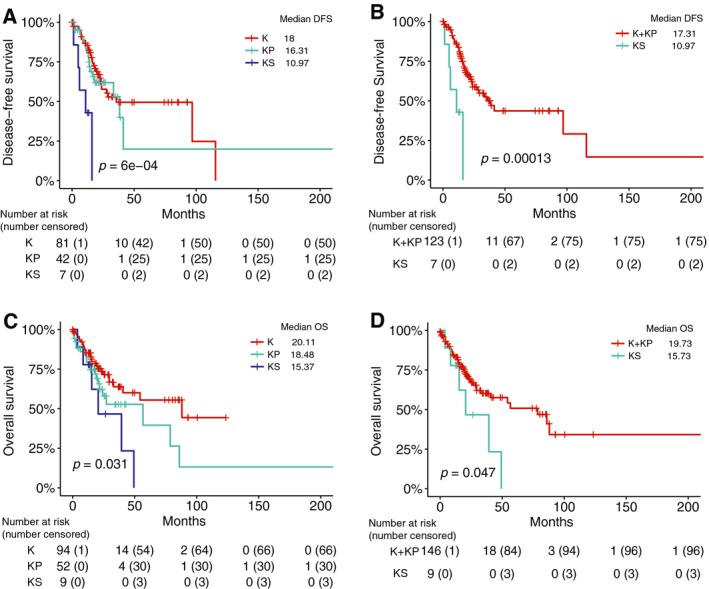
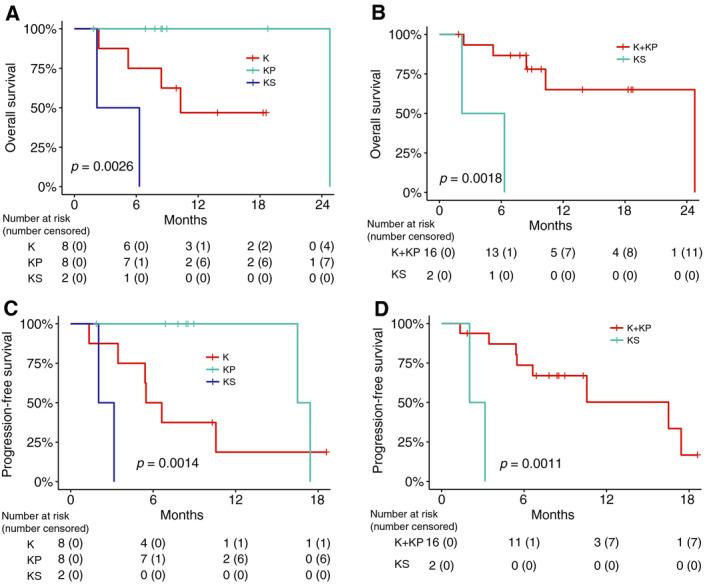
KRAS is a key oncogenic driver in lung adenocarcinoma (LUAD). Chromatin-remodeling gene SMARCA4 is comutated with KRAS in LUAD; however, the impact of SMARCA4 mutations on clinical outcome has not been adequately established. This study sought to shed light on the clinical significance of SMARCA4 mutations in LUAD. The association of SMARCA4 mutations with survival outcomes was interrogated in four independent cohorts totaling 564 patients: KRAS-mutant patients with LUAD who received nonimmunotherapy treatment from (a) The Cancer Genome Atlas (TCGA) and (b) the MSK-IMPACT Clinical Sequencing (MSK-CT) cohorts; and KRAS-mutant patients with LUAD who received immune checkpoint inhibitor-based immunotherapy treatment from (c) the MSK-IMPACT (MSK-IO) and (d) the Wake Forest Baptist Comprehensive Cancer Center (WFBCCC) immunotherapy cohorts. Of the patients receiving nonimmunotherapy treatment, in the TCGA cohort (n = 155), KRAS-mutant patients harboring SMARCA4 mutations (KS) showed poorer clinical outcome [P = 6e-04 for disease-free survival (DFS) and 0.031 for overall survival (OS), respectively], compared to KRAS-TP53 comutant (KP) and KRAS-only mutant (K) patients; in the MSK-CT cohort (n = 314), KS patients also exhibited shorter OS than KP (P = 0.03) or K (P = 0.022) patients. Of patients receiving immunotherapy, KS patients consistently exhibited the shortest progression-free survival (PFS; P = 0.0091) in the MSK-IO (n = 77), and the shortest PFS (P = 0.0026) and OS (P = 0.0014) in the WFBCCC (n = 18) cohorts, respectively. Therefore, mutations of SMARCA4 represent a genetic factor leading to adverse clinical outcome in lung adenocarcinoma treated by either nonimmunotherapy or immunotherapy.
KRAS 是肺腺癌(LUAD)的关键致癌驱动基因。染色质重塑基因 SMARCA4 与 LUAD 中的 KRAS 发生共突变;然而,SMARCA4 突变对临床结局的影响尚未得到充分确立。本研究旨在阐明 SMARCA4 突变在 LUAD 中的临床意义。在总共 564 名患者的四个独立队列中,研究了 SMARCA4 突变与生存结局的关系:接受非免疫治疗的 KRAS 突变型 LUAD 患者,其治疗来自(a)癌症基因组图谱(TCGA)和(b)MSK-IMPACT 临床测序(MSK-CT)队列;以及接受免疫检查点抑制剂为基础的免疫治疗的 KRAS 突变型 LUAD 患者,其治疗来自(c)MSK-IMPACT(MSK-IO)和(d)维克森林浸信会综合癌症中心(WFBCCC)免疫治疗队列。在接受非免疫治疗的患者中,在 TCGA 队列(n=155)中,携带 SMARCA4 突变(KS)的 KRAS 突变型患者的临床结局较差[无病生存期(DFS)为 6e-04,总生存期(OS)为 0.031,分别为 P=6e-04 和 P=0.031],与 KRAS-TP53 共突变(KP)和 KRAS 单突变(K)患者相比;在 MSK-CT 队列(n=314)中,KS 患者的 OS 也短于 KP(P=0.03)或 K(P=0.022)患者。在接受免疫治疗的患者中,KS 患者在 MSK-IO 队列(n=77)中表现出最短的无进展生存期(PFS;P=0.0091),在 WFBCCC 队列(n=18)中表现出最短的 PFS(P=0.0026)和 OS(P=0.0014)。因此,SMARCA4 的突变代表了一个遗传因素,导致肺腺癌在接受非免疫治疗或免疫治疗时的临床结局不良。




 Zotero 插件