
运用三种工具评估人类环境流行病学研究中的偏倚风险:不同工具得出不同结论。
Assessing risk of bias in human environmental epidemiology studies using three tools: different conclusions from different tools.
机构信息
Program on Reproductive Health and the Environment, Department of Obstetrics, Gynecology and Reproductive Sciences, University of California, San Francisco, USA.
Department of Health Sciences, California State University, East Bay, Hayward, CA, USA.
出版信息
Syst Rev. 2020 Oct 29;9(1):249. doi: 10.1186/s13643-020-01490-8.
BACKGROUND
Systematic reviews are increasingly prevalent in environmental health due to their ability to synthesize evidence while reducing bias. Different systematic review methods have been developed by the US National Toxicology Program's Office of Health Assessment and Translation (OHAT), the US Environmental Protection Agency's (EPA) Integrated Risk Information System (IRIS), and by the US EPA under the Toxic Substances Control Act (TSCA), including the approach to assess risk of bias (ROB), one of the most vital steps which is used to evaluate internal validity of the studies. Our objective was to compare the performance of three tools (OHAT, IRIS, TSCA) in assessing ROB.
METHODS
We selected a systematic review on polybrominated diphenyl ethers and intelligence quotient and/or attention deficit hyperactivity disorder because it had been endorsed by the National Academy of Sciences. Two reviewers followed verbatim instructions from the tools and independently applied each tool to assess ROB in 15 studies previously identified. We documented the time to apply each tool and the impact the ROB ratings for each tool had on the final rating of the quality of the overall body of evidence.
RESULTS
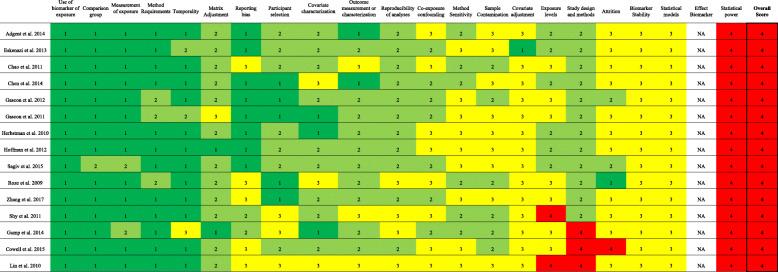
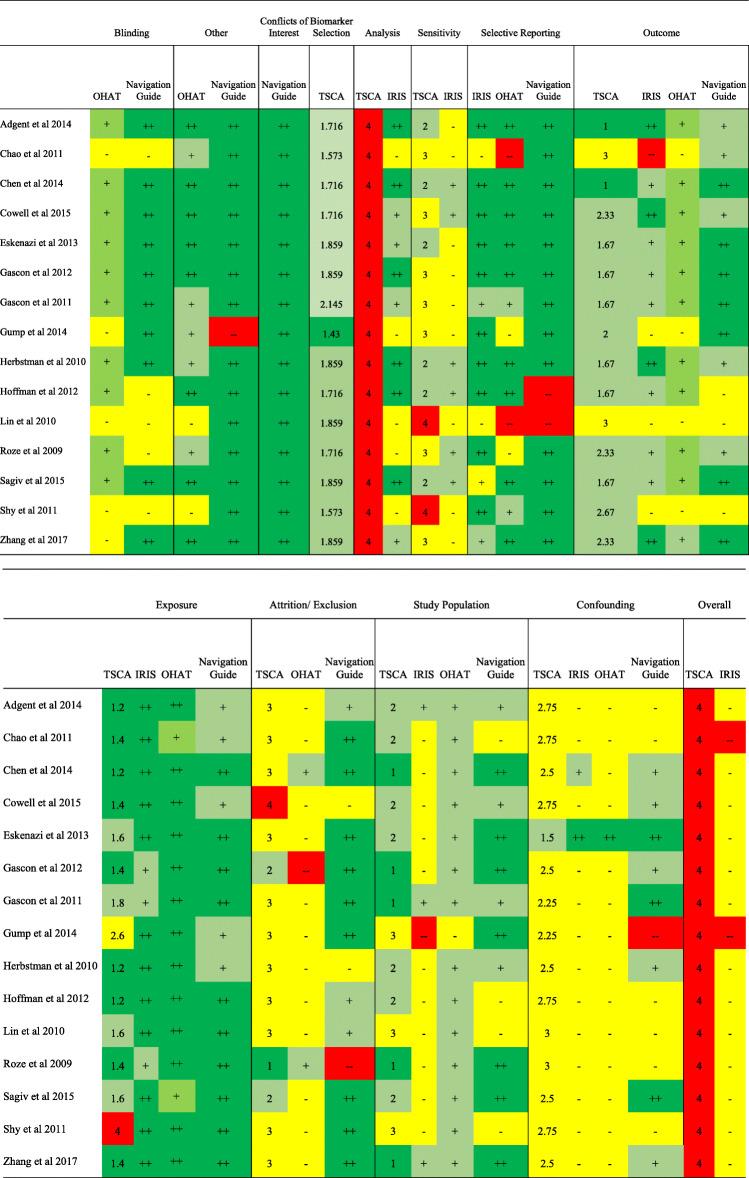
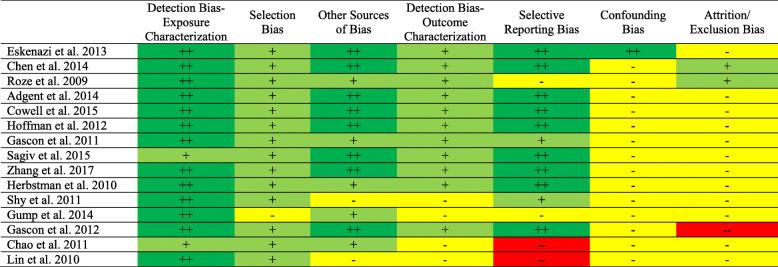
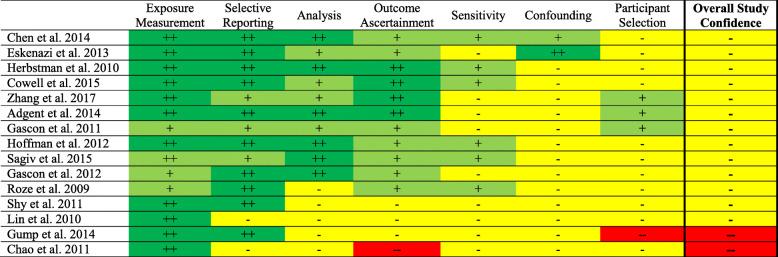
The time to complete the ROB assessments varied widely (mean = 20, 32, and 40 min per study for the OHAT, IRIS, and TSCA tools, respectively). All studies were rated overall "low" or "uninformative" using IRIS, due to "deficient" or "critically deficient" ratings in one or two domains. Similarly, all studies were rated "unacceptable" using the TSCA tool because of one "unacceptable" rating in a metric related to statistical power. Approximately half of the studies had "low" or "probably low ROB" ratings across all domains with the OHAT and Navigation Guide tools.
CONCLUSIONS
Tools that use overall ROB or study quality ratings, such as IRIS and TSCA, may reduce the available evidence to assess the harms of environmental exposures by erroneously excluding studies, which leads to inaccurate conclusions about the quality of the body of evidence. We recommend using ROB tools that circumvents these issues, such as OHAT and Navigation Guide.
SYSTEMATIC REVIEW REGISTRATION
This review has not been registered as it is not a systematic review.
背景
由于系统评价能够在减少偏倚的同时综合证据,因此在环境卫生领域越来越受到重视。美国国家毒理学计划办公室健康评估和转化 (OHAT)、美国环境保护署 (EPA) 的综合风险信息系统 (IRIS) 以及美国环境保护署根据《有毒物质控制法》 (TSCA) 制定了不同的系统评价方法,包括评估偏倚风险 (ROB) 的方法,这是评估研究内部有效性的最关键步骤之一。我们的目标是比较三种工具(OHAT、IRIS、TSCA)在评估 ROB 方面的性能。
方法
我们选择了一篇关于多溴联苯醚和智商和/或注意力缺陷多动障碍的系统评价,因为它得到了美国国家科学院的认可。两名审查员按照工具的说明逐字进行,并分别将每种工具应用于之前确定的 15 项研究中的 ROB 评估。我们记录了每种工具的应用时间,以及每种工具的 ROB 评分对整体证据质量最终评分的影响。
结果
完成 ROB 评估的时间差异很大(平均每研究 20、32 和 40 分钟,分别为 OHAT、IRIS 和 TSCA 工具)。由于在一个或两个领域的评分是“不足”或“严重不足”,因此所有研究使用 IRIS 进行整体评估均为“低”或“无信息”。同样,由于与统计能力相关的一个“不可接受”评分,所有研究使用 TSCA 工具都被评为“不可接受”。使用 OHAT 和导航指南工具,大约一半的研究在所有领域的 ROB 评分均为“低”或“可能低”。
结论
使用整体 ROB 或研究质量评分的工具,如 IRIS 和 TSCA,可能会通过错误地排除研究来减少评估环境暴露危害的可用证据,从而导致对证据质量的不准确结论。我们建议使用规避这些问题的 ROB 工具,如 OHAT 和导航指南。
系统评价注册
由于这不是系统评价,因此此审查未注册。
 Zotero 插件