
人类中风与新型冠状病毒感染:一项系统综述与荟萃分析
Stroke and Novel Coronavirus Infection in Humans: A Systematic Review and Meta-Analysis.
作者信息
Lee Kai Wei, Yusof Khan Abdul Hanif Khan, Ching Siew Mooi, Chia Peck Kee, Loh Wei Chao, Abdul Rashid Anna Misya'il, Baharin Janudin, Inche Mat Liyana Najwa, Wan Sulaiman Wan Aliaa, Devaraj Navin Kumar, Sivaratnam Dhashani, Basri Hamidon, Hoo Fan Kee
机构信息
Department of Family Medicine, Faculty of Medicine and Health Sciences, Universiti Putra Malaysia, Serdang, Malaysia.
Department of Medicine, Faculty of Medicine and Health Sciences, Universiti Putra Malaysia, Serdang, Malaysia.
出版信息
Front Neurol. 2020 Oct 6;11:579070. doi: 10.3389/fneur.2020.579070. eCollection 2020.
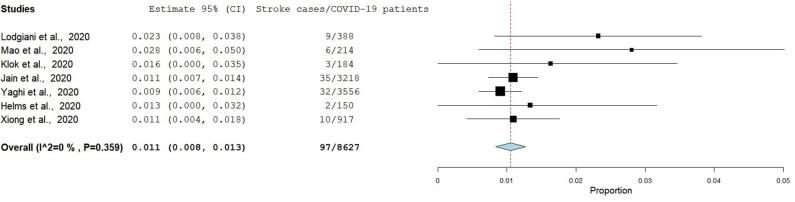
As the world witnessed the devastation caused by the coronavirus disease 2019 (COVID-19) outbreak, a growing body of literature on COVID-19 is also becoming increasingly available. Stroke has increasingly been reported as a complication of COVID-19 infection. However, a systematic synthesis of the available data has not been conducted. Therefore, we performed a systematic review and meta-analysis of currently available epidemiological, clinical, and laboratory data related to both stroke and COVID-19 infection. We systematically searched Medline, Cinahl, and PubMed for studies related to stroke and COVID-19 from inception up to June 4, 2020. We selected cohort studies, case series, and case reports that reported the occurrence of stroke in COVID-19 patients. A fixed-effects model was used to estimate the pooled frequency of stroke in COVID-19 patients with a 95% confidence interval (CI). Twenty-eight studies were included in the systematic review and seven studies for the meta-analysis. The pooled frequency of stroke in COVID-19 patients was 1.1% (95% CI: 0.8, 1.3). The heterogeneity was low ( = 0.0%). Even though the frequency of stroke among patients having COVID-19 infection was low, those with concomitant COVID-19 infection and stroke suffered from a more severe infection and eventually had a poorer prognosis with a higher mortality rate (46.7%) than COVID-19 alone. Many COVID-19 patients shared the common traditional risk factors for stroke. We noted that ischemic stroke involving the anterior circulation with large vessels occlusion is the most common type of stroke with more strokes seen in multi-territorial regions, suggesting systemic thromboembolism. An elevated level of D-dimers, C-reactive protein, ferritin, lactic acid dehydrogenase, troponin, ESR, fibrinogen, and a positive antiphospholipid antibody were also noted in this review. The occurrence of stroke in patients with COVID-19 infection is uncommon, but it may pose as an important prognostic marker and indicator of severity of infection, by causing large vessels occlusion and exhibiting a thrombo-inflammatory vascular picture. Physicians should be made aware and remain vigilant on the possible two-way relationship between stroke and COVID-19 infection. The rate of stroke among patients with COVID-19 infection may increase in the future as they share the common risk factors.
随着全球目睹2019冠状病毒病(COVID-19)疫情造成的破坏,关于COVID-19的文献也越来越多。越来越多的报道称,中风是COVID-19感染的一种并发症。然而,尚未对现有数据进行系统的综合分析。因此,我们对目前与中风和COVID-19感染相关的流行病学、临床和实验室数据进行了系统综述和荟萃分析。我们系统地检索了Medline、Cinahl和PubMed,以查找从开始到2020年6月4日与中风和COVID-19相关的研究。我们选择了报告COVID-19患者中风发生情况的队列研究、病例系列和病例报告。采用固定效应模型估计COVID-19患者中风的合并发生率,并给出95%置信区间(CI)。系统综述纳入了28项研究,荟萃分析纳入了7项研究。COVID-19患者中风的合并发生率为1.1%(95%CI:0.8,1.3)。异质性较低(I² = 0.0%)。尽管COVID-19感染患者中风的发生率较低,但合并COVID-19感染和中风的患者感染更严重,最终预后较差,死亡率(46.7%)高于单纯COVID-19患者。许多COVID-19患者具有中风的常见传统危险因素。我们注意到,涉及前循环且大血管闭塞的缺血性中风是最常见的中风类型,多区域出现的中风更多,提示存在系统性血栓栓塞。本综述还发现D-二聚体、C反应蛋白、铁蛋白、乳酸脱氢酶、肌钙蛋白、血沉、纤维蛋白原水平升高以及抗磷脂抗体呈阳性。COVID-19感染患者中风的发生并不常见,但它可能通过导致大血管闭塞并呈现血栓炎症性血管病变,成为感染严重程度的重要预后标志物和指标。医生应了解并警惕中风与COVID-19感染之间可能存在的双向关系。由于COVID-19感染患者具有共同的危险因素,未来他们中风的发生率可能会增加。

 Zotero 插件