
地诺单抗给药可保留亚急性脊髓损伤患者膝关节的骨矿物质密度:一项随机临床试验的结果
Administration of Denosumab Preserves Bone Mineral Density at the Knee in Persons With Subacute Spinal Cord Injury: Findings From a Randomized Clinical Trial.
作者信息
Cirnigliaro Christopher M, La Fountaine Michael F, Parrott J Scott, Kirshblum Steven C, McKenna Cristin, Sauer Susan J, Shapses Sue A, Hao Lihong, McClure Isa A, Hobson Joshua C, Spungen Ann M, Bauman William A
机构信息
Department of Veterans Affairs Rehabilitation Research & Development Service National Center for the Medical Consequences of Spinal Cord Injury James J. Peters Veterans Affairs Medical Center Bronx NY USA.
Department of Physical Therapy, School of Health and Medical Sciences Seton Hall University South Orange NJ USA.
出版信息
JBMR Plus. 2020 Jun 25;4(8):e10375. doi: 10.1002/jbm4.10375. eCollection 2020 Aug.
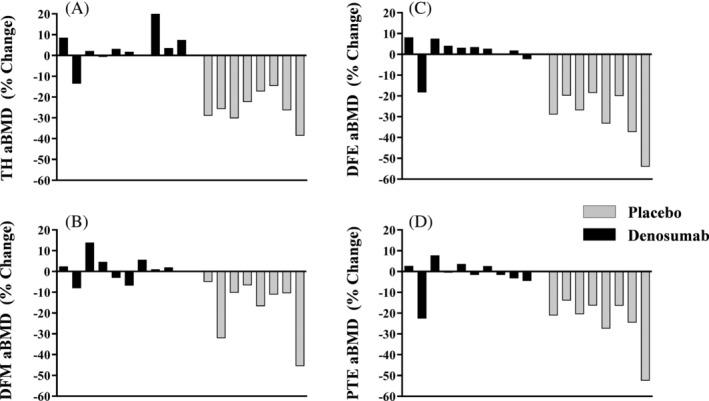
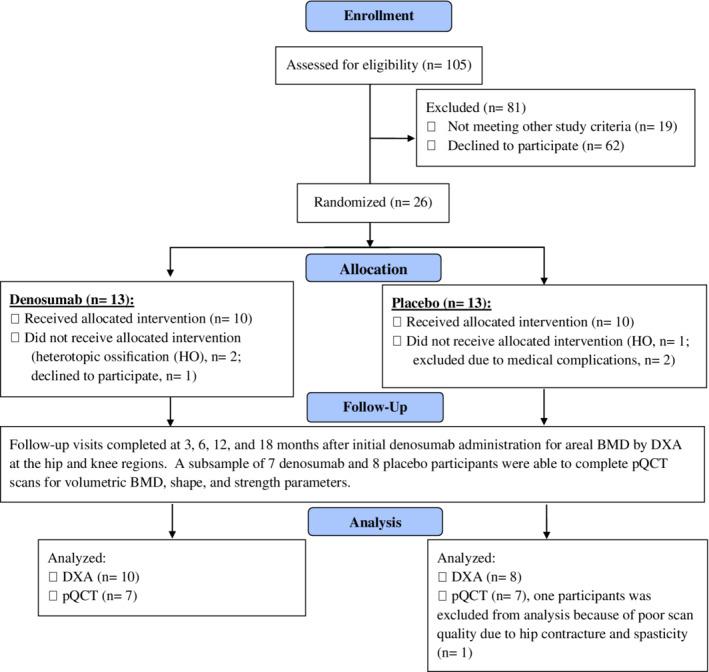
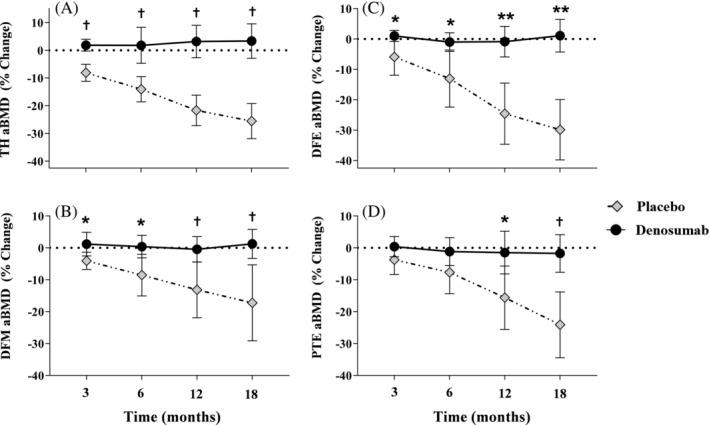
Persons with neurologically motor-complete spinal cord injury (SCI) have a marked loss of bone mineral density (BMD) of the long bones of the lower extremities, predisposing them to fragility fractures, especially at the knee. Denosumab, a commercially available human monoclonal IgG antibody to receptor activator of nuclear factor-κB ligand (RANKL), may provide an immunopharmacological solution to the rapid progressive deterioration of sublesional bone after SCI. Twenty-six SCI participants with subacute motor-complete SCI were randomized to receive either denosumab (60 mg) or placebo at baseline (BL), 6, and 12 months. Areal bone mineral density (aBMD) by dual energy x-ray absorptiometry (DXA) at 18 months at the distal femur was the primary outcome and aBMD of the proximal tibia and hip were the secondary outcomes analyzed in 18 of the 26 participants (denosumab, = 10 and placebo, = 8). The metrics of peripheral QCT (pQCT) were the exploratory outcomes analyzed in a subsample of the cohort (denosumab, = 7 and placebo = 7). The mean aBMD (±95% CI) for the denosumab versus the placebo groups demonstrated a significant group × time interactions for the following regions of interest at BL and 18 months: distal femoral metaphysis = mean aBMD 1.187; 95% CI, 1.074 to 1.300 and mean aBMD 1.202; 95% CI, 1.074 to 1.329 versus mean aBMD 1.162; 95% CI, 0.962 to 1.362 and mean aBMD 0.961; 95% CI, 0.763 to 1.159, respectively ( < 0.001); distal femoral epiphysis = mean aBMD 1.557; 95% CI, 1.437 to 1.675 and mean aBMD 1.570; 95% CI, 1.440 to 1.700 versus mean aBMD 1.565; 95% CI, 1.434 to 1.696 and mean aBMD 1.103; 95% CI, 0.898 to 1.309, respectively ( = 0.002); and proximal tibial epiphysis = mean aBMD 1.071; 95% CI, 0.957 to 1.186 and mean aBMD 1.050; 95% CI, 0.932 to 1.168 versus mean aBMD 0.994; 95% CI, 0.879 to 1.109 and mean aBMD 0.760; 95% CI, 0.601 to 0.919, respectively ( < 0.001). Analysis of pQCT imaging revealed a continued trend toward significantly greater loss in total volumetric BMD (vBMD) and trabecular vBMD at the 4% distal tibia region, with a significant percent loss for total bone mineral content. Thus, at 18 months after acute SCI, our findings show that denosumab maintained aBMD at the knee region, the site of greatest clinical relevance in the SCI population. © 2020 The Authors. published by Wiley Periodicals LLC. on behalf of American Society for Bone and Mineral Research.
神经学上运动完全性脊髓损伤(SCI)患者下肢长骨的骨矿物质密度(BMD)显著降低,使他们易发生脆性骨折,尤其是在膝关节处。地诺单抗是一种可商购的抗核因子κB受体活化剂配体(RANKL)的人单克隆IgG抗体,可能为SCI后损伤平面以下骨骼的快速进行性退变提供一种免疫药理学解决方案。26名亚急性运动完全性SCI参与者在基线(BL)、6个月和12个月时被随机分为接受地诺单抗(60mg)或安慰剂治疗。18个月时通过双能X线吸收法(DXA)测量股骨远端的面积骨密度(aBMD)是主要结局,26名参与者中的18名(地诺单抗组n = 10,安慰剂组n = 8)分析了胫骨近端和髋部的aBMD作为次要结局。外周定量CT(pQCT)指标是在该队列的一个子样本中分析的探索性结局(地诺单抗组n = 7,安慰剂组n = 7)。地诺单抗组与安慰剂组的平均aBMD(±95%CI)在BL和18个月时在以下感兴趣区域显示出显著的组×时间交互作用:股骨远端干骺端=平均aBMD 1.187;95%CI,1.074至1.300,平均aBMD 1.202;95%CI,1.074至1.329,而平均aBMD 1.162;95%CI,0.962至1.362,平均aBMD 0.961;95%CI,0.763至1.159,分别(P<0.001);股骨远端骨骺=平均aBMD 1.557;95%CI,1.437至1.675,平均aBMD 1.570;95%CI,1.440至1.700,而平均aBMD 1.565;95%CI,1.434至1.696,平均aBMD 1.103;95%CI,0.898至1.309,分别(P = 0.002);以及胫骨近端骨骺=平均aBMD 1.071;95%CI,0.957至1.186,平均aBMD 1.050;95%CI,0.932至1.168,而平均aBMD 0.994;95%CI,0.879至1.109,平均aBMD 0.760;95%CI,0.601至0.919,分别(P<0.001)。pQCT成像分析显示,在胫骨远端4%区域,总体积骨密度(vBMD)和小梁vBMD持续有显著更大损失的趋势,总骨矿物质含量有显著百分比损失。因此,在急性SCI后18个月,我们的研究结果表明,地诺单抗维持了SCI人群中临床相关性最大部位膝关节区域的aBMD。©2020作者。由Wiley Periodicals LLC代表美国骨与矿物质研究学会出版。
 Zotero 插件