
训练患者进行垂直阅读和水平阅读——一项随机对照研究。
Training of vertical versus horizontal reading in patients with hemianopia - a randomized and controlled study.
机构信息
Vision Rehabilitation Research Unit, Center for Ophthalmology, University of Tübingen, Tübingen, Germany.
Center of Neurology, Division of Neuropsychology, Hertie-Institute for Clinical Brain Research, University of Tübingen, Tübingen, Germany.
出版信息
Graefes Arch Clin Exp Ophthalmol. 2021 Mar;259(3):745-757. doi: 10.1007/s00417-020-04952-w. Epub 2020 Nov 4.
HYPOTHESIS
Patients with hemianopic field defects (HFD) might benefit from reading text in vertical orientation if they place the text in the seeing hemifield along the vertical midline.
METHODS
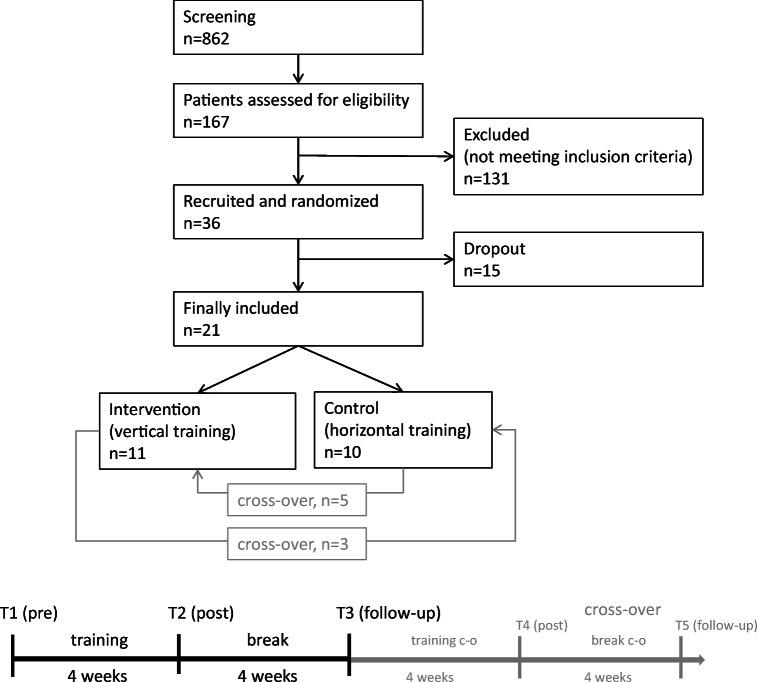
We assigned 21 patients with HFD randomly to either vertical or horizontal reading training. They trained reading single lines of texts from a computer screen at home for 2 × 30 min/day, 5 days/week, for 4 weeks. The main outcome variable was reading speed (RS) during reading standardized paragraphs of printed text (IReST) aloud. RS was assessed before training (T1), directly after training (T2) and 4 weeks later (T3). Quality of life (QoL) was assessed by Impact of Visual Impairment (IVI) questionnaire.
RESULTS
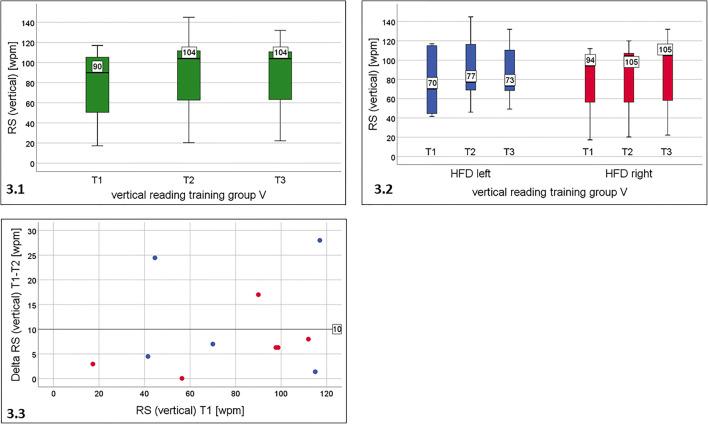
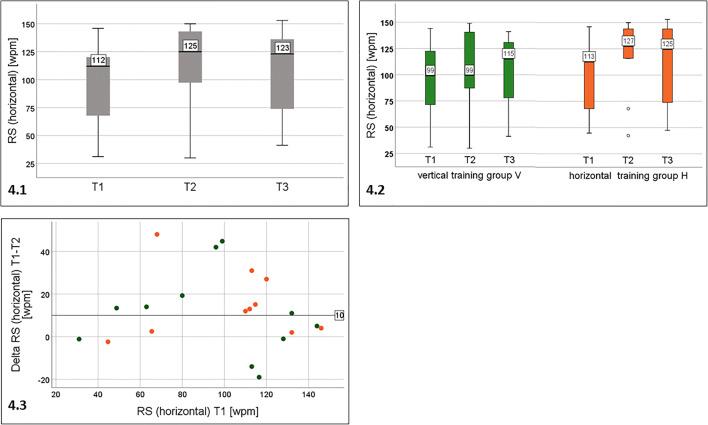
Vertical training improved RS in the vertical direction significantly. Only patients with right HFD benefited. Horizontal training improved RS in horizontal diection significantly, but much more in patients with left than in those with right HFD. Both effects remained stable at T3. RS during training at the computer improved highly significantly and correlated strongly with RS of printed text (Pearson r= > 0.9). QoL: Vertical training showed a statistically significant improvement in the complete IVI-score, patients with right HFD in the emotional IVI-score.
CONCLUSIONS
The improvements of RS were specific for the training. The stable effect indicates that the patients can apply the newly learned strategies to everyday life. The side of the HFD plays an essential role: Left-HFD patients benefitted from horizontal training, right-HFD patients from vertical training. However, the vertical RS did not reach the level of horizontal RS. The study was registered in the German Clinical Trials register (DRKS-ID: DRKS00018843).
假设
如果将文本放置在可见半视野中垂直中线的位置,患有偏盲视野缺损(HFD)的患者可能会受益于垂直方向阅读文本。
方法
我们将 21 名 HFD 患者随机分配到垂直或水平阅读训练中。他们在家中通过计算机屏幕阅读单行文本进行训练,每天 2 次,每次 30 分钟,每周 5 天,共 4 周。主要的观察变量是大声朗读标准化印刷文本段落(IReST)时的阅读速度(RS)。在训练前(T1)、直接训练后(T2)和 4 周后(T3)评估 RS。生活质量(QoL)通过视觉障碍影响问卷(IVI)进行评估。
结果
垂直训练显著提高了垂直方向的 RS。只有右侧 HFD 的患者受益。水平训练显著提高了水平方向的 RS,但左侧 HFD 的患者受益程度远高于右侧 HFD 的患者。两种效果在 T3 时仍保持稳定。在计算机上进行训练时的 RS 显著提高,与印刷文本的 RS 高度相关(Pearson r>0.9)。QoL:垂直训练在完整的 IVI 评分中显示出统计学上的显著改善,右侧 HFD 的患者在情感 IVI 评分中显示出显著改善。
结论
RS 的提高是特定于训练的。稳定的效果表明患者可以将新学到的策略应用于日常生活中。HFD 的侧别起着至关重要的作用:左侧 HFD 的患者从水平训练中受益,右侧 HFD 的患者从垂直训练中受益。然而,垂直 RS 并未达到水平 RS 的水平。该研究在德国临床试验注册中心(DRKS-ID:DRKS00018843)注册。



 Zotero 插件