
疟原虫基因缺失对疟疾快速诊断检测性能的影响。
Impact of Plasmodium falciparum gene deletions on malaria rapid diagnostic test performance.
机构信息
Queensland University of Technology, Brisbane, QLD, Australia.
The CDC Foundation, Atlanta, GA, USA.
出版信息
Malar J. 2020 Nov 4;19(1):392. doi: 10.1186/s12936-020-03460-w.
BACKGROUND
Malaria rapid diagnostic tests (RDTs) have greatly improved access to diagnosis in endemic countries. Most RDTs detect Plasmodium falciparum histidine-rich protein 2 (HRP2), but their sensitivity is seriously threatened by the emergence of pfhrp2-deleted parasites. RDTs detecting P. falciparum or pan-lactate dehydrogenase (Pf- or pan-LDH) provide alternatives. The objective of this study was to systematically assess the performance of malaria RDTs against well-characterized pfhrp2-deleted P. falciparum parasites.
METHODS
Thirty-two RDTs were tested against 100 wild-type clinical isolates (200 parasites/µL), and 40 samples from 10 culture-adapted and clinical isolates of pfhrp2-deleted parasites. Wild-type and pfhrp2-deleted parasites had comparable Pf-LDH concentrations. Pf-LDH-detecting RDTs were also tested against 18 clinical isolates at higher density (2,000 parasites/µL) lacking both pfhrp2 and pfhrp3.
RESULTS
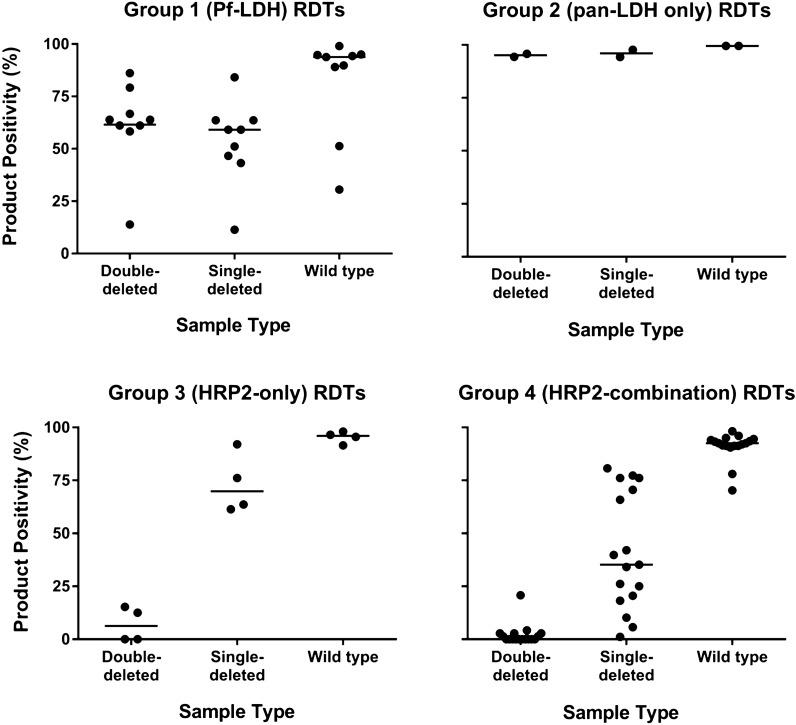
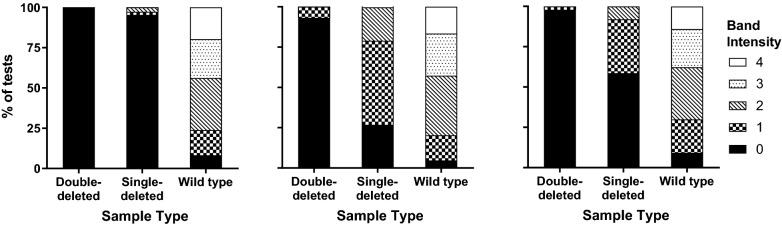
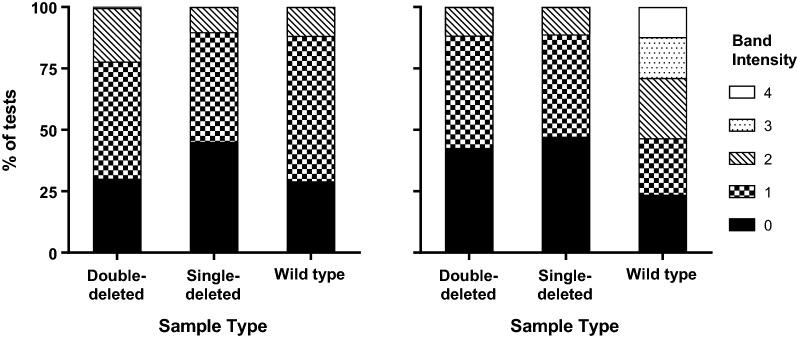
RDT positivity against pfhrp2-deleted parasites was highest (> 94%) for the two pan-LDH-only RDTs. The positivity rate for the nine Pf-LDH-detecting RDTs varied widely, with similar median positivity between double-deleted (pfhrp2/3 negative; 63.9%) and single-deleted (pfhrp2-negative/pfhrp3-positive; 59.1%) parasites, both lower than against wild-type P. falciparum (93.8%). Median positivity for HRP2-detecting RDTs against 22 single-deleted parasites was 69.9 and 35.2% for HRP2-only and HRP2-combination RDTs, respectively, compared to 96.0 and 92.5% for wild-type parasites. Eight of nine Pf-LDH RDTs detected all clinical, double-deleted samples at 2,000 parasites/µL.
CONCLUSIONS
The pan-LDH-only RDTs evaluated performed well. Performance of Pf-LDH-detecting RDTs against wild-type P. falciparum does not necessarily predict performance against pfhrp2-deleted parasites. Furthermore, many, but not all HRP2-based RDTs, detect pfhrp2-negative/pfhrp3-positive samples, with implications for the HRP2-based RDT screening approach for detection and surveillance of HRP2-negative parasites.
背景
疟疾快速诊断检测(RDT)极大地提高了在流行地区进行诊断的可及性。大多数 RDT 检测恶性疟原虫高变区 2 型(PfHRP2),但 PfHRP2 缺失寄生虫的出现严重威胁了其敏感性。检测恶性疟原虫或全乳酸脱氢酶(Pf-LDH)的 RDT 提供了替代方案。本研究旨在系统评估针对经充分特征描述的 PfHRP2 缺失恶性疟原虫寄生虫的疟疾 RDT 的性能。
方法
32 种 RDT 对 100 种野生型临床分离株(200 个寄生虫/µL)和 40 种来自 10 种培养适应和临床分离株的 PfHRP2 缺失寄生虫的样本进行了检测。野生型和 PfHRP2 缺失寄生虫的 Pf-LDH 浓度相当。Pf-LDH 检测 RDT 也对缺乏 PfHRP2 和 PfHRP3 的 18 种临床分离株在更高密度(2000 个寄生虫/µL)进行了检测。
结果
PfHRP2 缺失寄生虫的 RDT 阳性率(>94%)最高,对于两种全-LDH 仅 RDT 而言。9 种 Pf-LDH 检测 RDT 的阳性率差异很大,双缺失(PfHRP2/3 阴性;63.9%)和单缺失(PfHRP2 阴性/PfHRP3 阳性;59.1%)寄生虫的中位阳性率均低于野生型恶性疟原虫(93.8%)。在 2000 个寄生虫/µL时,22 种单缺失寄生虫中,HRP2 检测 RDT 对 22 种单缺失寄生虫的中位阳性率分别为 69.9%和 35.2%,而 HRP2 组合 RDT 的中位阳性率分别为 96.0%和 92.5%。在 2000 个寄生虫/µL时,8 种 Pf-LDH RDT 可检测到所有临床双缺失样本。
结论
评估的全-LDH 仅 RDT 表现良好。Pf-LDH 检测 RDT 对野生型恶性疟原虫的性能不一定能预测对 PfHRP2 缺失寄生虫的性能。此外,许多(但不是全部)基于 HRP2 的 RDT 检测到 PfHRP2 阴性/PfHRP3 阳性样本,这对基于 HRP2 的 RDT 筛查方法检测和监测 PfHRP2 阴性寄生虫具有影响。

 Zotero 插件