
消毒湿巾在消毒过程中会将艰难梭菌孢子从污染表面转移到未污染表面。
Disinfectant wipes transfer Clostridioides difficile spores from contaminated surfaces to uncontaminated surfaces during the disinfection process.
机构信息
Department of Food Science, Purdue University, 745 Agriculture Mall Drive, West Lafayette, IN, 47907, USA.
Diversey Inc., Charlotte, NC, 28273, USA.
出版信息
Antimicrob Resist Infect Control. 2020 Nov 4;9(1):176. doi: 10.1186/s13756-020-00844-0.
BACKGROUND
Pre-wetted disinfectant wipes are increasingly being used in healthcare facilities to help address the risk of healthcare associated infections (HAIs). However, HAIs are still a major problem in the US with Clostridioides difficile being the most common cause, leading to approximately 12,800 deaths annually in the US. An underexplored risk when using disinfectant wipes is that they may cross-contaminate uncontaminated surfaces during the wiping process. The objective of this study was to determine the cross-contamination risk that pre-wetted disinfectant towelettes may pose when challenged with C. difficile spores. We hypothesized that although the tested disinfectant wipes had no sporicidal claims, they will reduce spore loads. We also hypothesized that hydrogen peroxide disinfectant towelettes would present a lower cross-contamination risk than quaternary ammonium products.
METHODS
We evaluated the risk of cross-contamination when disinfectant wipes are challenged with C. difficile ATCC 43598 spores on Formica surfaces. A disinfectant wipe was used to wipe a Formica sheet inoculated with C. difficile. After the wiping process, we determined log CFU on previously uncontaminated pre-determined distances from the inoculation point and on the used wipes.
RESULTS
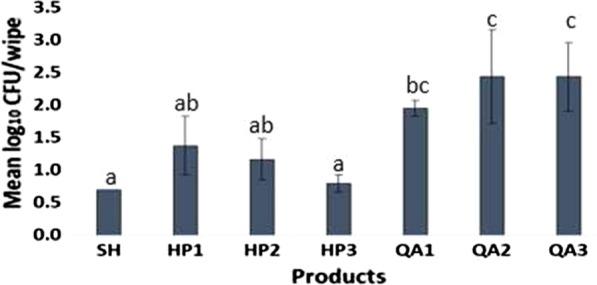
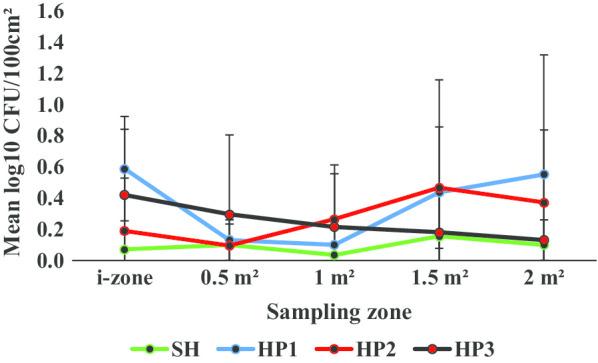
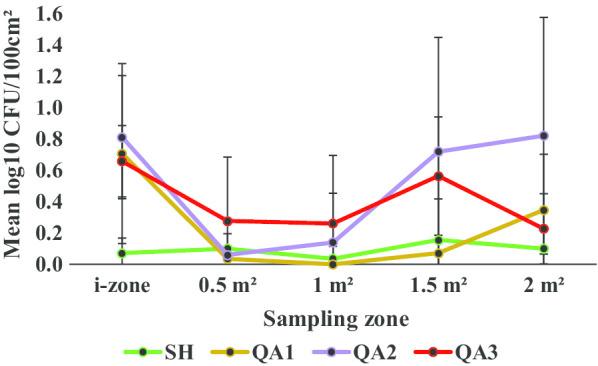
We found that the disinfectant wipes transferred C. difficile spores from inoculated surfaces to previously uncontaminated surfaces. We also found that wipes physically removed C. difficile spores and that hydrogen peroxide disinfectants were more sporicidal than the quaternary ammonium disinfectants.
CONCLUSION
Regardless of the product type, all disinfectant wipes had some sporicidal effect but transferred C. difficile spores from contaminated to otherwise previously uncontaminated surfaces. Disinfectant wipes retain C. difficile spores during and after the wiping process.
背景
预湿消毒剂擦拭巾在医疗机构中的使用日益增多,有助于降低与医疗保健相关的感染(HAIs)的风险。然而,HAIs 在美国仍然是一个主要问题,艰难梭菌是最常见的原因,导致美国每年约有 12800 人死亡。使用消毒剂擦拭巾时一个未被充分探索的风险是,在擦拭过程中,它们可能会使未受污染的表面受到交叉污染。本研究的目的是确定预湿消毒剂擦拭巾在受到艰难梭菌孢子挑战时可能带来的交叉污染风险。我们假设,尽管测试的消毒剂擦拭巾没有杀菌声明,但它们会降低孢子负荷。我们还假设过氧化氢消毒剂擦拭巾比季铵盐产品具有更低的交叉污染风险。
方法
我们评估了消毒剂擦拭巾在 Formica 表面受到艰难梭菌 ATCC 43598 孢子挑战时的交叉污染风险。使用消毒剂擦拭巾擦拭接种有艰难梭菌的 Formica 片。擦拭过程后,我们确定了在接种点之前未受污染的预先确定的距离以及使用的擦拭巾上的 log CFU。
结果
我们发现消毒剂擦拭巾将艰难梭菌孢子从接种表面转移到了先前未受污染的表面。我们还发现擦拭巾物理去除了艰难梭菌孢子,并且过氧化氢消毒剂比季铵盐消毒剂具有更强的杀菌作用。
结论
无论产品类型如何,所有消毒剂擦拭巾都具有一定的杀菌作用,但会将艰难梭菌孢子从污染表面转移到其他先前未受污染的表面。消毒剂擦拭巾在擦拭过程中和擦拭后保留艰难梭菌孢子。

 Zotero 插件