
睡眠紊乱是阿尔茨海默病的风险因素吗?来自两样本孟德尔随机分析的证据。
Is disrupted sleep a risk factor for Alzheimer's disease? Evidence from a two-sample Mendelian randomization analysis.
机构信息
MRC Integrative Epidemiology Unit, at the University of Bristol, Bristol, UK.
Population Health Sciences, University of Bristol Medical School, Bristol, UK.
出版信息
Int J Epidemiol. 2021 Jul 9;50(3):817-828. doi: 10.1093/ije/dyaa183.
BACKGROUND
It is established that Alzheimer's disease (AD) patients experience sleep disruption. However, it remains unknown whether disruption in the quantity, quality or timing of sleep is a risk factor for the onset of AD.
METHODS
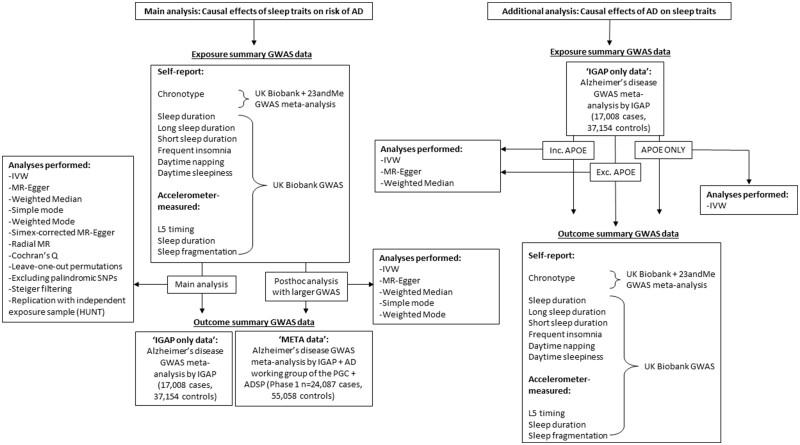
We used the largest published genome-wide association studies of self-reported and accelerometer-measured sleep traits (chronotype, duration, fragmentation, insomnia, daytime napping and daytime sleepiness), and AD. Mendelian randomization (MR) was used to estimate the causal effect of self-reported and accelerometer-measured sleep parameters on AD risk.
RESULTS
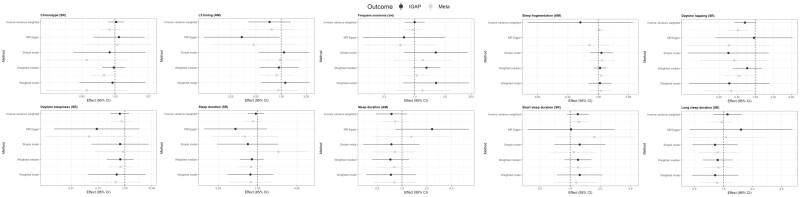
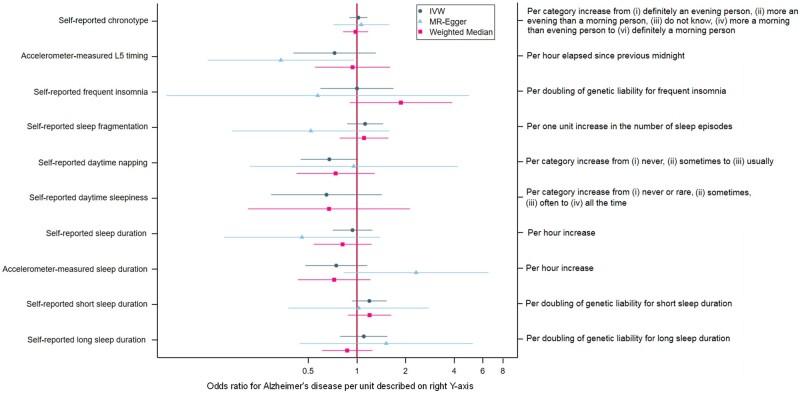
Overall, there was little evidence to support a causal effect of sleep traits on AD risk. There was some suggestive evidence that self-reported daytime napping was associated with lower AD risk [odds ratio (OR): 0.70, 95% confidence interval (CI): 0.50-0.99). Some other sleep traits (accelerometer-measured 'eveningness' and sleep duration, and self-reported daytime sleepiness) had ORs of a similar magnitude to daytime napping, but were less precisely estimated.
CONCLUSIONS
Overall, we found very limited evidence to support a causal effect of sleep traits on AD risk. Our findings provide tentative evidence that daytime napping may reduce AD risk. Given that this is the first MR study of multiple self-report and objective sleep traits on AD risk, findings should be replicated using independent samples when such data become available.
背景
已有研究证实阿尔茨海默病(AD)患者存在睡眠障碍。然而,目前尚不清楚睡眠的数量、质量或时间的改变是否是 AD 发病的一个危险因素。
方法
我们使用了已发表的最大规模的关于自我报告和加速度计测量的睡眠特征(睡眠类型、持续时间、碎片化、失眠、白天小睡和白天嗜睡)和 AD 的全基因组关联研究。孟德尔随机化(MR)用于估计自我报告和加速度计测量的睡眠参数对 AD 风险的因果影响。
结果
总体而言,几乎没有证据支持睡眠特征对 AD 风险有因果影响。有一些提示性证据表明,自我报告的白天小睡与较低的 AD 风险相关[比值比(OR):0.70,95%置信区间(CI):0.50-0.99]。其他一些睡眠特征(加速度计测量的“傍晚”和睡眠时间,以及自我报告的白天嗜睡)的 OR 与白天小睡相似,但估计精度较低。
结论
总体而言,我们发现非常有限的证据支持睡眠特征对 AD 风险有因果影响。我们的研究结果提供了初步证据表明白天小睡可能降低 AD 风险。鉴于这是第一项关于多种自我报告和客观睡眠特征对 AD 风险的 MR 研究,当获得此类数据时,应使用独立样本进行复制。
 Zotero 插件