
使用F-FDG-PET/MRI评估化脓性脊椎骨髓炎的治疗反应
Assessment of Therapeutic Response in Pyogenic Vertebral Osteomyelitis Using F-FDG-PET/MRI.
作者信息
Jeon Ikchan, Kong Eunjung, Kim Sang Woo, Cho Ihn Ho, Hong Cheol Pyo
机构信息
Department of Neurosurgery, Yeungnam University College of Medicine, Daegu 42415, Korea.
Department of Nuclear Medicine, Yeungnam University College of Medicine, Daegu 42415, Korea.
出版信息
Diagnostics (Basel). 2020 Nov 8;10(11):916. doi: 10.3390/diagnostics10110916.
PURPOSE
There is still no definite method to determine therapeutic response in pyogenic vertebral osteomyelitis (PVO). We analyzed the value of F-fluorodeoxyglucose positron emission tomography (FDG-PET) for assessing therapeutic response in PVO.
METHODS
This retrospective study included 53 patients (32 men and 21 women) with lumbar PVO. The results of clinical assessments for therapeutic response were divided into "Cured" (group C) and "Non-cured" (group NC). The differences in clinical and radiological features of PVO lesions between the two groups were analyzed using clinical data and simultaneous FDG-PET/magnetic resonance imaging (MRI) obtained at each clinical assessment.
RESULTS
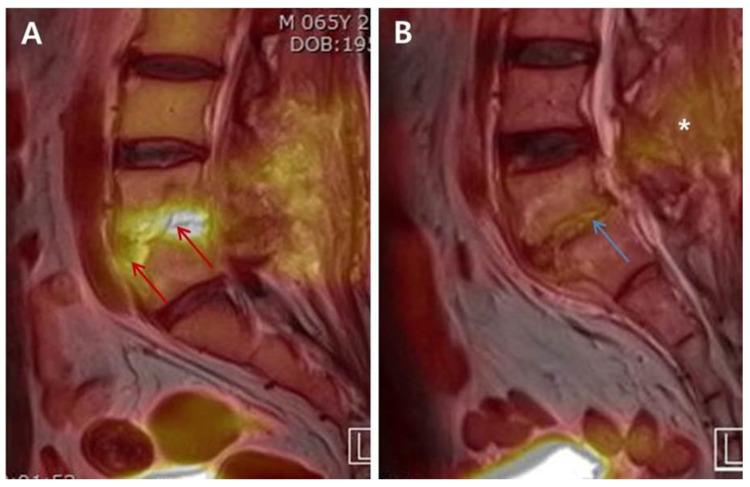
Clinical assessments and FDG-PET/MRIs were performed at 41.89 ± 16.08 (21-91) days of parenteral antibiotic therapy. There were 39 patients in group C and 14 in group NC. Diagnostic accuracies (DAs) of FDG uptake intensity-based interpretation and C-reactive protein (CRP) for residual PVO were as follows ( < 0.01): 84.9% of the maximum standardized uptake value of PVO lesion (PvoSUV), 86.8% of ΔPvoSUV-NmlSUV (SUV of normal vertebra), 86.8% of ΔPvoSUV-NmlSUV (SUV of normal vertebra), and 71.7% of CRP. DAs were better (92.5-94.3%) when applying FDG uptake intensity-based interpretation and CRP together. Under the FDG uptake distribution-based interpretation, FDG uptake was significantly limited to intervertebral structures in group C ( = 0.026).
CONCLUSION
The interpretations of intensity and distribution of FDG uptake on FDG-PET are useful for detecting residual PVO in the assessment of therapeutic response of PVO. The combination of FDG-PET and CRP is expected to increase DA for detecting residual PVO.
目的
目前仍没有确定的方法来判定化脓性椎体骨髓炎(PVO)的治疗反应。我们分析了F-氟脱氧葡萄糖正电子发射断层扫描(FDG-PET)在评估PVO治疗反应中的价值。
方法
这项回顾性研究纳入了53例腰椎PVO患者(32例男性和21例女性)。治疗反应的临床评估结果分为“治愈”(C组)和“未治愈”(NC组)。使用每次临床评估时获得的临床数据以及同步的FDG-PET/磁共振成像(MRI),分析两组之间PVO病变的临床和放射学特征差异。
结果
在肠外抗生素治疗41.89±16.08(21 - 91)天时进行了临床评估和FDG-PET/MRI。C组有39例患者,NC组有14例患者。基于FDG摄取强度的解读以及C反应蛋白(CRP)对残留PVO的诊断准确性(DAs)如下(<0.01):PVO病变最大标准化摄取值(PvoSUV)的84.9%,ΔPvoSUV-NmlSUV(正常椎体SUV)的86.8%,ΔPvoSUV-NmlSUV(正常椎体SUV)的86.8%,以及CRP的71.7%。将基于FDG摄取强度的解读和CRP一起应用时,DAs更好(92.5 - 94.3%)。在基于FDG摄取分布的解读下,C组中FDG摄取显著局限于椎间结构(=0.026)。
结论
FDG-PET上FDG摄取强度和分布的解读对于在PVO治疗反应评估中检测残留PVO很有用。预计FDG-PET和CRP的联合使用可提高检测残留PVO的诊断准确性。
 Zotero 插件