
一项名为“SMARTFAMILY”的基于家庭的集体移动健康干预对促进身体活动和健康饮食的影响:一项随机对照试验方案
Effects of a Collective Family-Based Mobile Health Intervention Called "SMARTFAMILY" on Promoting Physical Activity and Healthy Eating: Protocol for a Randomized Controlled Trial.
作者信息
Wunsch Kathrin, Eckert Tobias, Fiedler Janis, Cleven Laura, Niermann Christina, Reiterer Harald, Renner Britta, Woll Alexander
机构信息
Institute of Sports and Sports Science, Karlsruhe Institute of Technology, Karlsruhe, Germany.
Department of Sports Science, University of Konstanz, Konstanz, Germany.
出版信息
JMIR Res Protoc. 2020 Nov 11;9(11):e20534. doi: 10.2196/20534.
BACKGROUND
Numerous smartphone apps are targeting physical activity and healthy eating, but empirical evidence on their effectiveness for initialization and maintenance of behavior change, especially in children and adolescents, is still limited.
OBJECTIVE
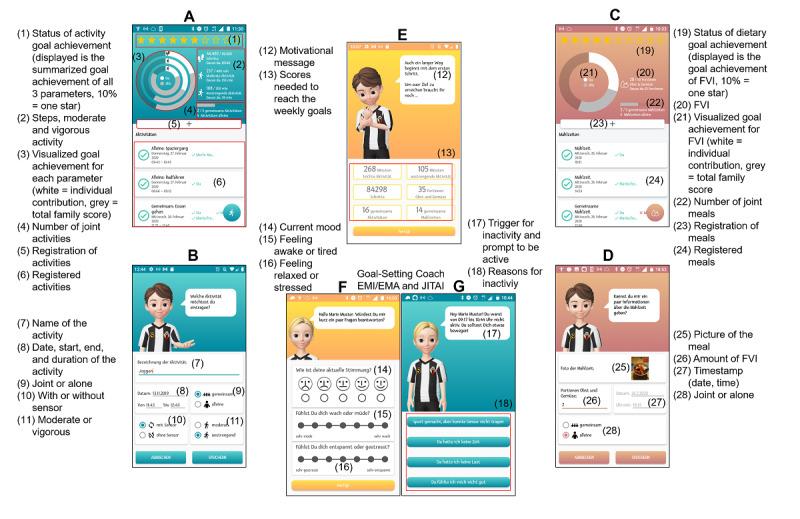
The aim of this study was to conceptualize a theory-based and evidence-based mHealth intervention called SMARTFAMILY (SF) that targets physical activity and healthy eating in a collective family-based setting. Subsequently, the app will be refined and re-evaluated to analyze additional effects of just-in-time adaptive interventions (JITAIs) and gamification features.
METHODS
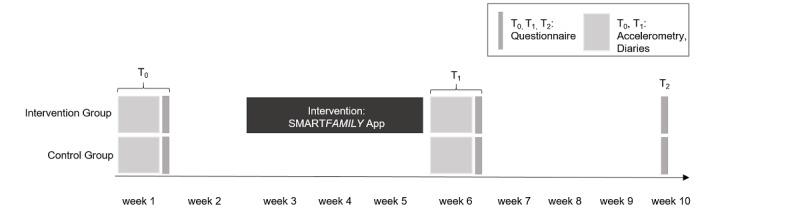
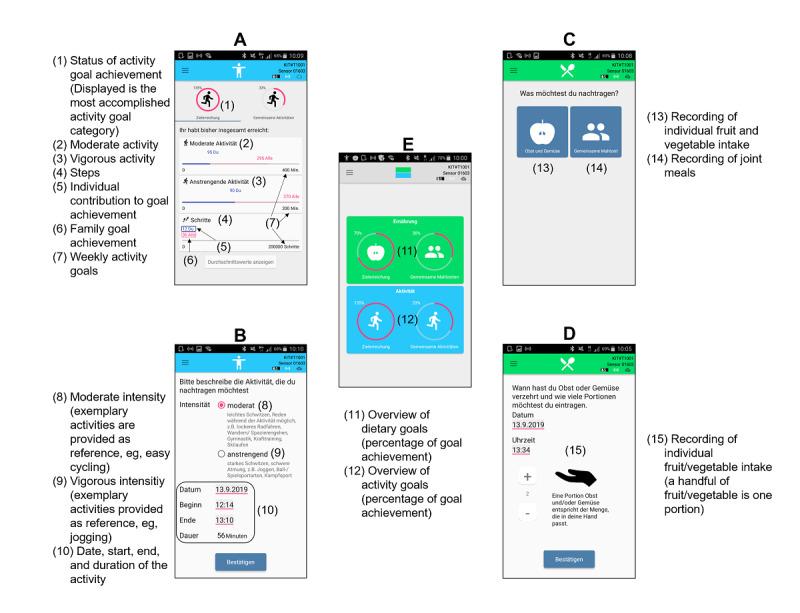
A smartphone app based on behavior change theories and behavior change techniques was developed and implemented and will be evaluated with family members individually and cooperatively (SF trial). Existing evidence and gained results were used to refine and will be used to re-evaluate the app (SF2.0 trial). Both trials are cluster randomized controlled trials with 3 measurement occasions. The intervention group uses the app for 3 consecutive weeks, whereas the control group receives no treatment. Baseline measurements (T) and postintervention measurements (T) include physical activity (ie, self-reported and accelerometry) and healthy eating measurements (ie, self-reported fruit and vegetable intake) as the primary outcomes. The secondary outcomes (ie, self-reported) are intrinsic motivation, behavior-specific self-efficacy, and the family health climate, complemented by an intentional measure in SF2.0. Four weeks following T, a follow-up assessment (T) is completed by the participants, consisting of all questionnaire items to assess the stability of the intervention effects. Mixed-method analysis of covariance will be used to calculate the primary intervention effects (ie, physical activity, fruit and vegetable intake) while controlling for covariates, including family health climate, behavior-specific self-efficacy, and intrinsic motivation.
RESULTS
This study is funded by the German Federal Ministry of Education and Research and ethically approved by the Karlsruhe Institute of Technology. For both trials, it is hypothesized that the apps will positively influence physical activity and healthy eating in the whole family. Furthermore, SF2.0 is expected to produce stronger effects (ie, higher effect sizes) compared to SF. SF app development and piloting are completed. Data acquisition for the SF trial is terminated and discontinued due to the COVID-19 pandemic. SF2.0 app development and piloting are completed, while data acquisition is ongoing. Participant recruitment for the SF 2.0 trial started in February 2020. The results for SF are expected to be published in mid-2021, and the results of SF2.0 are expected to be published in mid-2022.
CONCLUSIONS
In this study, it is hypothesized that targeting the whole family will facilitate behavior change at the individual level and the family level, as the implemented strategies address changes in daily family life. Furthermore, subsequent app development (SF2.0) with supplementary addition of motivation-enhancing features and a JITAI approach is expected to enhance positive intervention effects.
TRIAL REGISTRATION
German Clinical Trials Register DRKS00010415; https://tinyurl.com/yyo87yyu.
INTERNATIONAL REGISTERED REPORT IDENTIFIER (IRRID): DERR1-10.2196/20534.
背景
众多智能手机应用程序都以身体活动和健康饮食为目标,但关于它们在引发和维持行为改变方面有效性的实证证据仍然有限,尤其是在儿童和青少年中。
目的
本研究旨在构思一种基于理论和证据的移动健康干预措施,称为SMARTFAMILY(SF),该措施在以家庭为单位的集体环境中针对身体活动和健康饮食。随后,将对该应用程序进行优化和重新评估,以分析实时自适应干预(JITAIs)和游戏化功能的额外效果。
方法
开发并实施了一款基于行为改变理论和行为改变技术的智能手机应用程序,并将与家庭成员分别及合作进行评估(SF试验)。利用现有证据和已获得的结果对应用程序进行优化,并将用于重新评估该应用程序(SF2.0试验)。两项试验均为整群随机对照试验,有3个测量时点。干预组连续3周使用该应用程序,而对照组不接受任何治疗。基线测量(T1)和干预后测量(T2)包括身体活动(即自我报告和加速度计测量)和健康饮食测量(即自我报告的水果和蔬菜摄入量)作为主要结局。次要结局(即自我报告)为内在动机、行为特定自我效能感和家庭健康氛围,并在SF2.0中辅以一项意向性测量。在T2之后4周,参与者完成随访评估(T3),包括所有问卷项目以评估干预效果的稳定性。将使用协方差的混合方法分析来计算主要干预效果(即身体活动、水果和蔬菜摄入量),同时控制协变量,包括家庭健康氛围、行为特定自我效能感和内在动机。
结果
本研究由德国联邦教育与研究部资助,并获得卡尔斯鲁厄理工学院的伦理批准。对于两项试验,均假设该应用程序将对整个家庭的身体活动和健康饮食产生积极影响。此外,预计SF2.0与SF相比将产生更强的效果(即更高的效应量)。SF应用程序的开发和试点已完成。由于COVID-19大流行,SF试验的数据采集已终止。SF2.0应用程序的开发和试点已完成,而数据采集正在进行中。SF 2.0试验的参与者招募于2020年2月开始。预计SF的结果将于2021年年中发表,SF2.0的结果将于2022年年中发表。
结论
在本研究中,假设针对整个家庭将促进个体层面和家庭层面的行为改变,因为所实施的策略涉及日常家庭生活中的变化。此外,后续添加激励增强功能和JITAI方法的应用程序开发(SF2.0)预计将增强积极的干预效果。
试验注册
德国临床试验注册中心DRKS00010415;https://tinyurl.com/yyo87yyu。
国际注册报告识别码(IRRID):DERR1-10.2196/20534。

 Zotero 插件