
基于社会认知理论的个性化移动健康干预措施StepAdd对2型糖尿病患者增加身体活动的疗效:一项随机对照试验方案
Efficacy of StepAdd, a Personalized mHealth Intervention Based on Social Cognitive Theory to Increase Physical Activity Among Patients With Type 2 Diabetes Mellitus: Protocol for a Randomized Controlled Trial.
作者信息
Waki Kayo, Tsurutani Yuya, Waki Hironori, Enomoto Syunpei, Kashiwabara Kosuke, Fujiwara Akira, Orime Kazuki, Kinguchi Sho, Yamauchi Toshimasa, Hirawa Nobuhito, Tamura Kouichi, Terauchi Yasuo, Nangaku Masaomi, Ohe Kazuhiko
机构信息
Department of Biomedical Informatics, Graduate School of Medicine, The University of Tokyo, Tokyo, Japan.
Department of Diabetes and Metabolic Diseases, Graduate School of Medicine, The University of Tokyo, Tokyo, Japan.
出版信息
JMIR Res Protoc. 2024 Feb 23;13:e53514. doi: 10.2196/53514.
BACKGROUND
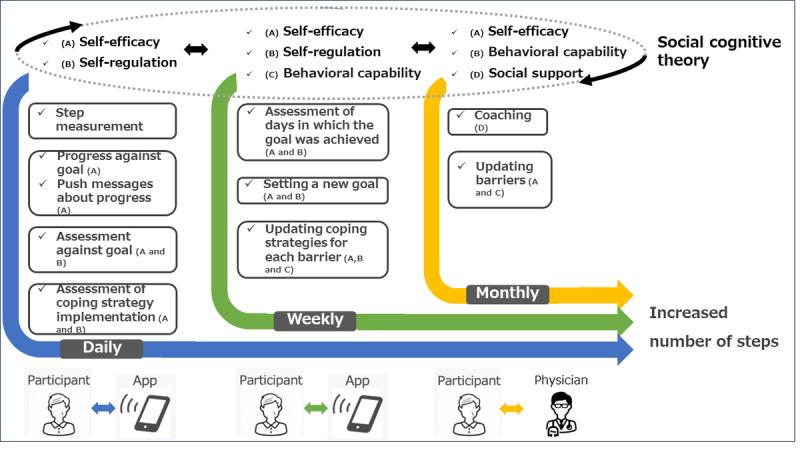
Increasing physical activity improves glycemic control in patients with type 2 diabetes (T2D). Mobile health (mHealth) interventions have been proven to increase exercise, but engagement often fades with time. As the use of health behavior theory in mHealth design can increase effectiveness, we developed StepAdd, an mHealth intervention based on the constructs of social cognitive theory (SCT). StepAdd improves exercise behavior self-efficacy and self-regulation through the use of goal-setting, barrier-identifying, and barrier-coping strategies, as well as automatic feedback functions. A single-arm pilot study of StepAdd among 33 patients with T2D showed a large increase in step count (mean change of 4714, SD 3638 daily steps or +86.7%), along with strong improvements in BMI (mean change of -0.3 kg/m) and hemoglobin A level (mean change of -0.79 percentage points).
OBJECTIVE
In this study, we aim to investigate the efficacy and safety of StepAdd, an mHealth exercise support system for patients with T2D, via a large, long, and controlled follow-up to the pilot study.
METHODS
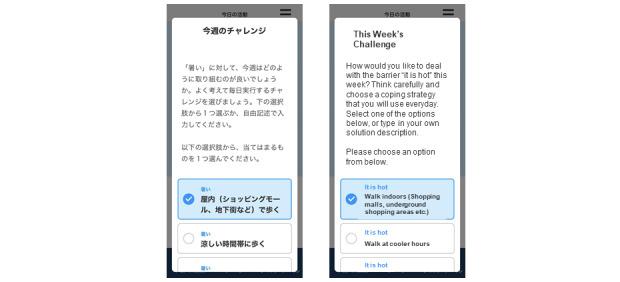
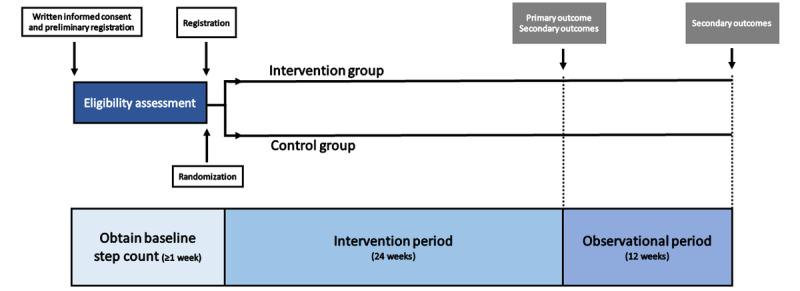
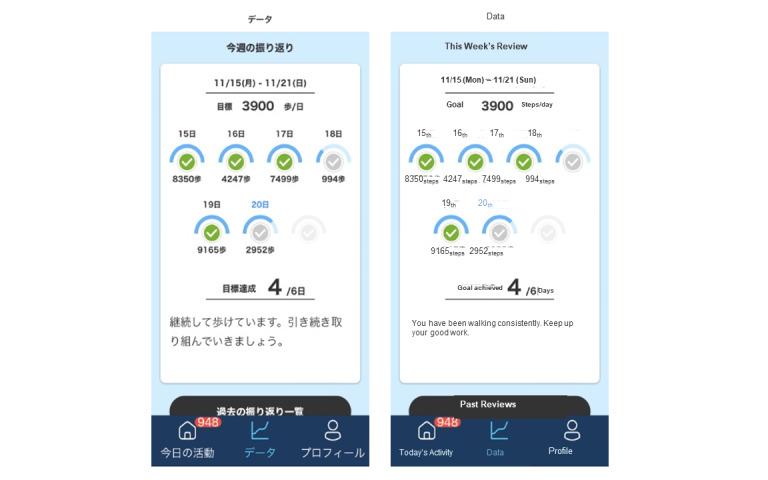
This is a randomized, open-label, multicenter study targeting 160 patients with T2D from 5 institutions in Japan with a 24-week intervention. The intervention group will record daily step counts, body weight, and blood pressure using the SCT-based mobile app, StepAdd, and receive feedback about these measurements. In addition, they will set weekly step count goals, identify personal barriers to walking, and define strategies to overcome these barriers. The control group will record daily step counts, body weight, and blood pressure using a non-SCT-based placebo app. Both groups will receive monthly consultations with a physician who will advise patients regarding lifestyle modifications and use of the app. The 24-week intervention period will be followed by a 12-week observational period to investigate the sustainability of the intervention's effects. The primary outcome is between-group difference in the change in hemoglobin A values at 24 weeks. The secondary outcomes include other health measures, measurements of steps, measurements of other behavior changes, and assessments of app use. The trial began in January 2023 and is intended to be completed in December 2025.
RESULTS
As of September 5, 2023, we had recruited 44 patients. We expect the trial to be completed by October 8, 2025, with the follow-up observation period being completed by December 31, 2025.
CONCLUSIONS
This trial will provide important evidence about the efficacy of an SCT-based mHealth intervention in improving physical activities and glycemic control in patients with T2D. If this study proves the intervention to be effective and safe, it could be a key step toward the integration of mHealth as part of the standard treatment received by patients with T2D in Japan.
TRIAL REGISTRATION
Japan Registry of Clinical Trials (JRCT) jRCT2032220603; https://rctportal.niph.go.jp/en/detail?trial_id=jRCT2032220603.
INTERNATIONAL REGISTERED REPORT IDENTIFIER (IRRID): DERR1-10.2196/53514.
背景
增加身体活动可改善2型糖尿病(T2D)患者的血糖控制。移动健康(mHealth)干预已被证明可增加运动量,但参与度往往会随着时间推移而下降。由于在mHealth设计中运用健康行为理论可提高有效性,我们开发了StepAdd,这是一种基于社会认知理论(SCT)构建的mHealth干预措施。StepAdd通过使用目标设定、障碍识别和应对策略以及自动反馈功能来提高运动行为自我效能和自我调节能力。一项针对33名T2D患者的StepAdd单臂试点研究显示,步数大幅增加(平均每日步数变化为4714步,标准差为3638步,即增加了86.7%),同时体重指数(BMI)(平均变化为-0.3kg/m²)和糖化血红蛋白水平(平均变化为-0.79个百分点)也有显著改善。
目的
在本研究中,我们旨在通过对试点研究进行大规模、长期且有对照的随访,调查针对T2D患者的mHealth运动支持系统StepAdd的疗效和安全性。
方法
这是一项随机、开放标签、多中心研究,目标是来自日本5家机构的160名T2D患者,进行为期24周的干预。干预组将使用基于SCT的移动应用程序StepAdd记录每日步数、体重和血压,并接收有关这些测量结果的反馈。此外,他们将设定每周步数目标,识别步行的个人障碍,并确定克服这些障碍的策略。对照组将使用基于非SCT的安慰剂应用程序记录每日步数、体重和血压。两组患者每月都将接受医生的咨询,医生会就生活方式调整和应用程序的使用向患者提供建议。24周的干预期之后将有一个12周的观察期,以调查干预效果的可持续性。主要结局是24周时糖化血红蛋白值变化的组间差异。次要结局包括其他健康指标、步数测量、其他行为变化测量以及应用程序使用评估。该试验于2023年1月开始,预计于2025年12月完成。
结果
截至2023年9月5日,我们已招募了44名患者。我们预计该试验将于2025年10月8日完成,随访观察期将于2025年12月31日完成。
结论
本试验将为基于SCT的mHealth干预在改善T2D患者身体活动和血糖控制方面的疗效提供重要证据。如果本研究证明该干预有效且安全,这可能是将mHealth纳入日本T2D患者标准治疗的关键一步。
试验注册
日本临床试验注册中心(JRCT)jRCT2032220603;https://rctportal.niph.go.jp/en/detail?trial_id=jRCT2032220603。
国际注册报告识别码(IRRID):DERR1-10.2196/53514。
 Zotero 插件