
基于电子病历的个体化糖尿病自我管理移动应用对 2 型糖尿病患者的疗效:6 个月随机对照试验。
Efficacy of Personalized Diabetes Self-care Using an Electronic Medical Record-Integrated Mobile App in Patients With Type 2 Diabetes: 6-Month Randomized Controlled Trial.
机构信息
Division of Endocrinology and Metabolism, Department of Internal Medicine, Seoul St. Mary's Hospital, College of Medicine, The Catholic University of Korea, Seoul, Republic of Korea.
Division of Endocrinology and Metabolism, Department of Internal Medicine, Wonkwang University Sanbon Hospital, Gunpo, Republic of Korea.
出版信息
J Med Internet Res. 2022 Jul 28;24(7):e37430. doi: 10.2196/37430.
BACKGROUND
A system that combines technology and web-based coaching can help treat chronic conditions such as diabetes. However, the effectiveness of apps in mobile health (mHealth) interventions is inconclusive and unclear due to heterogeneous interventions and varying follow-up durations. In addition, randomized controlled trial data are limited, and long-term follow-up is lacking, especially for apps integrated into electronic medical records.
OBJECTIVE
We aimed to assess the effect of an electronic medical record-integrated mobile app for personalized diabetes self-care, focusing on the self-monitoring of blood glucose and lifestyle modifications, on glycemic control in patients with type 2 diabetes mellitus.
METHODS
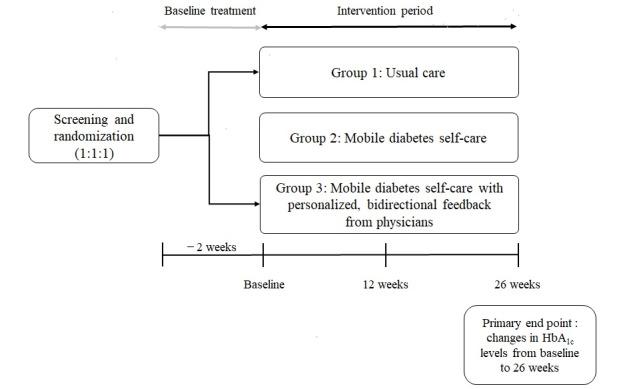
In a 26-week, 3-arm, randomized, controlled, open-label, parallel group trial, patients with type 2 diabetes mellitus and a hemoglobin A (HbA) level of ≥7.5% were recruited. The mHealth intervention consisted of self-monitoring of blood glucose with the automatic transfer of glucose, diet, and physical activity counseling data (iCareD system). Participants were randomly assigned to the following three groups: usual care (UC), mobile diabetes self-care (MC), and MC with personalized, bidirectional feedback from physicians (MPC). The primary outcome was the change in HbA levels at 26 weeks. In addition, diabetes-related self-efficacy, self-care activities, and satisfaction with the iCareD system were assessed after the intervention.
RESULTS
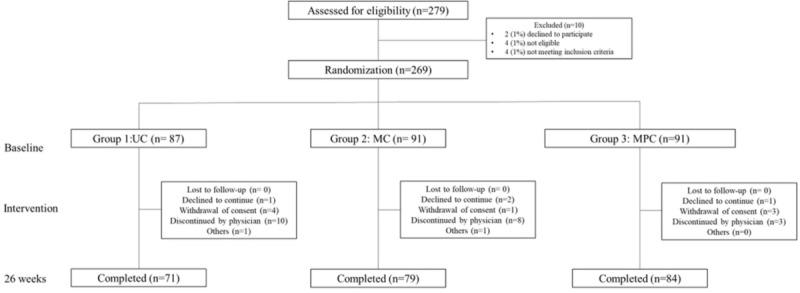
A total of 269 participants were enrolled, and 234 patients (86.9%) remained in the study at 26 weeks. At 12 weeks after the intervention, the mean decline in HbA levels was significantly different among the 3 groups (UC vs MC vs MPC: -0.49% vs -0.86% vs -1.04%; P=.02). The HbA level decreased in all groups; however, it did not differ among groups after 26 weeks. In a subgroup analysis, HbA levels showed a statistically significant decrease after the intervention in the MPC group compared with the change in the UC or MC group, especially in patients aged <65 years (P=.02), patients with a diabetes duration of ≥10 years (P=.02), patients with a BMI of ≥25.0 kg/m (P=.004), patients with a C-peptide level of ≥0.6 ng/mL (P=.008), and patients who did not undergo treatment with insulin (P=.004) at 12 weeks. A total of 87.2% (137/157) of the participants were satisfied with the iCareD system.
CONCLUSIONS
The mHealth intervention for diabetes self-care showed short-term efficacy in glycemic control, and the effect decreased over time. The participants were comfortable with using the iCareD system and exhibited high adherence.
TRIAL REGISTRATION
Clinical Research Information Service, Republic of Korea KCT0004128; https://tinyurl.com/bdd6pa9m.
背景
将技术与基于网络的辅导相结合的系统可以帮助治疗糖尿病等慢性病。然而,移动健康(mHealth)干预措施中的应用程序的效果尚不确定,原因是干预措施存在异质性,随访时间也不同。此外,随机对照试验数据有限,缺乏长期随访,特别是对于整合到电子病历中的应用程序。
目的
我们旨在评估一款整合了电子病历的移动应用程序对 2 型糖尿病患者个性化糖尿病自我护理的影响,重点是血糖自我监测和生活方式改变,以评估其对血糖控制的影响。
方法
在一项为期 26 周、3 组、随机、对照、开放标签、平行组试验中,招募了糖化血红蛋白(HbA)水平≥7.5%的 2 型糖尿病患者。mHealth 干预措施包括血糖自我监测和自动传输血糖、饮食和体力活动咨询数据(iCareD 系统)。参与者被随机分配到以下三组:常规护理(UC)、移动糖尿病自我护理(MC)和医生提供个性化、双向反馈的 MC(MPC)。主要结局是 26 周时 HbA 水平的变化。此外,在干预后评估了糖尿病相关自我效能、自我护理活动和对 iCareD 系统的满意度。
结果
共纳入 269 名参与者,234 名患者(86.9%)在 26 周时仍留在研究中。干预 12 周后,三组间 HbA 水平的平均下降差异有统计学意义(UC 组 vs MC 组 vs MPC 组:-0.49% vs -0.86% vs -1.04%;P=.02)。所有组的 HbA 水平均下降,但 26 周后组间无差异。在亚组分析中,与 UC 组或 MC 组相比,MPC 组的 HbA 水平在干预后下降具有统计学意义,尤其是在年龄<65 岁的患者中(P=.02)、糖尿病病程≥10 年的患者中(P=.02)、BMI≥25.0 kg/m 的患者中(P=.004)、C 肽水平≥0.6 ng/mL 的患者中(P=.008)和未接受胰岛素治疗的患者中(P=.004)。共有 87.2%(137/157)的参与者对 iCareD 系统感到满意。
结论
糖尿病自我护理的移动健康干预在血糖控制方面显示出短期疗效,且随着时间的推移效果逐渐下降。参与者使用 iCareD 系统感到舒适,并且具有较高的依从性。
试验注册
韩国临床试验注册中心,注册号 KCT0004128;https://tinyurl.com/bdd6pa9m。

 Zotero 插件