
自我管理支持系统DialBetesPlus对糖尿病肾病的疗效:一项随机对照试验方案
Efficacy of the Self-management Support System DialBetesPlus for Diabetic Kidney Disease: Protocol for a Randomized Controlled Trial.
作者信息
Kawai Yuki, Sankoda Akiko, Waki Kayo, Miyake Kana, Hayashi Aki, Mieno Makiko, Wakui Hiromichi, Tsurutani Yuya, Saito Jun, Hirawa Nobuhito, Yamakawa Tadashi, Komiya Shiro, Isogawa Akihiro, Satoh Shinobu, Minami Taichi, Osada Uru, Iwamoto Tamio, Takano Tatsuro, Terauchi Yasuo, Tamura Kouichi, Yamauchi Toshimasa, Kadowaki Takashi, Nangaku Masaomi, Kashihara Naoki, Ohe Kazuhiko
机构信息
Department of Planning, Information and Management, University of Tokyo Hospital, Tokyo, Japan.
Department of Medical Science and Cardiorenal Medicine, Yokohama City University Graduate School of Medicine, Yokohama, Japan.
出版信息
JMIR Res Protoc. 2021 Aug 17;10(8):e31061. doi: 10.2196/31061.
BACKGROUND
Diabetic kidney disease (DKD) is one of the main complications of type 2 diabetes mellitus (T2DM). DKD is a known risk factor for end-stage renal disease, cardiovascular disease, and all-cause death. Effective intervention for early-stage DKD is vital to slowing down the progression of kidney disease and improve prognoses. Mobile health (mHealth) is reportedly effective in supporting patients' self-care and improving glycemic control, but the impact of mHealth on DKD has yet to be shown.
OBJECTIVE
The purpose of this study is to evaluate the efficacy of standard therapy with the addition of a self-management support system, DialBetesPlus, in patients with DKD and microalbuminuria.
METHODS
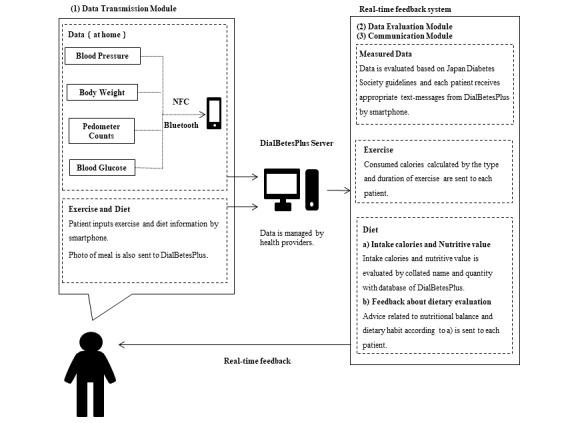
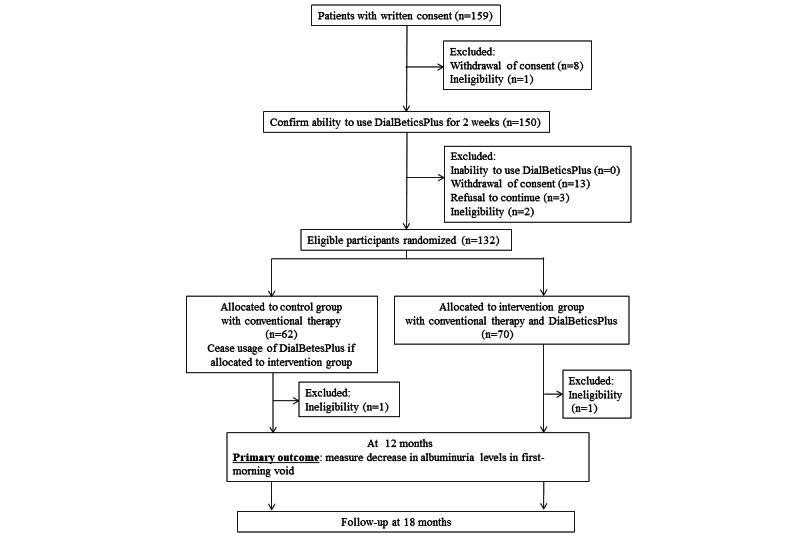
This study is a prospective, randomized, open-label, multicenter clinical trial. The target population consists of 160 patients diagnosed with T2DM accompanied by microalbuminuria. We randomly assigned the patients to 2 groups-the intervention group using DialBetesPlus in addition to conventional therapy and the control group using conventional therapy alone. DialBetesPlus is a smartphone application that supports patients' self-management of T2DM. The study period was 12 months, with a follow-up survey at 18 months. The primary outcome was a change in albuminuria levels at 12 months. Secondary outcomes included changes in physical parameters, blood test results (glycemic control, renal function, and lipid metabolism), lifestyle habits, self-management scores, medication therapy, and quality of life.
RESULTS
The study was approved in April 2018. We began recruiting patients in July 2018 and completed recruiting in August 2019. The final 18-month follow-up was conducted in March 2021. We recruited 159 patients and randomly allocated 70 into the intervention group and 61 into the control group, with 28 exclusions due to withdrawal of consent, refusal to continue, or ineligibility. The first results are expected to be available in 2021.
CONCLUSIONS
This is the first randomized controlled trial assessing the efficacy of mHealth on early-stage DKD. We expect that albuminuria levels will decrease significantly in the intervention group due to improved glycemic control with ameliorated self-care behaviors.
TRIAL REGISTRATION
UMIN-CTR UMIN000033261; https://upload.umin.ac.jp/cgi-open-bin/ctr/ctr_view.cgi?recptno=R000037924.
INTERNATIONAL REGISTERED REPORT IDENTIFIER (IRRID): DERR1-10.2196/31061.
背景
糖尿病肾病(DKD)是2型糖尿病(T2DM)的主要并发症之一。DKD是终末期肾病、心血管疾病和全因死亡的已知危险因素。对早期DKD进行有效干预对于减缓肾病进展和改善预后至关重要。据报道,移动健康(mHealth)在支持患者自我护理和改善血糖控制方面有效,但mHealth对DKD的影响尚未得到证实。
目的
本研究旨在评估在DKD和微量白蛋白尿患者中,在标准治疗基础上加用自我管理支持系统DialBetesPlus的疗效。
方法
本研究是一项前瞻性、随机、开放标签、多中心临床试验。目标人群包括160例诊断为T2DM并伴有微量白蛋白尿的患者。我们将患者随机分为两组——干预组除接受常规治疗外还使用DialBetesPlus,对照组仅接受常规治疗。DialBetesPlus是一款支持患者对T2DM进行自我管理的智能手机应用程序。研究期为12个月,在18个月时进行随访调查。主要结局是12个月时蛋白尿水平的变化。次要结局包括身体参数、血液检测结果(血糖控制、肾功能和脂质代谢)、生活习惯、自我管理评分、药物治疗和生活质量的变化。
结果
该研究于2018年4月获得批准。我们于2018年7月开始招募患者,并于2019年8月完成招募。最终的18个月随访于2021年3月进行。我们招募了159例患者,随机将70例分配到干预组,61例分配到对照组,有28例因撤回同意、拒绝继续或不符合资格而被排除。预计2021年可获得初步结果。
结论
这是第一项评估mHealth对早期DKD疗效的随机对照试验。我们预计,由于血糖控制改善和自我护理行为改善,干预组的蛋白尿水平将显著降低。
试验注册
UMIN-CTR UMIN000033261;https://upload.umin.ac.jp/cgi-open-bin/ctr/ctr_view.cgi?recptno=R000037924。
国际注册报告识别码(IRRID):DERR1-10.2196/31061。
 Zotero 插件