
一线化疗联合西妥昔单抗或贝伐单抗治疗转移性结直肠癌时,原发肿瘤位置、早期肿瘤缩小及缓解深度的临床影响
Clinical impact of primary tumour location, early tumour shrinkage, and depth of response in the treatment of metastatic colorectal cancer with first-line chemotherapy plus cetuximab or bevacizumab.
作者信息
Sagawa Tamotsu, Sato Yasushi, Hirakawa Masahiro, Hamaguchi Kyoko, Fukuya Akira, Okamoto Koichi, Miyamoto Hiroshi, Muguruma Naoki, Fujikawa Koshi, Takahashi Yasuo, Takayama Tetsuji
机构信息
Department of Gastroenterology, Hokkaido Cancer Center, Sapporo, Hokkaido, Japan.
Department of Community Medicine for Gastroenterology and Oncology, Tokushima University Graduate School of Biomedical Sciences, Tokushima, Japan.
出版信息
Sci Rep. 2020 Nov 13;10(1):19815. doi: 10.1038/s41598-020-76756-1.
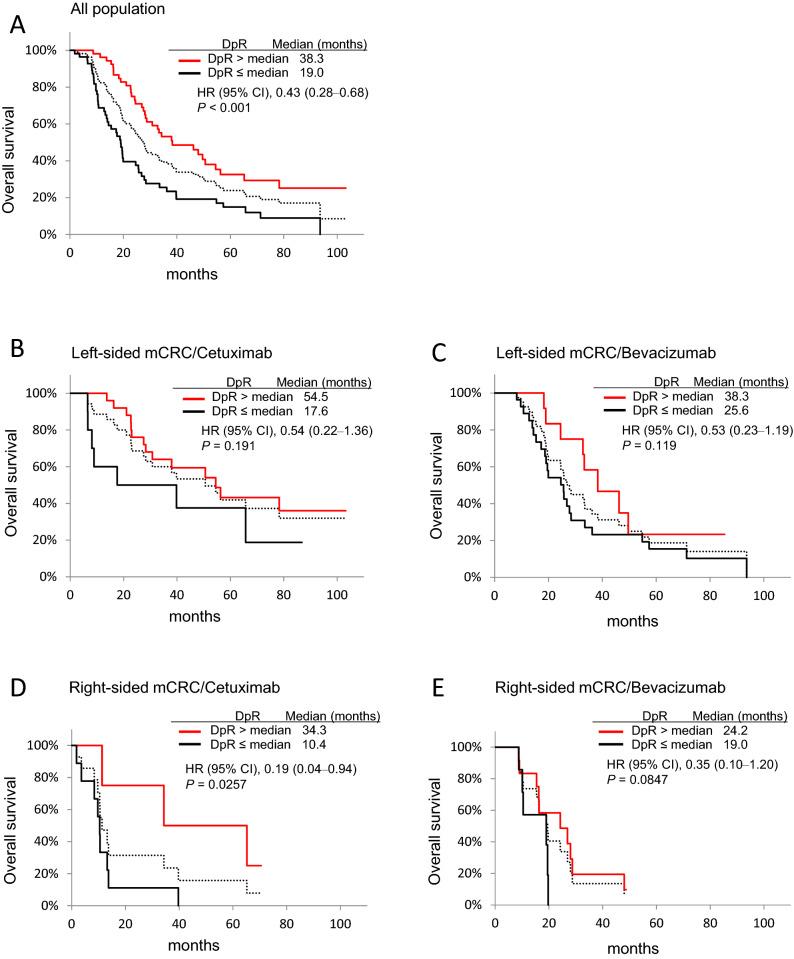
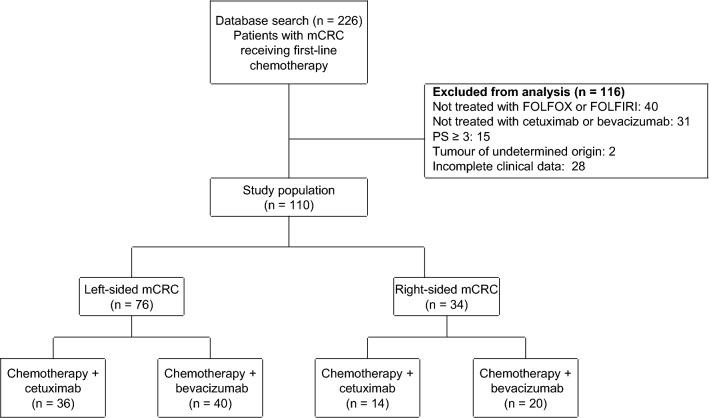
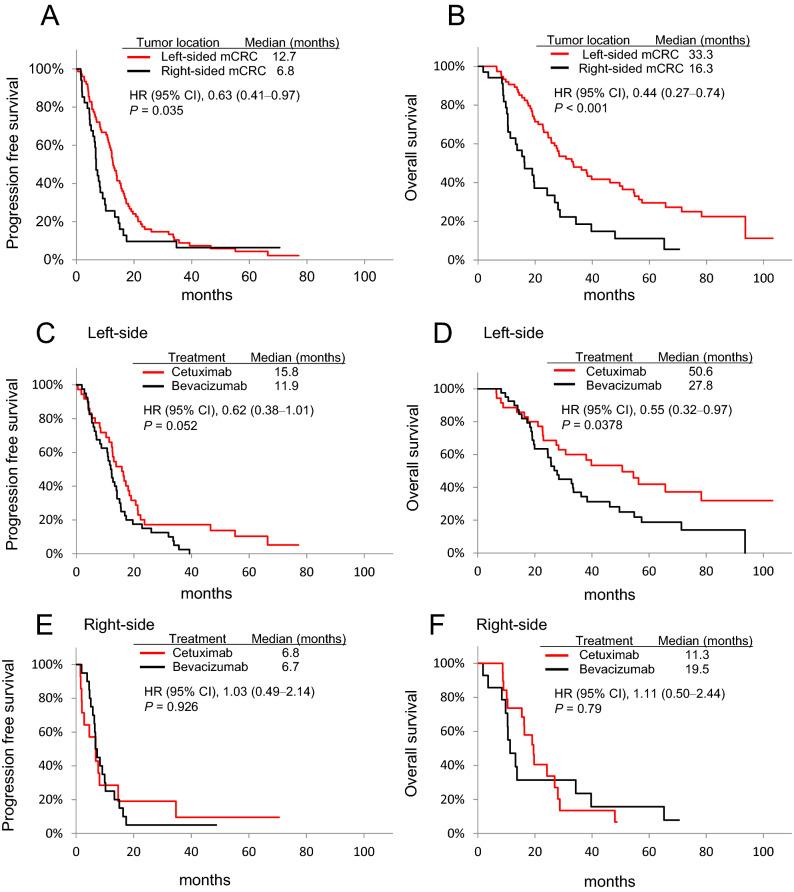
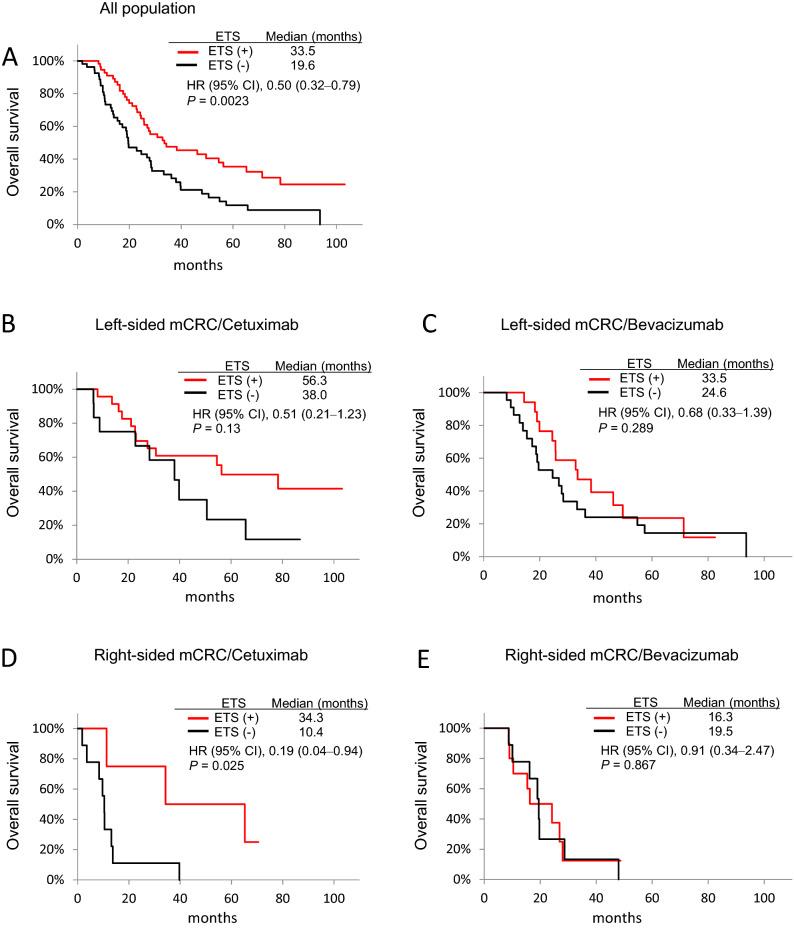
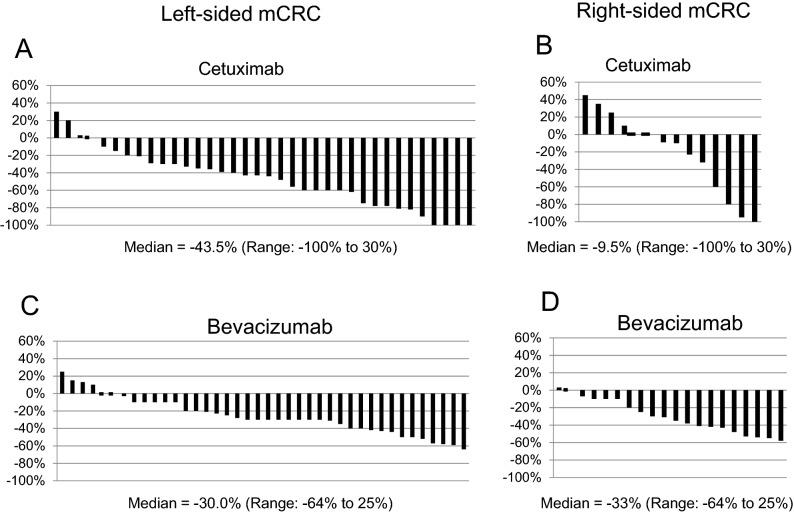
The primary tumour location is an important prognostic factor for previously untreated metastatic colorectal cancer (mCRC). However, the predictive efficacies of primary tumour location, early tumour shrinkage (ETS), and depth of response (DpR) on mCRC treatment has not been fully evaluated. This study aimed to investigate the predictive efficacies of these traits in mCRC patients treated with first-line 5-fluorouracil-based chemotherapy plus biologic agents, namely, cetuximab and bevacizumab. This was a retrospective analysis of the medical records of 110 patients with pathology-documented unresectable mCRC. Patients with left-sided mCRC receiving any first-line regimen showed better overall survival (OS) than those with right-sided mCRC [33.3 vs 16.3 months; hazard ratio (HR) 0.44; 95% confidence interval (CI) 0.27-0.74; p < 0.001]. In patients with left-sided tumours, treatment with chemotherapy plus cetuximab yielded longer OS than chemotherapy plus bevacizumab (50.6 vs 27.8 months, HR 0.55; 95% CI 0.32-0.97; p = 0.0378). mCRC patients with ETS and high DpR showed better OS than those lacking ETS and with low DpR (33.5 vs 19.6 months, HR 0.50, 95% CI 0.32-0.79, p = 0.023 and 38.3 vs 19.0 months, HR 0.43, 95% CI 0.28-0.68, p < 0.001, respectively). Moreover, ETS and/or high DpR achieved in patients with right-sided mCRC receiving chemotherapy plus cetuximab were associated with significantly better OS than in those lacking ETS and with low DpR (34.3 vs 10.4 months, HR 0.19, 95% CI 0.04-0.94, p = 0.025 and 34.3 vs 10.4 months, HR 0.19, 95% CI 0.04-0.94, p = 0.0257, respectively). Taken together, our study demonstrates that primary tumour location is not only a well-known prognostic factor but also a relevant predictive factor in patients with mCRC receiving chemotherapy plus cetuximab. Additionally, both ETS and DpR could predict treatment outcomes and also potentially guide cetuximab treatment even in right-sided mCRCs.
原发肿瘤位置是既往未经治疗的转移性结直肠癌(mCRC)的一个重要预后因素。然而,原发肿瘤位置、早期肿瘤缩小(ETS)和缓解深度(DpR)对mCRC治疗的预测效能尚未得到充分评估。本研究旨在调查这些特征在接受一线基于5-氟尿嘧啶的化疗联合生物制剂(即西妥昔单抗和贝伐单抗)治疗的mCRC患者中的预测效能。这是一项对110例经病理证实为不可切除mCRC患者的病历进行的回顾性分析。接受任何一线治疗方案的左侧mCRC患者的总生存期(OS)优于右侧mCRC患者[33.3个月对16.3个月;风险比(HR)0.44;95%置信区间(CI)0.27 - 0.74;p < 0.001]。在左侧肿瘤患者中,化疗联合西妥昔单抗治疗的OS长于化疗联合贝伐单抗治疗(50.6个月对27.8个月,HR 0.55;95% CI 0.32 - 0.97;p = 0.0378)。具有ETS和高DpR的mCRC患者的OS优于缺乏ETS和低DpR的患者(33.5个月对19.6个月,HR 0.50,95% CI 0.32 - 0.79,p = 0.023;以及38.3个月对19.0个月,HR 0.43,95% CI 0.28 - 0.68,p < 0.001)。此外,接受化疗联合西妥昔单抗治疗的右侧mCRC患者中实现的ETS和/或高DpR与缺乏ETS和低DpR的患者相比,OS显著更好(34.3个月对10.4个月,HR 0.19,95% CI 0.04 - 0.94,p = 0.025;以及34.3个月对10.4个月,HR 0.19,95% CI 0.
 Zotero 插件