
宫入菌 588 诱导产生的保护素 D1 对抗生素诱导的肠道紊乱具有抗炎作用。
MIYAIRI 588-Induced Protectin D1 Has an Anti-inflammatory Effect on Antibiotic-Induced Intestinal Disorder.
作者信息
Ariyoshi Tadashi, Hagihara Mao, Eguchi Shuhei, Fukuda Aiki, Iwasaki Kenta, Oka Kentaro, Takahashi Motomichi, Yamagishi Yuka, Mikamo Hiroshige
机构信息
Department of Clinical Infectious Diseases, Aichi Medical University Graduate School of Medicine, Nagakute, Japan.
Miyarisan Pharmaceutical Co., Ltd., Saitama, Japan.
出版信息
Front Microbiol. 2020 Oct 30;11:587725. doi: 10.3389/fmicb.2020.587725. eCollection 2020.
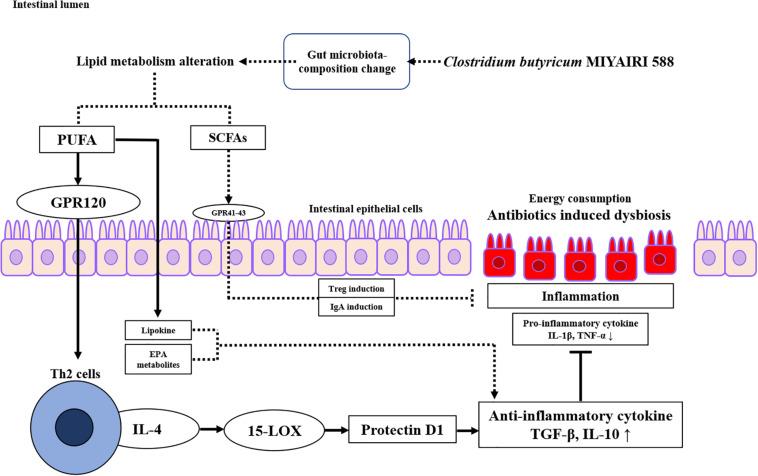
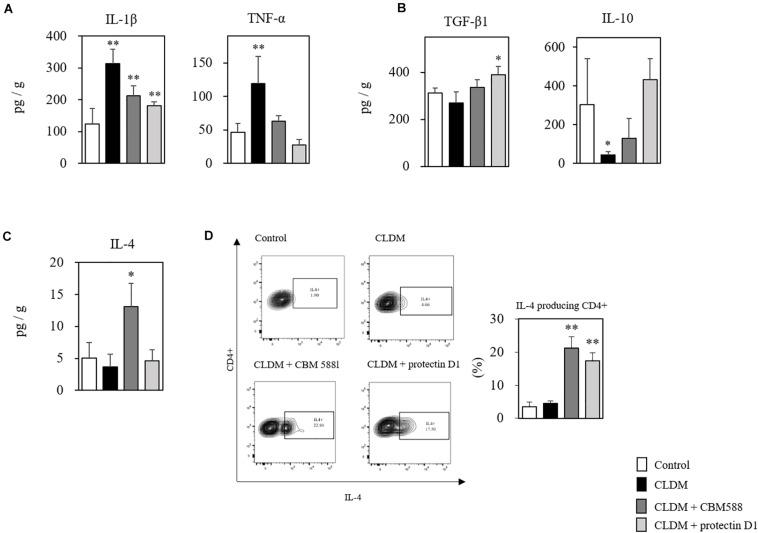
Metabolites are thought as the end products in cellular regulatory processes and their levels show the strongest relationships with the phenotype. Previously, we showed that the administration of MIYAIRI 588 (CBM 588) upregulated protectin D1, an anti-inflammatory lipid metabolite, in colon tissue under antibiotic therapy. However, how CBM 588 induces protectin D1 expression and whether the metabolite has anti-inflammatory effects on antibiotic-induced inflammation are unclear. Therefore, here, we evaluated the effect of CBM 588 on lipid metabolism and protectin D1 in gut protection from antibiotic-induced intestinal disorders. In the CBM 588 treatment group, expression levels of genes encoding lipid receptors related to the conversion of DHA to protectin D1, such as polyunsaturated fatty acid (PUFA) receptors, G-protein coupled receptor 120 (GPR120), and 15-lipoxygenase (LOX), were increased in colon tissue. CD4 cells producing interleukin (IL)-4, the main component of T helper type 2 (Th2) cells that can activate 15-LOX, also increased in CBM 588-treated groups even after clindamycin co-administration. In addition, similar to CBM 588, exogenously administered protectin D1 reduced inflammatory cytokines, while IL-10 and TGF-β1, works as anti-inflammatory cytokines, were increased. Our data revealed that CBM 588 activated 15-LOX to enhance protectin D1 production by increasing IL-4-producing CD4 cell population in the intestinal tract. Additionally, CBM 588-induced protectin D1 clearly upregulated IL-10-producing CD4 cells to control antibiotic-induced gut inflammation. We provide new insights into CBM 588-mediated lipid metabolism induction for the treatment of gut inflammatory diseases.
代谢物被认为是细胞调节过程中的终产物,其水平与表型的关系最为密切。此前,我们发现,在抗生素治疗下,服用宫入菌(CBM 588)可上调结肠组织中一种抗炎脂质代谢物——保护素D1的水平。然而,CBM 588如何诱导保护素D1的表达,以及该代谢物对抗生素诱导的炎症是否具有抗炎作用尚不清楚。因此,在此我们评估了CBM 588对脂质代谢和保护素D1在肠道保护免受抗生素诱导的肠道疾病方面的作用。在CBM 588治疗组中,结肠组织中与DHA转化为保护素D1相关的脂质受体编码基因的表达水平增加,如多不饱和脂肪酸(PUFA)受体、G蛋白偶联受体120(GPR120)和15-脂氧合酶(LOX)。即使在联合使用克林霉素后,CBM 588治疗组中产生白细胞介素(IL)-4的CD4细胞(可激活15-LOX的2型辅助性T细胞(Th2)的主要成分)也有所增加。此外,与CBM 588类似,外源性给予保护素D1可减少炎性细胞因子,而作为抗炎细胞因子的IL-10和转化生长因子-β1则增加。我们的数据显示,CBM 588通过增加肠道中产生IL-4的CD4细胞群体来激活15-LOX,从而增强保护素D1的产生。此外,CBM 588诱导产生的保护素D1明显上调了产生IL-10的CD4细胞,以控制抗生素诱导的肠道炎症。我们为CBM 588介导的脂质代谢诱导治疗肠道炎症性疾病提供了新的见解。



 Zotero 插件