
Lutikizumab(一种抗白细胞介素-1/双可变域免疫球蛋白)对骨关节炎有效吗?来自贝叶斯网络荟萃分析的结果。
Is Lutikizumab, an Anti-Interleukin-1/ Dual Variable Domain Immunoglobulin, efficacious for Osteoarthritis? Results from a bayesian network meta-analysis.
机构信息
Department of Orthopedics, The Second Xiangya Hospital, Central South University, Changsha, Hunan 410011, China.
Department of Dermatology, Xiangya Hospital, Central South University, Changsha, China.
出版信息
Biomed Res Int. 2020 Nov 4;2020:9013283. doi: 10.1155/2020/9013283. eCollection 2020.
OBJECTIVE
Most guidelines recommend the use of nonsteroidal anti-inflammatory drugs (NSAIDs), duloxetine, and tramadol for the nonoperative treatment of osteoarthritis (OA), but the use of them is limited by the tolerability and safety concerns. Lutikizumab is a novel anti-IL-1/ dual variable domain immunoglobulin that can simultaneously bind and inhibit IL-1 and IL-1 to relieve the pain and dysfunction symptoms. We conducted this network meta-analysis to comprehensively compare the clinical efficacy and safety of lutikizumab with other drugs recommended by guidelines.
METHODS
We conducted a Bayesian network and conventional meta-analyses to compare the efficacy and safety of lutikizumab with other traditional drugs. All eligible randomized clinical trials, in PubMed, CNKI, EMBASE, and Web of Science databases, from January 2000 to January 2020, were included. The Cochrane risk of the bias assessment tool was used for quality assessment. Pain relief, function improvement, and risk of adverse effects (AEs) were compared in this study.
RESULTS
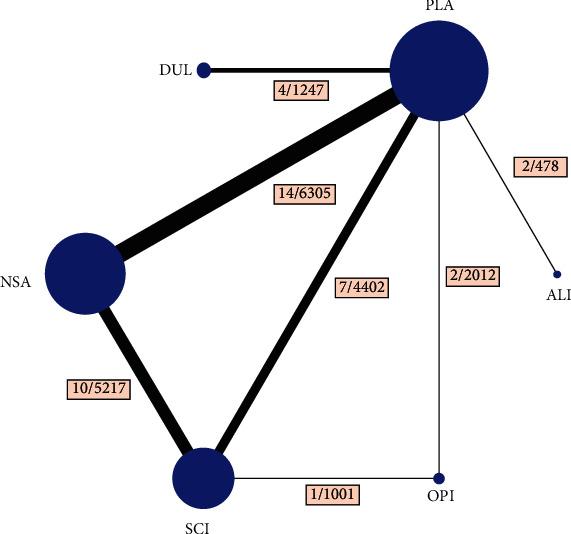
24 articles with 11858 patients were included. Duloxetine (DUL) had the largest effect for pain relief (4.76, 95% CI [2.35 to 7.17]), and selective cox-2 inhibitors (SCI) were the most efficacious treatment for physical function improvement (SMD 3.94, 95% CI [2.48 to 5.40]). Lutikizumab showed no benefit compared with placebo for both pain relief (SMD 1.11, 95% CI [-2.29 to 4.52]) and function improvement (SMD 0.992, 95% CI [-0.433 to 4.25]). Lutikizumab and all other drugs are of favorable tolerance for patients in the treatment of OA compared with placebo.
CONCLUSIONS
Lutikizumab, the new anti-Interleukin-1/ dual variable domain immunoglobulin, showed no improvement in pain or function when compared with placebo. Selective cox-2 inhibitors and duloxetine remain the most effective and safest treatment for OA. More high-quality trials are still needed to reconfirm the findings of this study.
目的
大多数指南建议使用非甾体抗炎药(NSAIDs)、度洛西汀和曲马多对骨关节炎(OA)进行非手术治疗,但由于耐受性和安全性问题,这些药物的使用受到限制。Lutikizumab 是一种新型的抗白细胞介素 1/双可变域免疫球蛋白,可同时结合并抑制白细胞介素 1 和白细胞介素 1,缓解疼痛和功能障碍症状。我们进行了这项网络荟萃分析,以全面比较 lutikizumab 与指南推荐的其他药物的临床疗效和安全性。
方法
我们进行了贝叶斯网络和常规荟萃分析,以比较 lutikizumab 与其他传统药物的疗效和安全性。纳入了 2000 年 1 月至 2020 年 1 月期间在 PubMed、CNKI、EMBASE 和 Web of Science 数据库中检索到的所有符合条件的随机临床试验。使用 Cochrane 偏倚风险评估工具进行质量评估。本研究比较了疼痛缓解、功能改善和不良反应(AE)风险。
结果
纳入了 24 项研究,共 11858 名患者。度洛西汀(DUL)在缓解疼痛方面效果最大(4.76,95%CI[2.35 至 7.17]),选择性 COX-2 抑制剂(SCI)在改善躯体功能方面最有效(SMD3.94,95%CI[2.48 至 5.40])。与安慰剂相比,lutikizumab 对疼痛缓解(SMD1.11,95%CI[-2.29 至 4.52])和功能改善(SMD0.992,95%CI[-0.433 至 4.25])均无益处。与安慰剂相比,lutikizumab 和其他所有药物在治疗 OA 时对患者的耐受性均较好。
结论
新型抗白细胞介素 1/双可变域免疫球蛋白 lutikizumab 与安慰剂相比,在疼痛或功能方面无改善。选择性 COX-2 抑制剂和度洛西汀仍然是 OA 最有效和最安全的治疗方法。仍需要更多高质量的试验来重新确认本研究的结果。

 Zotero 插件