
用于亚细胞蛋白质鉴定与可视化的基于纳米抗体的探针
Nanobody-Based Probes for Subcellular Protein Identification and Visualization.
作者信息
de Beer Marit A, Giepmans Ben N G
机构信息
Department of Biomedical Sciences of Cells and Systems, University of Groningen, University Medical Center Groningen, Groningen, Netherlands.
出版信息
Front Cell Neurosci. 2020 Nov 2;14:573278. doi: 10.3389/fncel.2020.573278. eCollection 2020.
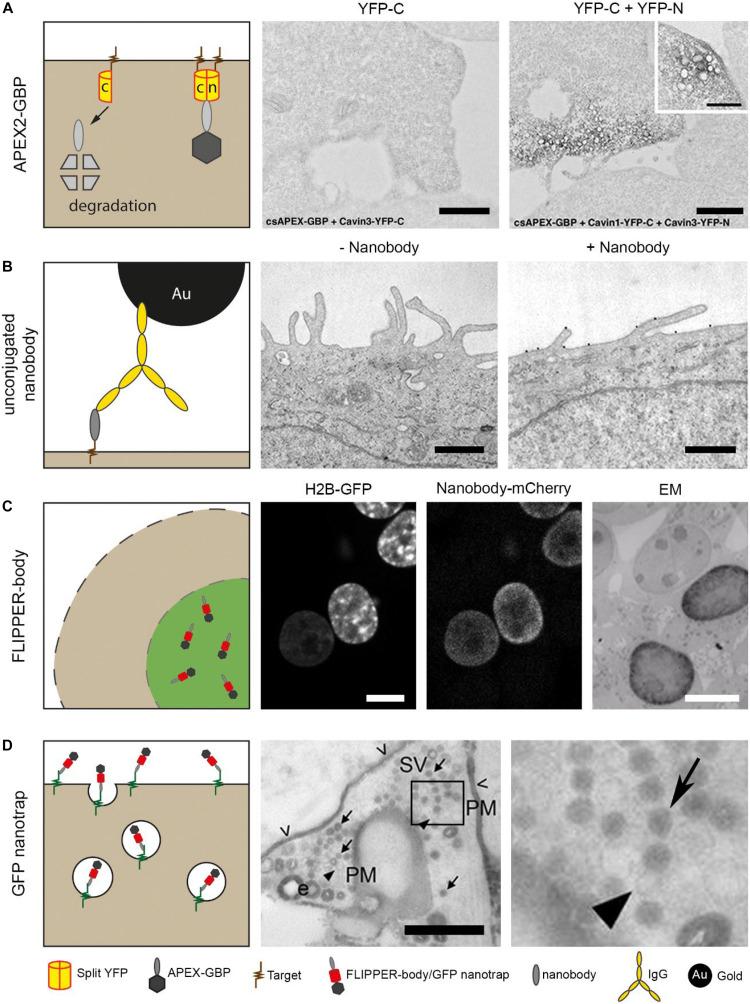
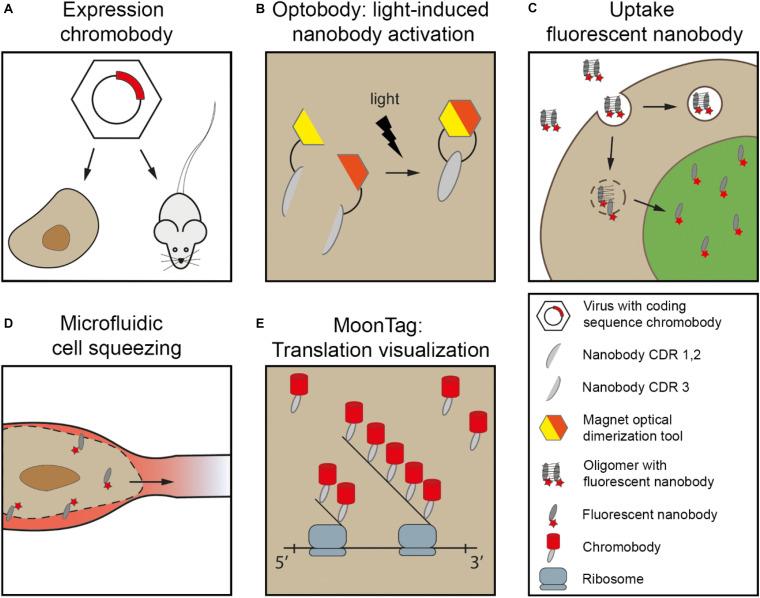
Understanding how building blocks of life contribute to physiology is greatly aided by protein identification and cellular localization. The two main labeling approaches developed over the past decades are labeling with antibodies such as immunoglobulin G (IgGs) or use of genetically encoded tags such as fluorescent proteins. However, IgGs are large proteins (150 kDa), which limits penetration depth and uncertainty of target position caused by up to ∼25 nm distance of the label created by the chosen targeting approach. Additionally, IgGs cannot be easily recombinantly modulated and engineered as part of fusion proteins because they consist of multiple independent translated chains. In the last decade single domain antigen binding proteins are being explored in bioscience as a tool in revealing molecular identity and localization to overcome limitations by IgGs. These nanobodies have several potential benefits over routine applications. Because of their small size (15 kDa), nanobodies better penetrate during labeling procedures and improve resolution. Moreover, nanobodies cDNA can easily be fused with other cDNA. Multidomain proteins can thus be easily engineered consisting of domains for targeting (nanobodies) and visualization by fluorescence microscopy (fluorescent proteins) or electron microscopy (based on certain enzymes). Additional modules for e.g., purification are also easily added. These nanobody-based probes can be applied in cells for live-cell endogenous protein detection or may be purified prior to use on molecules, cells or tissues. Here, we present the current state of nanobody-based probes and their implementation in microscopy, including pitfalls and potential future opportunities.
蛋白质鉴定和细胞定位极大地有助于理解生命的组成部分如何影响生理功能。在过去几十年中开发的两种主要标记方法是使用抗体(如免疫球蛋白G(IgG))进行标记,或使用荧光蛋白等基因编码标签。然而,IgG是大分子蛋白质(150 kDa),这限制了穿透深度,并且由于所选靶向方法产生的标签距离可达约25 nm,导致目标位置存在不确定性。此外,IgG不能作为融合蛋白的一部分轻易地进行重组调节和工程改造,因为它们由多个独立翻译的链组成。在过去十年中,单域抗原结合蛋白作为一种揭示分子身份和定位的工具,正在生物科学领域进行探索,以克服IgG的局限性。与常规应用相比,这些纳米抗体具有几个潜在的优势。由于其尺寸小(15 kDa),纳米抗体在标记过程中穿透性更好,分辨率更高。此外,纳米抗体的cDNA可以很容易地与其他cDNA融合。因此,可以很容易地构建多结构域蛋白,其由靶向结构域(纳米抗体)和通过荧光显微镜(荧光蛋白)或电子显微镜(基于某些酶)进行可视化的结构域组成。还可以很容易地添加用于例如纯化的其他模块。这些基于纳米抗体的探针可应用于细胞中进行活细胞内源性蛋白质检测,或在用于分子、细胞或组织之前进行纯化。在这里,我们介绍了基于纳米抗体的探针的当前状态及其在显微镜中的应用,包括陷阱和潜在的未来机会。
 Zotero 插件